

Lines by Product Type
Kvass Filling Line: A Live Product and In-Bottle Stability
Kvass combines the challenges of two products: it is carbonated like soda and biologically active like beer. The line must retain carbon dioxide during filling while ensuring microbiological stability after capping.

The Primary Goal Is to Stop Fermentation
Fermented kvass contains live yeast. If the yeast is not removed or inactivated, gas generation will continue inside the bottle: the product will become cloudy, the bottle will expand, and part of the batch may have to be discarded. The line must therefore include either filtration or pasteurization.
Filtration preserves the flavor profile but requires sterile conditions throughout the entire section up to capping. Pasteurization is more reliable and less expensive to operate, but it changes the flavor to some extent. The choice depends on the product's market positioning.
Sediment must be addressed separately: unfiltered kvass may contain suspended solids, but this requires continuous control of the yeast dose and low-temperature storage throughout the supply chain.
Line Configuration
- 1
Wort Preparation
Steeping kvass wort concentrate and dosing sugar syrup.
- 2
Fermentation and Blending
Temperature-controlled fermentation in tanks, followed by blending to the target specifications.
- 3
Clarification
Separation or filtration to remove suspended yeast.
- 4
Carbonation
Carbon dioxide injection in a carbonator to 4-6 g/L at a reduced temperature.
- 5
Isobaric Filling
Counterpressure triblock: rinsing, filling, and capping without carbonation loss.
- 6
Tunnel Pasteurization
Used for bottles when a finished-product pasteurization process is selected.
Kvass Filling Formats
| Format | Equipment | Comments |
|---|---|---|
| PET 0.5-2 L | Isobaric triblock | Primary retail format |
| Glass 0.5 L | Isobaric monoblock with crown capper | Premium retail placement; requires pasteurization |
| Kegs 20-50 L | Keg washer and keg filler | Foodservice and draft sales |
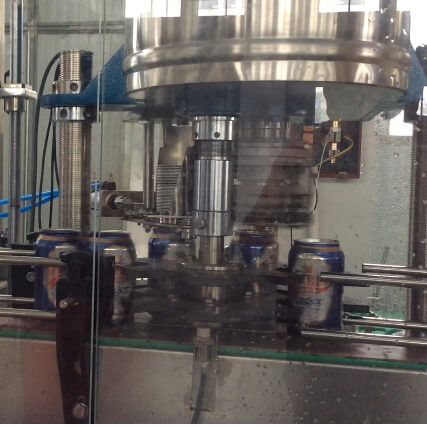
| Aluminum can | Rotary filler and seamer | Growing format with superior light protection |
FAQ
Can kvass be filled on a carbonated water line?
Technically, yes, provided that the line is isobaric and has a separate CIP circuit. However, a fermentation and clarification section and a more stringent sanitation program will also be required.
Is pasteurization mandatory?
It is not mandatory when cold sterile filtration is used and the product has a short shelf life. For extended shelf life at ambient temperature, pasteurization is virtually indispensable.
What production capacity is reasonable for a startup?
For a regional producer, 2000-4000 bottles per hour is usually sufficient. The line is loaded seasonally, and excess summer capacity does not offset winter downtime.
Read next
Ready solutions
Equipment catalog
Project services
Related projects
Calculation on the topic
We will calculate your line
Describe the product, packaging formats and planned volume — we will prepare a line scheme, specification and preliminary budget estimate with payback.
- Line scheme and unit specification for your product
- Budget range and payback period
- Site requirements: power, water, personnel