

Lines by Product Type
Household Chemical Filling Line: Foam, Corrosive Media, and Dosing Systems
Household chemicals combine several properties that complicate filling: they foam, may be viscous, are often chemically aggressive, and are filled into complex-shaped containers fitted with triggers and pumps. These factors determine the materials, filling method, and capper design.
Three Product Properties That Define the Line
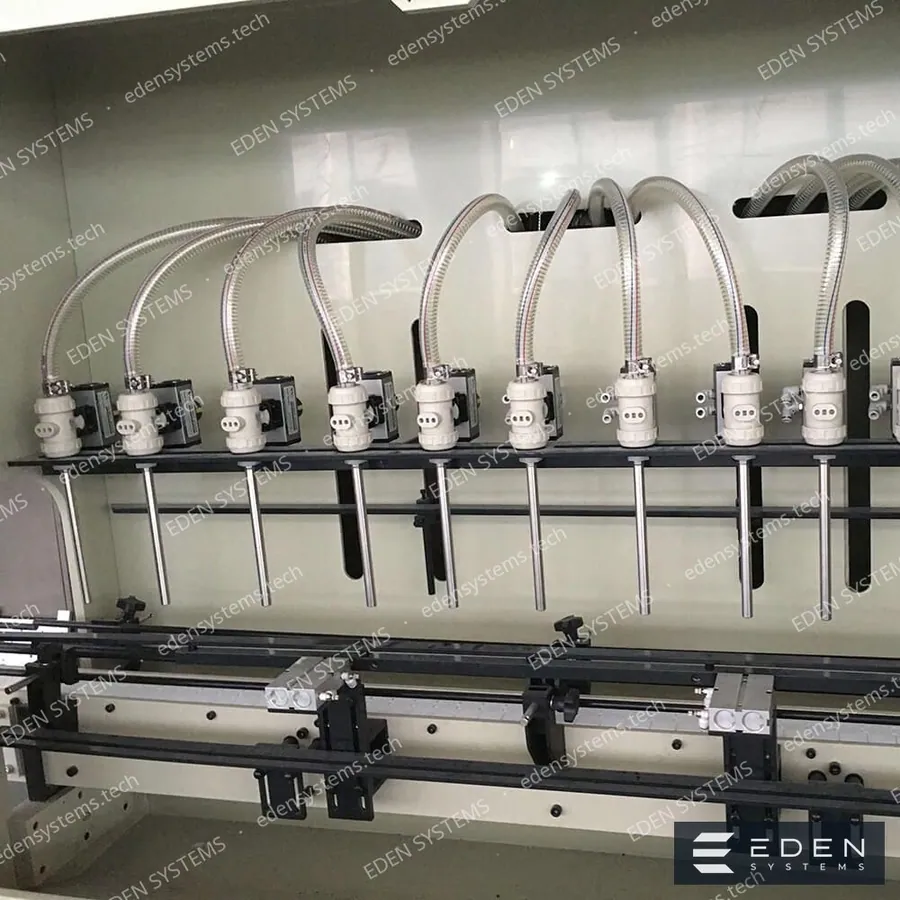
Foaming. Detergents foam when the stream falls freely, and the foam interferes with accurate level detection and spills over the neck. The solution is submerged filling with a nozzle that rises as the container fills, combined with a lower speed during the final phase of the dose.
Viscosity. Gels, fabric softeners, and concentrates require volumetric filling and larger passage diameters. Gravity filling is not suitable for these products.
Chemical aggressiveness. Acidic and chlorine-containing formulations attack standard seals and conventional grades of stainless steel. All product-contact components must be selected for chemical compatibility with the specific formulation, including specialized pump and gasket versions where necessary.
Component-Specific Requirements
- Filling Unit
- Volumetric piston or diaphragm filling, lifting fill nozzles, and an adjustable speed profile to control foaming.
- Product-Path Materials
- AISI 316L stainless steel, fluoropolymer seals, and polypropylene for specific chemicals. Materials are selected according to the formulation, not a general rule.
- Capping
- Triggers, dispensing pumps, flip-top caps, and standard screw caps require four different feeding and tightening mechanisms. Triggers require orientation by position and often need a separate unit.
- Containers
- Complex-shaped bottles behave poorly on conveyors: they are unstable, require guides, and sometimes must be conveyed by the neck.
- Induction Sealing
- A foil membrane under the closure protects against leakage during transportation. This requires a separate unit downstream of the capper.
- Area Ventilation
- For volatile formulations, supply and exhaust ventilation and local extraction above the filling unit are part of the project, not an option.
Product and Solution
| Product | Challenge | Technical Solution |
|---|---|---|
| Dishwashing detergent | Heavy foaming | Submerged filling with a lifting nozzle and reduced speed at the end of the dose |
| Laundry detergent gel | High viscosity | Piston filling, larger passage diameter, and heating if required |
| Chlorine-containing cleaner | Corrosion and vapors | Chemically resistant product-path materials and local exhaust |
| Product with a trigger sprayer | Sprayer orientation | Trigger orientation and positioning unit |
| Automotive chemicals in jerry cans | Large containers and large dose volume | Weight filling and separate conveying |
Multiproduct Lines
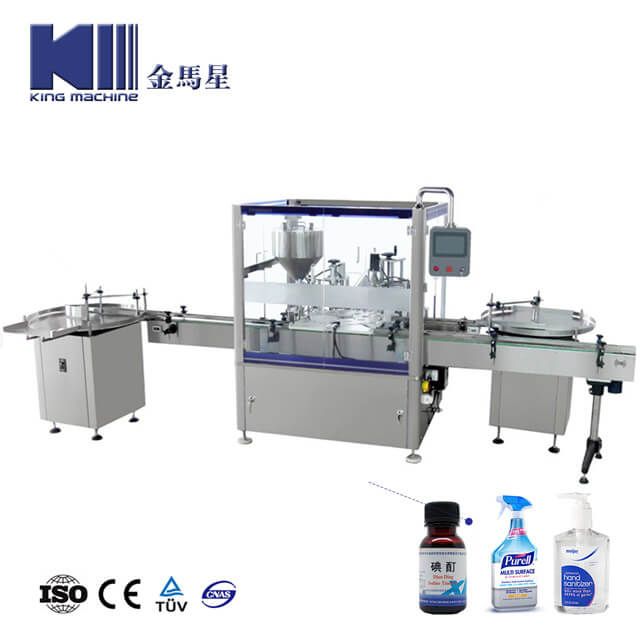
Household chemical manufacturers rarely produce only one product. The line almost always handles several formulations and several bottle formats, which means the key parameter is not maximum speed but changeover and cleaning time.
During design, this translates into specific requirements: quick-release fill nozzles, automated product-path cleaning, a minimum number of manual adjustment points during format changes, and recipe parameter storage in the control system. A line requiring a four-hour changeover for five product changes per week loses more output than it gains from higher filling speed.
FAQ
Can food and nonfood products be filled on the same line?
No. Combining household chemical and food-product streams is unacceptable under both regulations and common sense: trace residues of cleaning formulations in a food-product path are unacceptable. These require separate lines and, as a rule, separate rooms.
Which filling method is best for a broad product range?
Servo-driven volumetric piston filling. It covers a wide viscosity range, allows the dose to be changed through software, and stores recipes, which is critical for frequent transitions between products.
Is induction sealing required?
It is mandatory for products transported long distances and sold through retail channels where leakage is a concern. For concentrates and professional chemicals in large containers, high-quality capping with torque control is usually sufficient.
Read next
Ready solutions
Equipment catalog
Project services
Related projects
Calculation on the topic
We will calculate your line
Describe the product, packaging formats and planned volume — we will prepare a line scheme, specification and preliminary budget estimate with payback.
- Line scheme and unit specification for your product
- Budget range and payback period
- Site requirements: power, water, personnel