

Lines by Product Type
Water Filling Line: Technology and Key Units
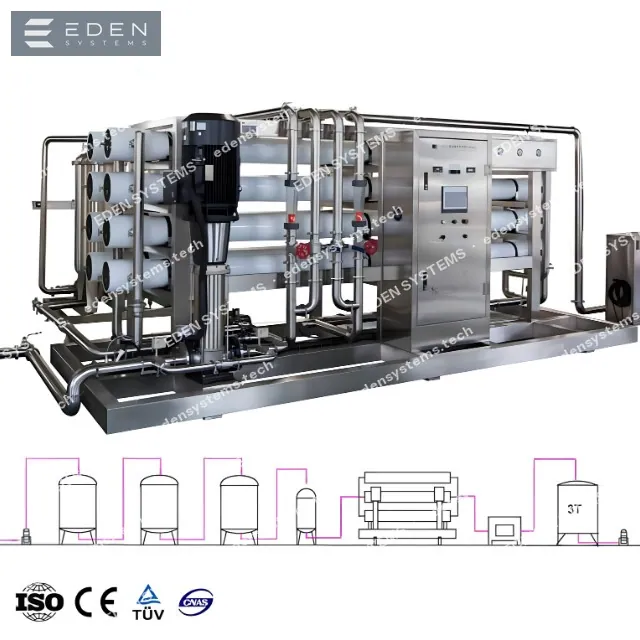
Filling drinking water appears simple until the first laboratory test report arrives. The main challenge is not filling, but water treatment and sanitation: the line must not degrade the water between the well and the bottle.
Where the Project Begins
It begins not with selecting a line, but with chemical and microbiological analysis of the source. Water composition determines the water treatment process, and water treatment determines a significant part of the budget and all subsequent operating economics: chemical consumption, membrane replacement frequency, and concentrate discharge volume.
A well with high iron content, a well with elevated hardness, and a well containing organic matter require three different systems. There is no universal water treatment solution, and a proposal prepared without a water analysis is only a guess.
The second question is what type of water you will produce. Natural mineral water retains its natural composition, and treatment options are limited. Purified drinking water can undergo deep purification followed by remineralization. These require different process configurations and are governed by different regulatory frameworks.
Process Sequence
- 1
Water Intake and Storage
Well pump, raw water tank, and metering unit. Primary disinfection is also usually installed here.
- 2
Mechanical Treatment
Sediment filters, iron removal, and, if necessary, manganese and hydrogen sulfide removal.
- 3
Softening
Ion-exchange filters reduce hardness and protect reverse osmosis membranes from scaling.
- 4
Reverse Osmosis
Membrane treatment for purified drinking water. For natural mineral water, it is used only partially or not at all in order to preserve the water’s composition.
- 5
Remineralization and Adjustment
Restoration of mineral content and taste characteristics after deep purification.
- 6
Disinfection
Ultraviolet treatment and ozonation. Ozone also treats the inside surface of the bottle and decomposes into oxygen without leaving residue in the product.
- 7
Filling
A “rinsing—filling—capping” triblock. The product path from the final filter to the filling valve is kept as short as possible.
- 8
Finishing and Packaging
Labeling, date coding, shrink wrapping, and palletizing.
Units That Determine Consistent Quality
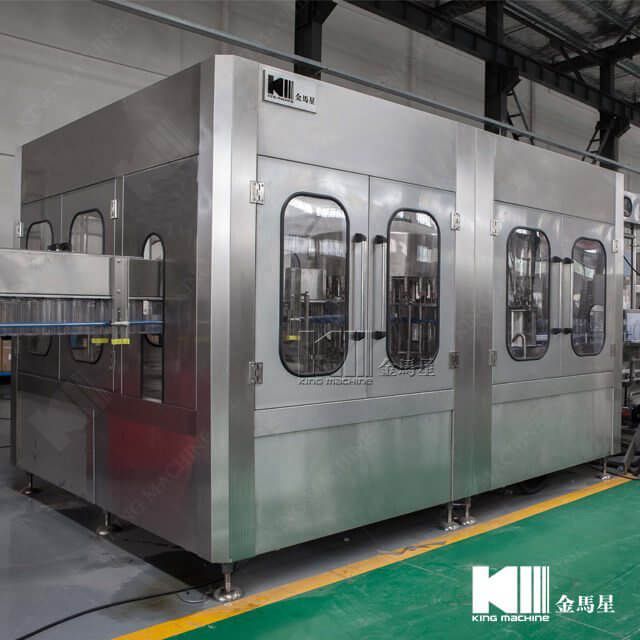
- Rinser
- The bottle is gripped by the neck, inverted, and rinsed with purified or ozonated water. Recirculating the rinse water reduces consumption by approximately one-third.
- Filling Valve
- Still water uses gravity level filling: the dose is determined by bottle geometry, with accuracy within ±1%. Carbonated water uses isobaric filling under counterpressure.
- Capping Head
- A magnetic clutch sets the application torque. An undertightened cap leaks, while an overtightened cap strips the threads. Torque verification is a mandatory acceptance parameter.
- CIP Circuit
- Clean-in-place sanitation in a closed loop. Without a proper CIP system, the line becomes a source of secondary contamination after two to three weeks of operation.
- Product-Contact Parts
- Polished AISI 304 and 316L stainless steel, no dead zones, and disassemblable units. Any pocket in the product path is a potential biofilm growth point.
Typical Configurations
| Application | Capacity | Configuration |
|---|---|---|
| Local brand, one format | 2 000-4 000 bottles/hr | Water treatment, 12-18-valve triblock, purchased containers |
| Regional plant | 6 000-12 000 bottles/hr | Water treatment, in-line blowing, 24-32-valve triblock, automatic packaging |
| Limited facility space | 6 000-14 000 bottles/hr | Blowing-filling-capping combiblock, compact packaging system |
| Returnable 19 L containers | 150-1 200 bottles/hr | Bottle washing, inspection, 19 L triblock, capper |
FAQ
Can carbonated and still water be filled on the same line?
Yes, if isobaric filling and a mixer-carbonator are included from the outset. An isobaric machine can fill both carbonated and still products, but the reverse is not true: a gravity valve cannot fill carbonated water. If carbonated products are planned, isobaric filling must be specified from the start.
Is ozonation necessary if ultraviolet treatment is installed?
They perform different functions. Ultraviolet light disinfects the flow as it passes through the lamp but provides no residual action. Ozone works throughout the volume, treats the inside surface of the container, and provides protection during capping. PET drinking water lines generally use both.
How often should reverse osmosis membranes be replaced?
Service life depends on pretreatment quality and raw water hardness, typically 2-3 years with properly selected softening. Signs that replacement is approaching include reduced capacity and increased permeate salinity at unchanged pressure.
Read next
Ready solutions
Equipment catalog
Project services
Related projects
Calculation on the topic
We will calculate your line
Describe the product, packaging formats and planned volume — we will prepare a line scheme, specification and preliminary budget estimate with payback.
- Line scheme and unit specification for your product
- Budget range and payback period
- Site requirements: power, water, personnel