

Lines by Product Type
Vegetable Oil Filling Line: Fill Accuracy and Clean Capping
Oil is viscous, strings from the valve, and leaves a film on everything it touches. The line must deliver an accurate dose, cut off drips after filling, and keep oil away from the bottle neck before capping.
Why Oil Should Not Be Filled by Level
Gravity level filling determines volume through bottle geometry. This works for water but not for oil: the product is sold by volume or weight with a specified tolerance, while viscosity and temperature significantly affect flow behavior.
Volumetric piston filling or weight filling is therefore used. A piston filler meters the dose through piston travel, while a weight filler uses a load cell under each position to monitor mass. The second option is more expensive but provides better accuracy and is unaffected by changes in product density caused by temperature fluctuations.
The second specialized component is the drip cutoff. Without it, a string of oil remains after the valve closes, contaminating the bottle neck and outer surface. This leads to poor closure seating, label adhesion problems, and oily residue on the packaging.
Key Line Components
- Preparation and Filtration
- Buffer tanks, product filtration, and temperature maintenance when required to ensure stable viscosity.
- Filling Unit
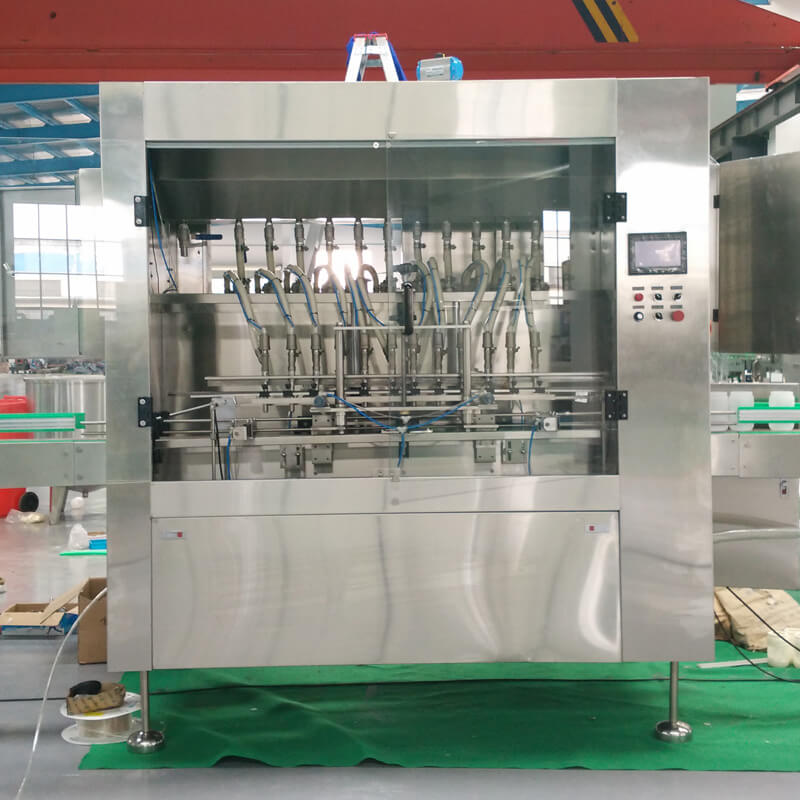
- Piston or weight filling with valves equipped with drip cutoff and lifting fill nozzles.
- Capping
- Closure tightening with torque control. Oil-contaminated threads are the primary cause of leakage.
- Fill-Weight Inspection
- A checkweigher downstream of the filler with automatic rejection of packages outside the weight tolerance.
- Labeling
- Pressure-sensitive labels require a dry, clean bottle surface, so an air-blowing and wiping station is often installed upstream.
- Packaging
- Shrink wrapping or case packing. Oil containers are slippery, which must be considered in conveyor and grouping-device design.
Formats and Typical Solutions
| Container | Capacity | Filling Type | Special Considerations |
|---|---|---|---|
| 0.5-1 L PET | 3 000-9 000 bottles/hr | Piston | Mass-market segment and automatic packaging |
| 1-5 L PET | 1 500-4 000 bottles/hr | Piston or weight | Handled containers and separate conveying |
| 0.25-1 L glass | 1 000-4 000 bottles/hr | Weight | Premium segment and gentle conveying |
| 5-20 L jerry cans | 300-1 200 units/hr | Weight | Industrial and packaged oils |
Sanitation and Product Changeover
Oil does not create microbiological risks comparable to dairy products, but it forms a persistent film and accumulates oxidized residue in stagnant areas. The product path must be fully drainable, with no pockets, and the filling components must be designed for disassembly.
Changeover between oil types must be planned separately. Switching from sunflower oil to olive oil or to oil with additives requires complete flushing of the product path. The duration of this operation directly affects how many SKUs can realistically be produced on one line per shift.
FAQ
Piston or weight filling?
Piston filling is less expensive and sufficient for most edible oils in standard containers. Weight filling is selected when accuracy requirements are strict, the product is expensive, or containers are large enough that a small percentage deviation results in a significant loss in liters.
Can sauces be filled on an oil line?
To some extent. Piston filling works with viscous products, but sauces containing particles require valves with larger passage diameters and a different feed system. This versatility must be designed in from the beginning, not added after startup.
Does the product need to be heated?
At low production-area temperatures, viscosity increases, the dose drifts, and filling speed decreases. Maintaining a stable product temperature in the buffer tank solves both problems and is usually included in the design.
Read next
Ready solutions
Equipment catalog
Project services
Related projects
Calculation on the topic
We will calculate your line
Describe the product, packaging formats and planned volume — we will prepare a line scheme, specification and preliminary budget estimate with payback.
- Line scheme and unit specification for your product
- Budget range and payback period
- Site requirements: power, water, personnel