

Vegetable Oil Filling Line
A complete cycle: from preform blow moulding to a stretch-wrapped pallet. The line is built around your product viscosity, temperature and container format.
- Product
- Vegetable and blended oils, viscosity up to 300 cP
- Container
- PET, PP, PE, glass, tinplate
- Container shape
- Round, square, shaped
- Fill volume
- 0.2–6 L
- Filling valves
- 4–80
- Output
- 1,000–20,000 bph
- Filling method
- Weight (load cell) or servo-driven piston
- Dosing accuracy
- Max deviation ±2–3 g, SD 1.5
- Capping
- Screw, press-on, servo-torque, induction sealing
- Operating conditions
- 10–40 °C, no condensation
- Power supply
- 380 V ±5%, 3-phase, 50 Hz ±1%
Line parameters
About the solution
This solution covers filling of sunflower, rapeseed, corn, olive and blended oils into containers from 0.2 to 6 litres. The product is viscous and prone to film formation on the container walls, so filling is done by weight or with a servo-driven piston doser: the valve operates in two stages — fast bulk fill and slow trickle to target dose — with vacuum suck-back of the drip on closing.
Product-contact parts are AISI 316L stainless steel with food-grade seals. The frame and guards are AISI 304. Changeover parts (infeed/outfeed starwheels, guide rails, neck grippers) are tool-free, giving a changeover time between similar formats of 20–40 minutes.
The line is engineered as a single synchronised flow: every station's throughput carries a 10–15% margin over the filler so the labeller or packer never becomes the bottleneck. Layout is agreed against your plant floor plan before production starts.
Built into the design
Servo-controlled valve
Each valve is controlled individually: segmented speed profile, drip-free cutoff, vacuum suck-back of the residual drop after closing.
Weight feedback
Check weigher after filling automatically corrects the dose at the valve — weight drift is compensated without stopping the line.
Fast changeover
Infeed/outfeed starwheels, neck grippers and guide rails come off without tools; format parameters are stored as PLC recipes.
Sanitation and washdown
AISI 316L product path, disassemblable units with no dead zones, CIP loop with closed-circuit hot solution flush.
Traceability and reporting
Shift, batch and reject reports, date coding on bottle and case, data export to the customer's MES or ERP system.
Safety
Interlocked guards, perimeter emergency stops, status light tower, compliant with applicable technical regulations.
Line composition along the product flow
13 positions along the product flow. Every unit opens in the catalog: series, specifications, scope of supply and a quote request.
- 1
1. PET bottle blow moulder
Preform blown in-line with the filler; a buffer accumulator smooths the difference in cycle rates. For glass and tinplate this station is replaced with a depalletiser.
PET stretch blow moulding equipment →
- 2
2. Air conveyor for empty containers
Empty bottles travel on an air conveyor by the neck ring: no drops, no body contact, no dust.
PET stretch blow moulding equipment →
- 3
3. Product preparation: filtration and heating
Tank farm, fine filter and oil heating to a stable filling temperature — without this the dose drifts with viscosity.
Water treatment →
- 4
4. Filler (weight-based)
Load cell under every position, two-stage dose buildup, vacuum drip cutoff, skip-fill when no container is present.
Oil filling →
- 5
5. Filler (volumetric, alternative)
Servo-driven piston doser — an option for stable product temperature and volume-based labelling.
Oil filling →
- 6
6. Cap sorter and feeder
Hopper elevator, cap orientation and chute feed to the capping heads with presence control.
Capping equipment →
- 7
7. Capping machine
Magnetic or servo screw-capping heads with torque control, reject of under-torqued or skewed caps.
Capping equipment →
- 8
8. Induction foil sealing
Foil sealed onto the neck under the cap: tamper evidence, leak-tightness, extended shelf life.
Capping equipment →
- 9
9. Check weigher and inspection
Weighing of every bottle, feedback to the filling valve, rejection for underfill and capping defects.
Marking and quality inspection →
- 10
10. Self-adhesive labelling
Body label and back label, presence and positioning control, speed matched to line rate.
Labelling equipment →
- 11
11. Glue labelling (alternative)
Hot-melt wraparound labelling — cheaper on consumables for high runs of paper labels.
Labelling equipment →
- 12
12. Date coding and marking
Continuous inkjet or thermal transfer printer: date, shift and batch on the bottle, barcode on the case.
Marking and quality inspection →
- 13
13. Case packing and palletising
Case erector, bottle placement, tape sealing, robotic palletiser and stretch-wrap of the pallet.
Packing and palletising →
Line model selection
Selecting the filling module by container type
Dosing range 0.2-6 L, 4-80 filling heads, round, square or shaped container in PET, PP, PE, glass or metal.
| Dosing method | Filling heads | Output | Accuracy |
|---|---|---|---|
| Mechanical valve (gravity) | 4-24 | 1,000-8,000 btl/h | ±3-5 g of dose |
| Volumetric piston valve | 4-12 | 480-4,000 btl/h | ±0.5% |
| Weigh (load cell) | 1-24 | 400-6,000 btl/h | ±0.1-0.3% of dose |
| Flowmeter | 8-80 | 1,000-20,000 btl/h | ±2-3 g, 1.5 standard deviation |
Each filling head is controlled by an individual servo drive with a smooth transition from fast to fine filling and vacuum drip suction to prevent leakage.
Range from semi-automatic to rotary
Output is given for 500 mL - 1 L containers with suitable product viscosity.
| Model | Configuration | Filling positions | Output |
|---|---|---|---|
| EDS-OIL-S | Semi-automatic, 2 nozzles | 2 | 400-500 units/h |
| EDS-OIL-L | Inline piston | 4 / 6 / 8 / 12 | 480-2,880 btl/h |
| EDS-OIL-GY18-6 | Rotary | 18 filling / 6 capping | 5,000 btl/h |
| EDS-OIL-GY32-10 | Rotary | 32 filling / 10 capping | 10,000 btl/h |
| EDS-OIL-W | Weigh monoblock | 24 filling / 8 capping | 6,000 btl/h |
Operating conditions: 10-40 °C, no condensation. Power supply 380 V ±5%, 3-phase, 50 Hz ±1%.
Large-volume containers and packaging
Weight-based dosing with a submerged nozzle and two-stage cutoff is used for canisters, pails and drums.
| Container type | Dose | Output | Packaging |
|---|---|---|---|
| Canister / pail 10-25 kg | up to 25 kg | 700-800 units/h | Case or stretch wrap on a pallet |
| Pail / can 50 kg | up to 50 kg | 100-180 units/h | Individual stacking on a pallet |
| Drum 100-220 L | up to 300 kg | 80-150 drums/h | Manual or roller stacking on a pallet |
Values are indicative and are refined for the customer's specific container and product viscosity.
Line process flow
An oil filling line is built around a single filling module, but the dosing method and the composition of the line's front and back ends depend on the container: bottles for vegetable oil, canisters for lubricants, or drums for industrial feedstock.
Key features of the oil filling line
- Product-contact parts in 316L stainless steel, food-grade seals
- The filling valve operates at high speed without stringing the product
- A screw-type container divider reduces changeover parts when switching formats
- Tool-free quick-change parts: star wheels, neck grippers
- Each filling head is on an individual servo drive with segmented high- and low-speed filling
- Vacuum suction after filling prevents drips down the neck
- Dosing range 0.2-6 L on a single platform without changing valves
Layout for filling 0.5-5 L containers in PET or glass with in-line preform blow molding.
- 1Oil preparation and filtration
- 2PET container blow molder for oil
- 3Air conveyor for empty containers
- 4Weigh or volumetric filling module
- 5Capping machine
- 6Fill level and capping inspection
- 7Labeling machine
- 8Shrink wrap packing
- 9Palletizer and stretch wrapper
Key line stations
What sits behind the nameplate output: contact-part execution, operating logic and service points for every station.
Rinsing heads
Container preparation
- AISI 304/316 stainless nozzles and manifold with fan-jet spray: lower water consumption and more even rinsing over the entire inner surface.
- Neck-grip gripper with a polymer insert holds the bottle by the finish, minimizing the risk of preform crushing or scratching.
- Rinsing pump and piping in sanitary design, the circuit disassembles without tools.
- Rinse-water recirculation with filtration — up to 30% savings compared to drain discharge.
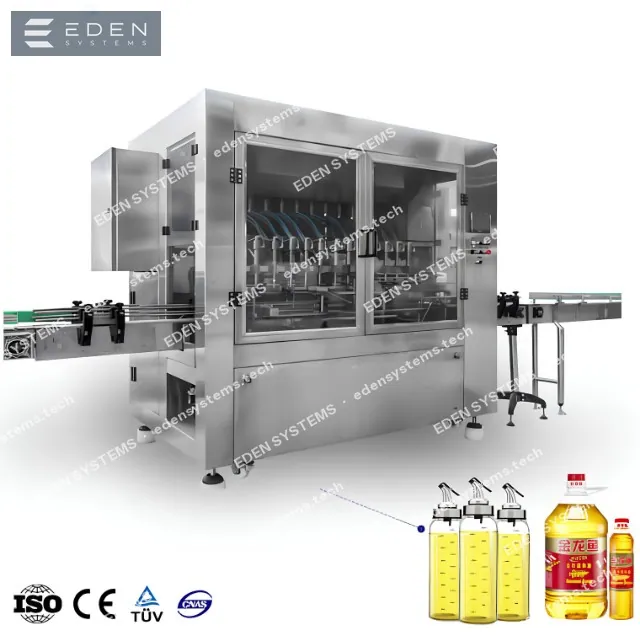
Core machines of the line
Equipment of the “Vegetable Oil Filling Line” layout: each tile opens the catalog with series, specifications and a quote request for that machine.
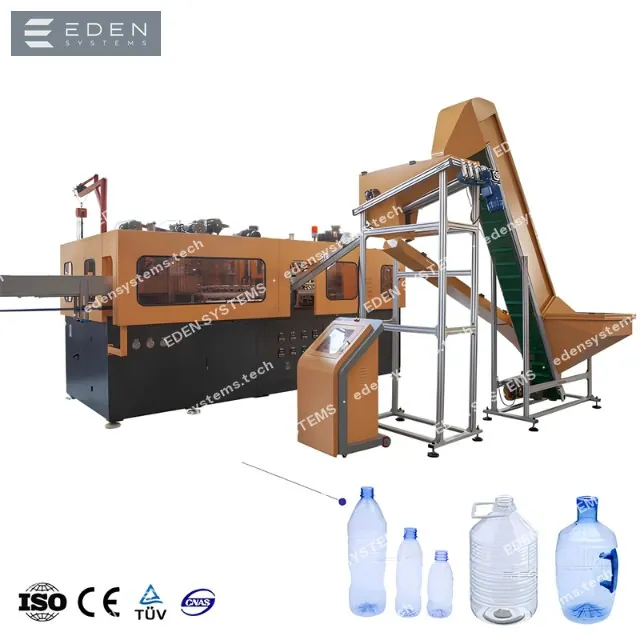
PET container blow molder for oil
Blow molding of the bottle from a preform for filling vegetable oil: reinforced stretch unit and mold cooling for extra-thick walls.
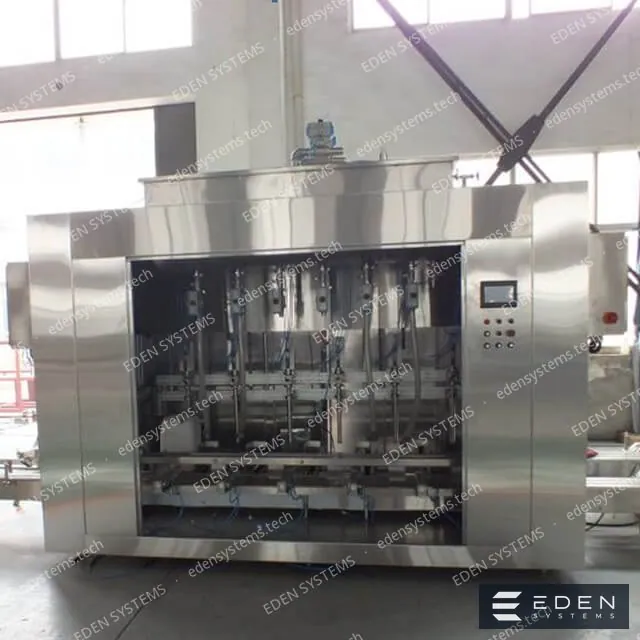
Inline weigh filling machine (SNYG series)
Weight-based dosing with feedback on each head, dose set from the panel without changing parts. Configurations from 4-12 heads, accuracy better than 0.5%.
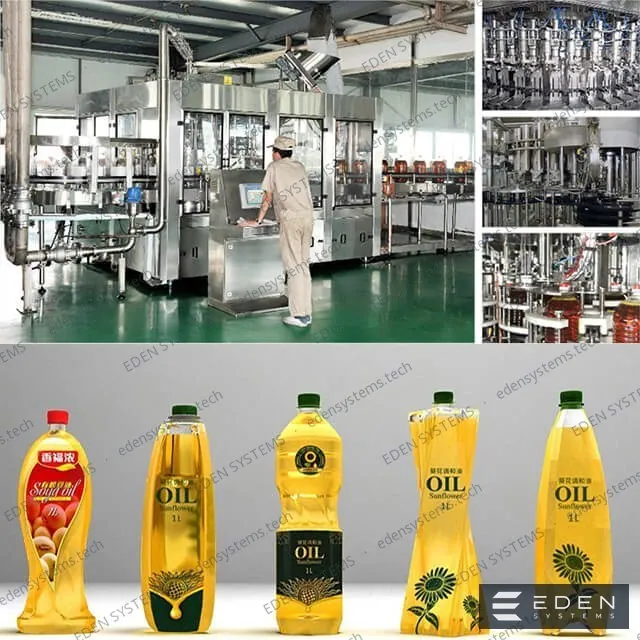
Rotary oil filling machine
Continuous-operation carousel machine with synchronous rotation of the filling and capping module: configurations GY12-4 to GY32-10 for 3,000-10,000 btl/h.
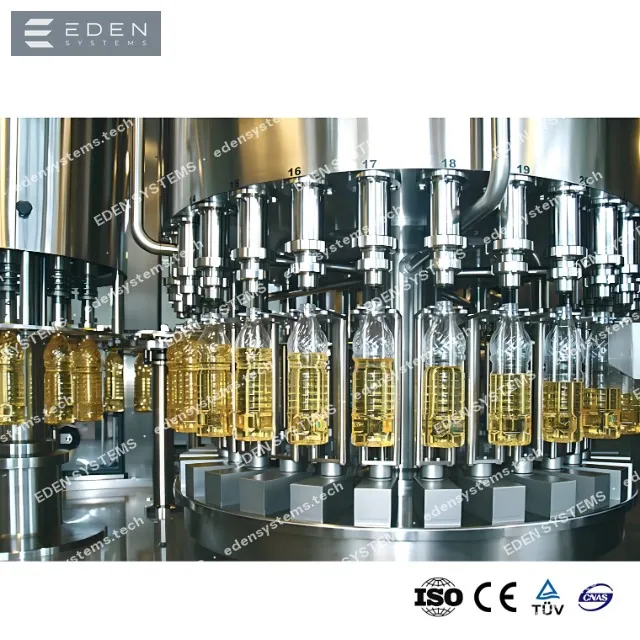
Weigh-fill + capping monoblock, 2-in-1
24 weigh-filling positions and 8 capping heads on a single frame: dose is measured by a load cell, unaffected by product viscosity or temperature.
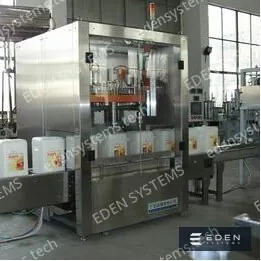
Canister filling machine (dual-row weigh station)
Two rows of 4 weigh-heads for 10-25 kg canisters and pails: submerged filling without splashing, weight-based cutoff with per-head adjustment.
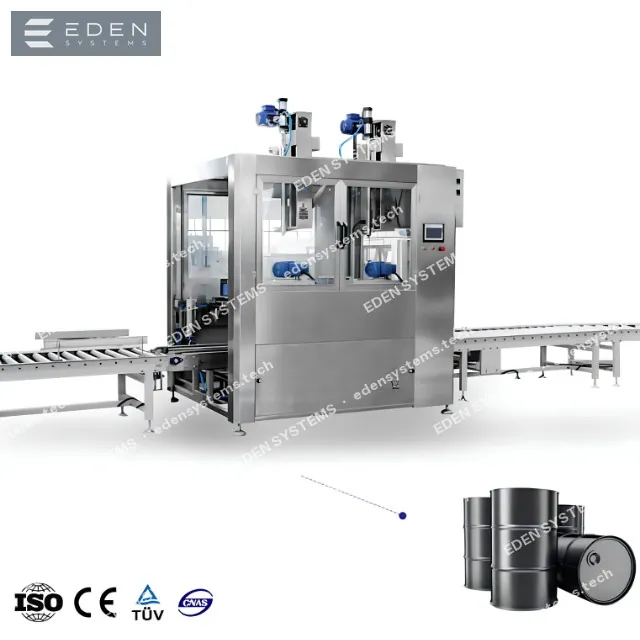
Drum filling machine, 100-220 L
Two-head weigh station for large containers: the drum sits on a weighing platform, filling has coarse and fine stages with a submerged nozzle.
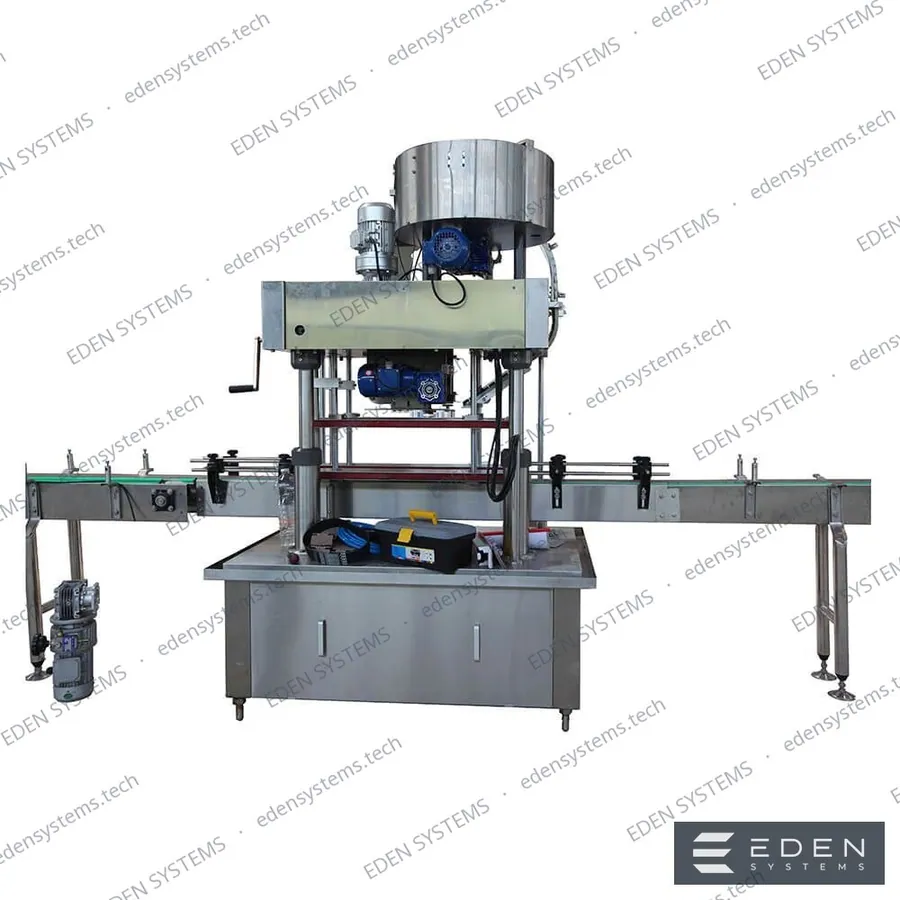
Capping machine
Screws on the plastic cap with torque and cap-presence control before each head, synchronized with the filling module's rhythm.
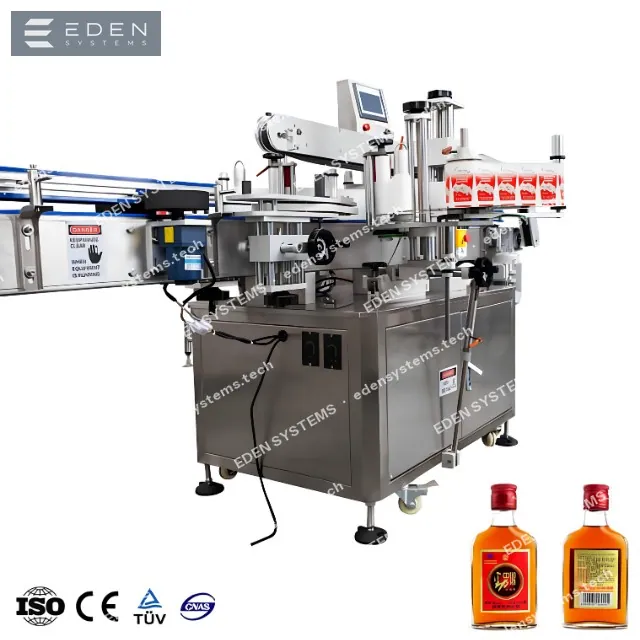
Labeling machine
Self-adhesive body label or roll-fed glue label matching the branded design of vegetable or motor oil containers.
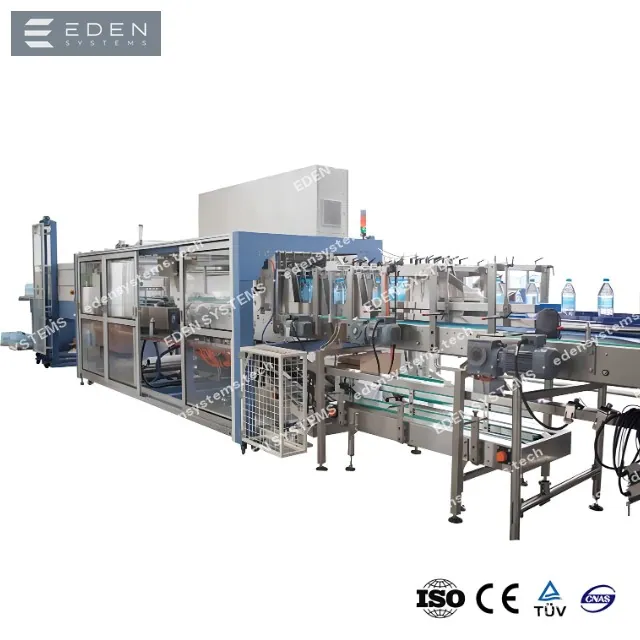
Shrink wrap packer
Group packaging of bottles into PE film using 2×3, 3×4, 4×6 patterns with a shrink tunnel before palletizing.
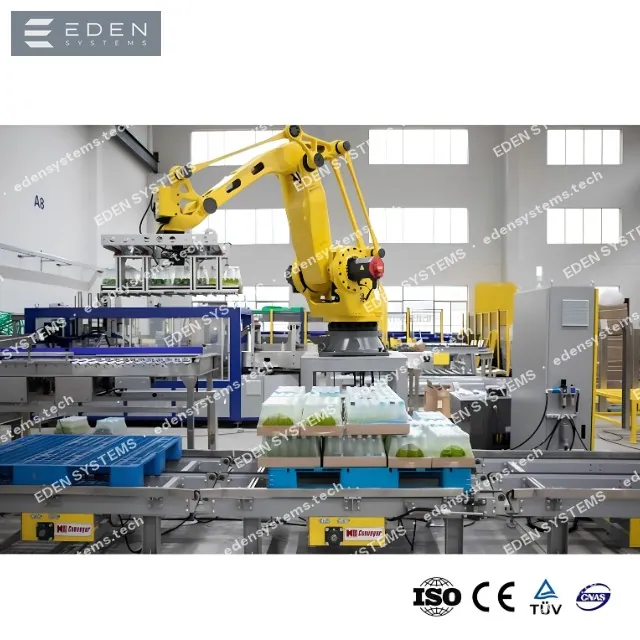
Palletizer and stretch wrapper
Layer-by-layer stacking of cases or canisters onto a pallet and stretch wrap with pre-tension before shipping to the warehouse.
Which closure do you use
The cap type defines the capping block: heads, feeding and orientation of the closure, torque or press-on force. State your option in the request and we will select the head and sorter for it.
PCO 1881 / 28 mm / 38 mm
Plastic screw cap
The tamper-evident band tears on opening. Torque is set on the HMI and monitored on every chuck.
Capping unit: Magnetic screwing head
28×18, 30×60 (ROPP)
Aluminum screw cap
The thread is rolled directly onto the bottle neck, the skirt is crimped over the finish — tamper-evidence without an extra seal.
Capping unit: ROPP thread-rolling head
foil 0.2–0.9 mm
Induction liner under the cap
The liner is welded to the finish after capping — tamper protection and seal integrity during transport.
Capping unit: In-line induction sealer
24 mm, 28 mm
Flip-top / disc-top cap
The closed cap is fed pre-oriented to the label so the flap faces the right direction after capping.
Capping unit: Press head + tightening
Auxiliary systems of the line
The engineering utilities without which a line never reaches its rated output: water and product preparation, sanitation, container handling.
Oil receiving and preparation
From the storage tank to the filler.
- AISI 304 storage tanks heated to 25–30 °C — viscosity stays stable year-round
- 100–200 μm inlet filtration, screening out sediment and sludge traces
- Gear or screw-type pumps with a VFD, pulsation-free delivery
- Mass flow meter on the inlet — raw material accounted for on every filling batch
Weigh-filling dosing system
Dose accuracy directly affects cost of goods.
- Load cells at every station with auto-correction against actual container weight
- Two-stage fill: fast flow to 90% of dose, then a fine-stream trim
- ±0.2% accuracy — saves product on every bottle when oil is expensive
- Container-volume recipes stored in the controller; format change is a recipe selection
CIP station (clean-in-place)
Product-path flushing between oil grades.
- Alkali, acid and hot-water tanks holding temperature within ±2 °C
- Recipe-driven wash programs: phase time, concentration and flow are logged
- Flow meter on the supply line — actual flow is verified, not assumed from the nameplate
- Hot-oil or caustic wash depending on the grade change and cleaning schedule
Conveying systems
Empty PET container infeed and capped bottle discharge.
- Air conveyor for empty containers with air filtration and neck guide rails
- Slat-top conveyor with independent drives and accumulation buffers between stations
- AISI 304 frame, Siemens / Schneider drives and controls, Sick photo sensors
- Photoelectric jam detection with automatic section stop before a line stoppage
Coding and inspection
Fill date, best-before date and batch on every bottle.
- Inkjet or laser coder: date, shift, batch number, traceability code
- Fill-level, cap presence and seating inspection with automatic reject to a pocket
- Good/reject product counters logged per shift hour
- Ready for mandatory marking: case and pallet aggregation at the line outfeed
Packing and palletizing
Multipack grouping and pallet formation.
- Shrink film pack or corrugated case, format tailored to the retailer's requirements
- Layer palletizer to a defined pattern, robotic version for constrained floor space
- Pallet wrapper with pre-stretch film: lower film consumption, pallet withstands transport
- SSCC pallet label printing and application, data handoff to the ERP system
PET container blow-molding
Bottle blow-molding for oil in-line.
- Infrared oven with zoned heating for even wall-thickness distribution
- Two-stage blow with high-pressure air recovery, saving up to 30%
- Mold change to another volume by two operators, from 30 minutes
- Blow-molder output synchronized with the filler, container buffer on the air conveyor
FAQ
Should oil be filled by weight or by volume?
Weight filling holds mass steady regardless of product temperature and density — important when the label states weight. Volumetric piston filling is cheaper and changes over faster, and is used when product temperature is stable and volume is stated. We evaluate both options for your product and show the difference in cost and accuracy.
How much space does the line need?
A 4,000 bph line in the base configuration takes roughly 25 × 8 metres with service aisles, plus a pallet staging area and preform storage. We provide an exact layout drawing against your plant plan before the contract is signed.
Can stations be added later?
Yes, the line is designed modularly: conveyors and the control cabinet carry spare ports and power capacity so a palletiser, inspection unit or second container format can be added later without reworking existing stations.
What are the delivery and start-up timelines?
Production takes 60–120 days depending on configuration, followed by shipping, supervised installation and commissioning on-site over 2–4 weeks, operator and technician training, and ramp-up to rated output during acceptance testing with your product.
How much does the Vegetable Oil Filling Line cost?
Price on request: the budget depends on output, container type, line composition and the level of automation. After a short brief we send a preliminary estimate within 1–2 working days and a full quotation broken down by machine within 3–5 days.
What are the delivery and commissioning lead times?
Standard machines ship 8–12 weeks after the specification is confirmed, complete lines 12–20 weeks. Transport takes 2–6 weeks depending on the route; installation and commissioning on site take 2–4 weeks, with operator training included.
What output does this line reach?
The working range is 1,000–20,000 bph. Exact output is confirmed against your container, product and shift plan: we calculate the line balance and keep a margin on the bottleneck machine.
Request a quote: Vegetable Oil Filling Line
Tell us the product, the container and the target output — we will return the line composition, a layout, a budget range and a delivery schedule.
Related solutions
Lines with a similar equipment set — useful when you plan several products on one site.
2,000–36,000 bph
Drinking Water Filling Line, 0.33–1 L
Rinser-filler-capper monobloc for PET, water treatment, labelling and shrink packing.
Open solution1,000–12,000 units/h
Household Chemicals Filling Line
Filling of detergents and surfactants into bottles and jerrycans, trigger and pump capping.
Open solution1,000–8,000 jph
Jam and Sauce Filling Line
Rotary piston filler for thick products with particulates, twist-off capping.
Open solutionServices for this line
Engineering, logistics, installation and service that turn this line into a working production site.
Digital layer
Any line can be supplied with a digital layer
SCADA, MES, OEE monitoring, batch traceability and integration with plant systems — engineered together with the line, not bolted on later.