

PET Containers and Blowing
PET Bottle Blow Molds: Design, Service Life, and Manufacturing
The mold determines bottle geometry, material distribution through the wall, and ultimately container weight. A mold design error means either excess PET consumption in every bottle or a bottle that collapses under its own weight on the pallet.
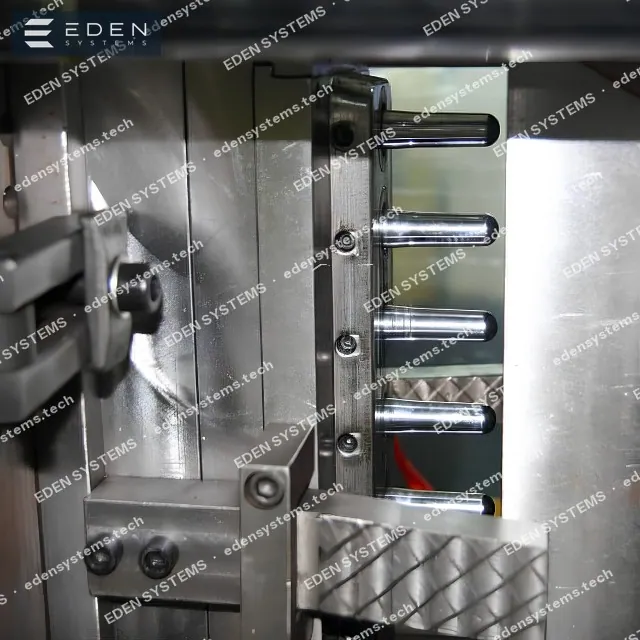
Mold Construction
A blow mold is an opening assembly consisting of two mold halves and a movable base insert. The mold halves form the side surface of the bottle, while the base insert forms the support area: carbonated beverage bottles use a petaloid base, while still-water bottles generally use a flat base with reinforcing ribs.
The primary material used for forming surfaces is a high-thermal-conductivity aluminum alloy. This is not a cost-saving measure, but a matter of physics: the mold must quickly remove heat from the freshly blown bottle, or the bottle will not have enough time to set its geometry during the cycle. Wear components are made of steel.
Cooling channels run inside the mold halves and connect to the chiller. Uniform cooling along the mold height directly affects wall clarity and bottle volume stability.
Parameters Defined During Mold Design
- Stretch Ratio
- The relationship between preform and finished-bottle dimensions along the axes. It determines molecular orientation and wall strength. Too little stretch produces a weak wall, while too much creates a risk of rupture.
- Material Distribution
- The wall profile is determined jointly by mold geometry and the preform heating profile. The goal is minimum weight while maintaining top-load strength and internal-pressure resistance.
- Base Design
- A petaloid base is mandatory for carbonated beverages: a flat base bulges outward under pressure, causing the bottle to become unstable.
- Reinforcing Ribs
- Circumferential and longitudinal ribs resist deformation during pallet stacking and vacuum formation during hot filling.
- Neck Finish
- The neck finish is formed in the preform and does not change during blowing. Its standard determines compatibility with the capping head and closure type.
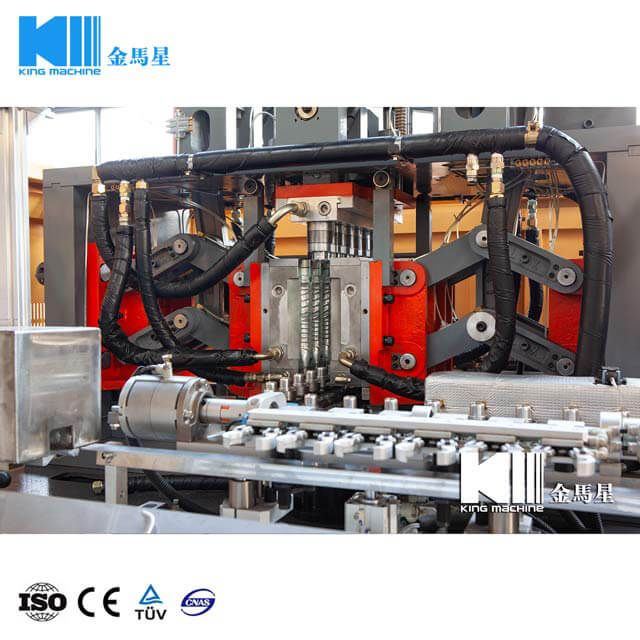
Information Required Before Mold Manufacturing
| Parameter | Purpose |
|---|---|
| Blow Molder Model and Brand | Mold mounting dimensions and attachment method |
| Nominal and Brimful Bottle Volume | Geometry calculation accounting for headspace |
| Neck Finish Standard | Compatibility with the preform and capper |
| Preform Weight | Calculation of stretch ratio and material distribution |
| Product | Carbonated, hot-filled, or standard products require different base and wall designs |
| 3D Model or Bottle Sample | Basis for designing the forming surfaces |
Maintenance and Service Life
The forming surface is not the primary wear area. Wear occurs in the closing components, guides, and base mechanism. The maintenance procedure is straightforward: remove deposits after each extended production campaign, verify closing tightness, flush scale from cooling channels, and replace wear components on schedule.
Deposits on the mold surface are a separate issue. They create an appearance defect on every bottle and are not immediately noticed because they accumulate gradually. Scheduled cleaning costs less than a batch of containers with matte spots.
FAQ
Can a mold from another blow molder manufacturer be used?
Sometimes, if the mounting dimensions and attachment system match, but an adapter plate is usually required. It is better to design the mold for the specific machine from the start; this is less expensive than adapting a mold designed for another machine.
How long does it take to manufacture a mold?
With a completed 3D bottle model, the standard lead time is several weeks. If the bottle must be designed from scratch, additional time is required for geometry development and material distribution analysis.
Is a petaloid base mandatory?
Yes, for carbonated beverages. Still water, oil, and chemical containers use a flat base with reinforcing ribs, which is simpler and less expensive to manufacture.
Read next
Ready solutions
Equipment catalog
Project services
Related projects
Calculation on the topic
We will calculate your line
Describe the product, packaging formats and planned volume — we will prepare a line scheme, specification and preliminary budget estimate with payback.
- Line scheme and unit specification for your product
- Budget range and payback period
- Site requirements: power, water, personnel