

PET Containers and Blowing
PET Filling Line: Components and Selection
PET remains the primary packaging material for water, carbonated beverages, juices, oil, and household chemicals. A line for PET containers is assembled from the same basic units, but their configuration and sequence vary depending on the product, container volume, and whether bottles are purchased or blown in-house. We explain the line components and selection criteria.
Basic Line Configuration
Every PET filling line performs four tasks: obtain a clean container, fill it with product, seal it, and prepare it for shipment. Everything else is added for the specific product.
The sequence of units is almost always the same: product preparation, container feeding or blowing, conveying, filling block, inspection, labeling, coding, secondary packaging, and palletizing. The differences begin with the specific technology used for each unit.
Line Units and Their Functions
- Product Preparation
- For water, this means a water treatment system. Beverage production also requires a syrup room, blending tanks, and a mixer-carbonator. Oil and chemical products require filtration and intermediate tanks with agitation.
- Preform Blowing or Finished-Container Unscrambler
- A blow molder converts preforms into bottles directly in the line. The alternative is an unscrambler that unloads finished bottles from a bulk bag. The choice affects container cost and warehouse logistics.
- Air Conveyor
- An empty PET bottle is lightweight and unstable, so it is suspended by the neck and conveyed by airflow rather than carried on a belt. The conveyor also acts as a buffer between blowing and filling.
- Filling Triblock
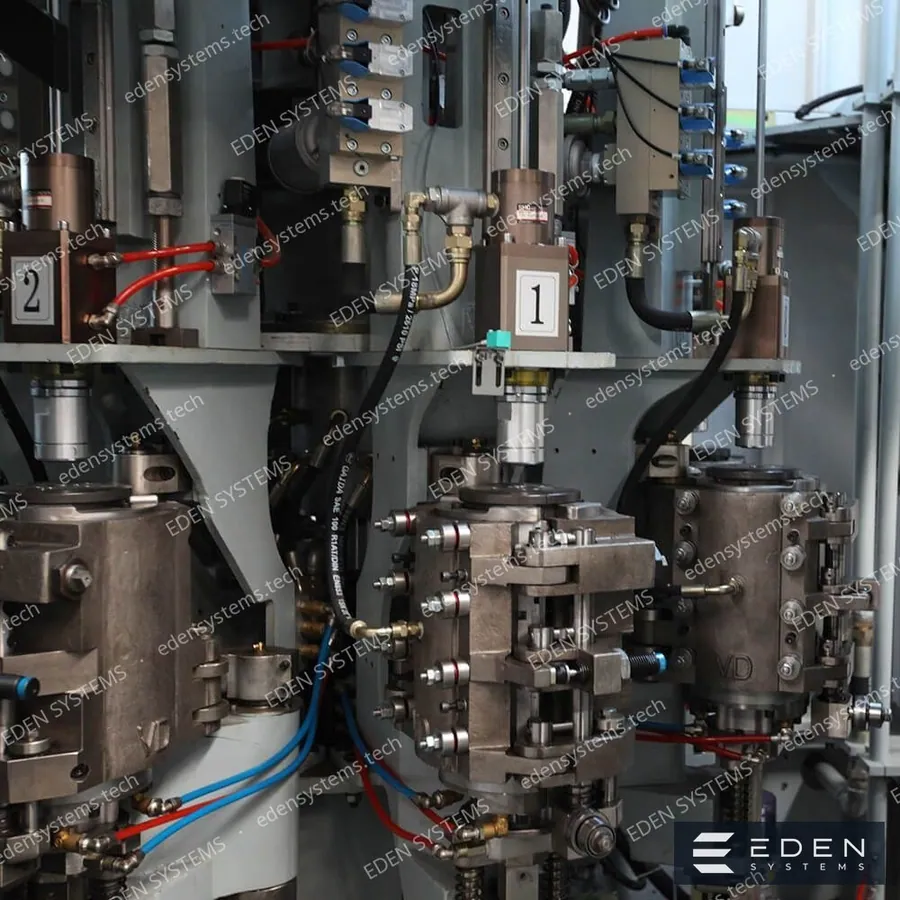
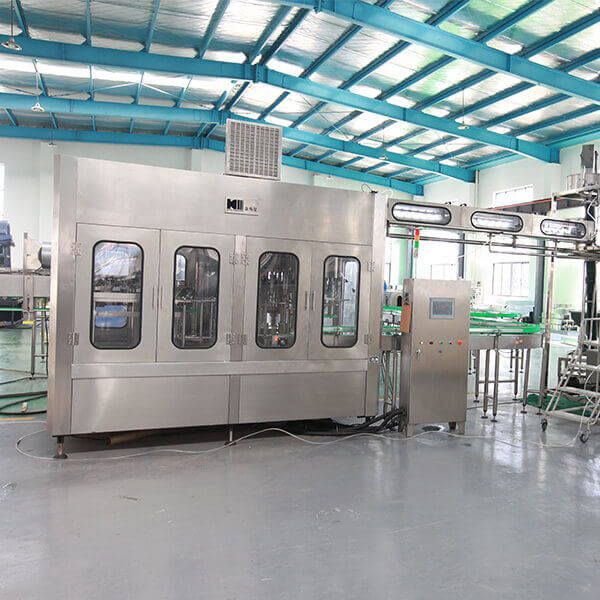
- Rinsing, filling, and capping on a single frame. This is the primary unit that determines the capacity of the entire line.
- Inspection
- Inspection of fill level and cap presence and seating, sometimes including X-ray or optical inspection. Rejects are removed before labeling to avoid wasting labels and packaging.
- Labeling
- Three technologies are used: roll-fed hot-melt labels, pressure-sensitive labels, and shrink sleeves. The choice is determined by package design and the consumables budget.
- Coding
- An inkjet or laser printer applies the date, shift, and code. Product categories subject to mandatory coding also require identification code printing, a verification camera, and aggregation.
- Secondary Packaging and Palletizing
- A shrink wrapper forms film-wrapped packs, a palletizer stacks the packs on a pallet, and a stretch wrapper secures the load.
How Capacity Relates to Line Configuration
The figures are approximate: the exact configuration depends on the product, container volume, and packaging requirements.
| Capacity | Filling Type | Containers | Typical Packaging |
|---|---|---|---|
| up to 1 500 bottles/hr | Semi-automatic, linear filling | Purchased finished containers | Manual case packing |
| 2 000-6 000 bottles/hr | Triblock, 12-24 valves | Semi-automatic blowing or finished containers | Shrink wrapping, manual palletizing |
| 6 000-12 000 bottles/hr | Triblock, 24-40 valves | In-line rotary blowing | Shrink wrapping, palletizer |
| from 12 000 bottles/hr | Triblock or combiblock | Rotary blowing, combiblock | Automatic packaging and palletizing |
How to Select a Line
This sequence of questions leads to an accurate specification.
- 1
Define the Product and Its Behavior
Still water, carbonated beverages, products with pulp, viscous oil, and aggressive chemicals require different filling valves and different product-contact materials. This is the first factor that determines the filling block type.
- 2
Define the Container Formats
Volumes, neck diameter, and closure type. Each additional format requires a change-parts kit and changeover time. Three formats instead of one may cost more than an increase in capacity.
- 3
Calculate the Actual Requirement
The calculation should be based not on peak capacity, but on annual volume, taking seasonality, equipment utilization, and shift patterns into account. A line operating at 30% utilization takes three times longer to pay back than projected.
- 4
Verify the Site
Line length, ceiling height for the blow molder and palletizer, electrical power, air, water, and drainage. Floor-space limitations can often be addressed with a combiblock instead of a “blow molder plus conveyor plus triblock” arrangement.
- 5
Identify the Bottleneck
Line capacity equals the capacity of its slowest unit. A labeler rated at 8 000 bottles per hour downstream of a triblock rated at 12 000 turns the entire system into an 8 000-bottle-per-hour line.
FAQ
Should bottles be blown in-house or purchased finished?
In-house blowing reduces container cost and eliminates the logistics of finished bottles, which are essentially transported air. It pays off with stable volume and a limited number of molds. Purchased containers are practical during startup, at low volumes, and when bottle designs change frequently.
How does a combiblock differ from a blow molder and triblock combination?
In a combiblock, blowing, filling, and capping are integrated into one unit without an air conveyor or intermediate buffer. It occupies less space, provides a shorter bottle path, and has fewer contamination points. The drawback is less flexibility: there is no buffer between blowing and filling, so stopping one section stops the entire block.
How many people are required to operate the line?
An automatic line rated at 6 000-12 000 bottles per hour is operated by a shift of 3-5 people: a filling block operator, packaging operator, mechanic, and support workers who supply consumables and handle shipping. A semi-automatic section requires more personnel for the same volumes.
Read next
Ready solutions
Equipment catalog
Project services
Related projects
Calculation on the topic
We will calculate your line
Describe the product, packaging formats and planned volume — we will prepare a line scheme, specification and preliminary budget estimate with payback.
- Line scheme and unit specification for your product
- Budget range and payback period
- Site requirements: power, water, personnel