

EDS-BL-L
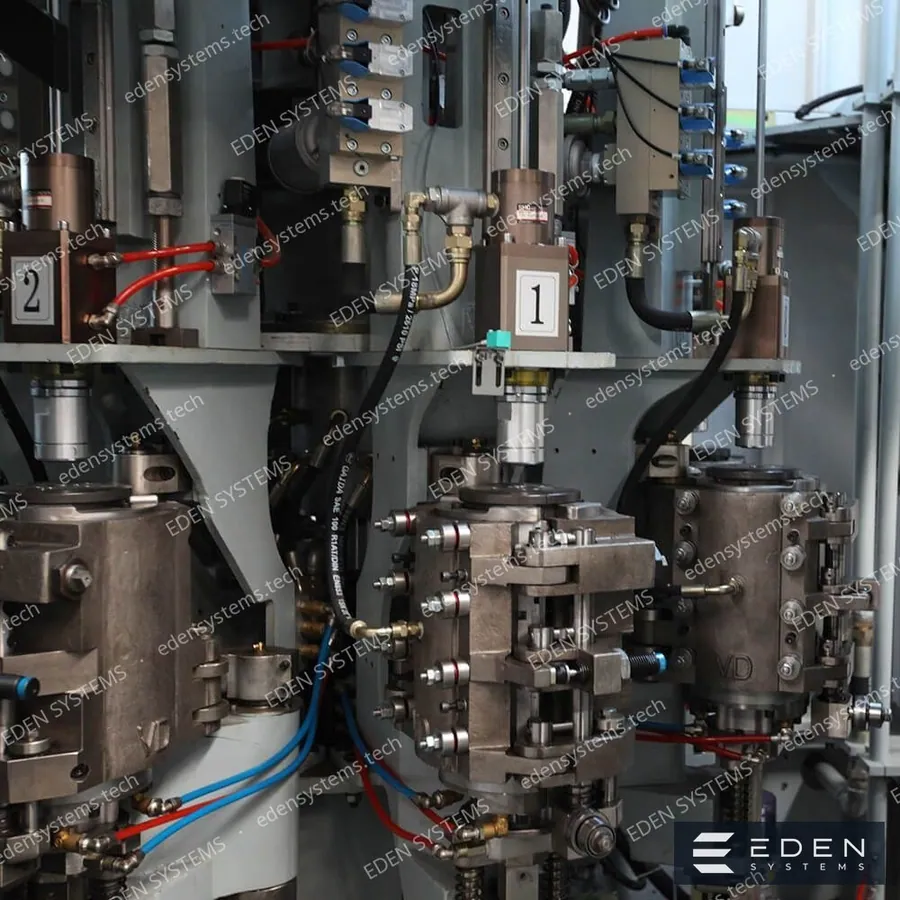
Linear blow moulder
2–6 cavities, best suited for medium volumes and frequent bottle-shape changes.
- Output
- 1,200–8,000 bph
- Container
- PET 0.2–2.0 L
- Cavities
- 2 / 4 / 6
- Blow pressure
- up to 40 bar
- Mould change
- 40–60 minutes
Preform → bottle, 1,200–40,000 bph
Making the bottle on site removes dependence on a container supplier and cuts logistics: you ship the preform, not air. Linear and rotary blow moulders with integrated preform feed and orientation.
Logistics savings
One truckload of preforms replaces 8–10 truckloads of finished bottles.
Infrared heating
A multi-zone oven with heat recovery: up to 40% energy savings per bottle.
Combiblock
Blowing, filling and capping in a single unit — no empty-container conveyor.
Preform → bottle, 1,200–40,000 bph
2–6 cavities, best suited for medium volumes and frequent bottle-shape changes.
6–24 cavities with continuous carousel rotation for industrial volumes.
The bottle goes straight from blowing to filling — a smaller plant footprint and lower contamination risk.
The cost depends on the number of cavities and bottle geometry. We quote it as a separate specification line and build the lead time into the project schedule.
Yes. We develop a 3D bottle model, check wall-thickness distribution and top-load strength, then manufacture the mould.
Describe the product, the target output and the container — we will come back with a preliminary specification, a budget range and a delivery schedule. If the task covers more than one machine, we will map out the whole line.
See how these machines work inside a complete line, and which engineering services cover the project.
Drinking water bottling lines
10 series: PET and glass, 2,000–36,000 bph
Carbonated soft drink filling
Isobaric filling, carbonation
Juice and pulp drink filling
Hot filling and aseptic
Beer and low-alcohol drink filling
Glass, can, keg
Wine and spirits filling
Inert atmosphere, glass
Dairy product filling
ESL and aseptic
Digital layer
SCADA, MES, OEE monitoring, batch traceability and integration with plant systems — engineered together with the line, not bolted on later.