

PET Containers and Blowing
PET Container Blowing: Technology, Equipment, and Bottle Cost
Blowing transforms a preform weighing only a few dozen grams into a finished bottle in seconds. We explain how the two-stage process works, how a semi-automatic machine differs from a rotary automatic machine, and at what volume in-house blowing begins to pay off.
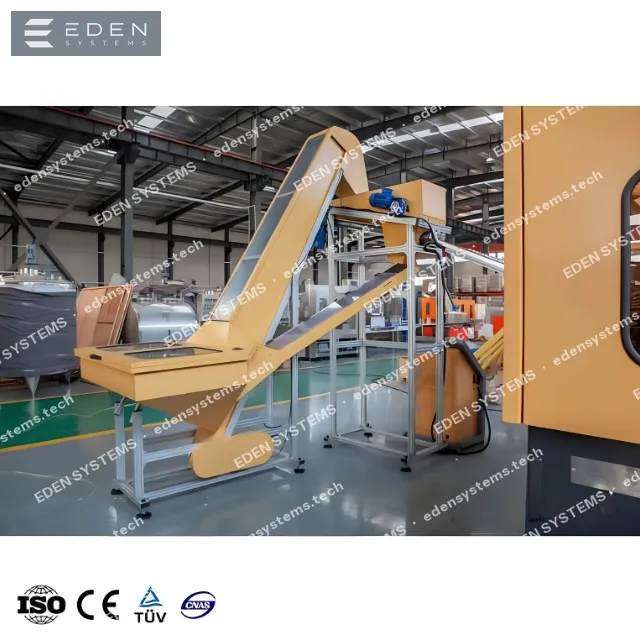
How It Works
The vast majority of production facilities use a two-stage process: the preform is injection-molded at a separate facility, cooled and stored, while blowing takes place later and at another location. This is convenient for logistics—preforms are compact, while a finished bottle is 90% air.
The process is called stretch blow molding. The preform passes through an infrared heating oven, where its walls are heated to approximately 100-120 °C—the highly elastic state in which the material stretches without melting. The preform then enters the mold, a stretch rod extends it along its axis, and compressed air presses the material against the mold walls.
Pressure is applied in two stages: pre-blow at approximately 8-12 bar and final blow at up to 25-40 bar. The biaxial orientation of molecules during stretching and blowing gives the bottle its strength—which is why a thin-walled PET bottle can withstand the internal pressure of a carbonated beverage.
Blowing Cycle
- 1
Preform Feeding and Orientation
A hopper, elevator, and orienter position the preforms neck-up and feed them onto holders.
- 2
Heating
An oven with IR lamps and zone control. The vertical heating profile determines material distribution in the wall of the finished bottle.
- 3
Temperature Equalization
A brief pause allows the temperature through the wall thickness to equalize. Skipping this stage produces an uneven wall.
- 4
Stretching and Pre-Blow
The rod stretches the preform axially, while low-pressure air gives it its initial shape.
- 5
Final Blow
High-pressure air presses the material against the cooled mold wall, forming the contours and base.
- 6
Cooling and Depressurization
The mold is cooled with recirculating water from the chiller, allowing the bottle to retain its geometry.
- 7
Ejection
The mold opens and the finished bottle is transferred to the air conveyor.
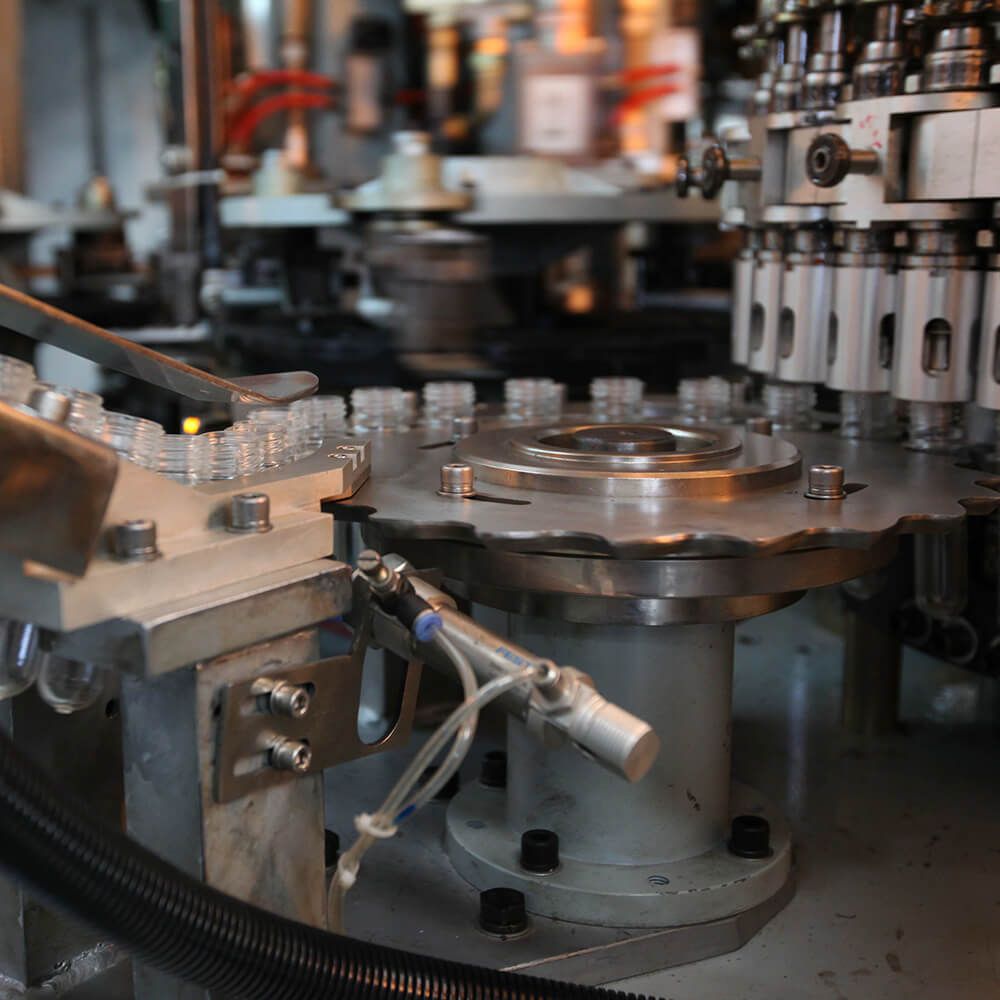
Semi-Automatic, Linear Automatic, and Rotary Automatic Machines
| Parameter | Semi-Automatic | Linear Automatic | Rotary Automatic |
|---|---|---|---|
| Capacity | 600-1 500 bottles/hr | 1 500-6 000 bottles/hr | 6 000-40 000+ bottles/hr |
| Preform Loading | Manual | Automatic | Automatic |
| Personnel | 1-2 dedicated operators | One operator for several machines | One operator per line |
| Mold Change | 15-30 minutes | 30-60 minutes | 40-90 minutes |
| Container Volume | 0.2-2 L, selected models up to 10 L | 0.2-2 L and 3-10 L | 0.2-3 L |
| Best Application | Startup, short runs, infrequent formats | Medium volumes, several formats | High-volume production, one or two standard formats |
Utilities and Equipment Required for Blowing
The machine itself accounts for only part of the cost. The auxiliary systems are mandatory and represent a significant investment.
- High-Pressure Compressor
- Up to 40 bar for blowing. This is a separate machine, often reciprocating, with a receiver and dryer. Air quality is critical: oil and moisture in the circuit damage the product and mold.
- Low-Pressure Compressor
- 7-10 bar for machine pneumatics, conveyors, and blow-off. Usually a rotary screw compressor.
- Chiller
- Recirculating cooling for the molds. Capacity is calculated from the heat load: insufficient cooling produces cloudy walls and unstable geometry.
- Air Dryer and Filters
- The dew point and air cleanliness class are determined by product requirements, especially when air comes into contact with food products.
- Molds
- A separate set is required for each bottle format. They are changed when changing SKUs.
When In-House Blowing Pays Off
The economics are straightforward: calculate the difference between the cost of a purchased finished bottle and the total of “preform cost plus energy plus depreciation plus maintenance.” Logistics savings are then added—a truck carrying finished bottles transports mostly air, while a truck carrying preforms transports material.
The payback threshold is affected by three factors: volume stability, number of formats, and distance from the finished-container supplier. The farther away the supplier is and the more standardized the product range, the faster in-house blowing pays off. Frequent bottle design changes work against it because every new bottle requires a new mold.
Another reason to choose in-house blowing is independence from seasonal container supply disruptions. In summer, bottle shortages can idle a filling line that is otherwise fully operational.
FAQ
Can bottles of different volumes be blown on the same machine?
Yes, provided a mold set is available for each volume and the preform neck diameter is the same. Changing the neck finish requires replacing not only the mold but also the conveying tooling, which takes significantly longer and costs more than a standard changeover.
What is the service life of a mold?
A high-quality aluminum-alloy mold with hardened forming components can withstand millions of cycles. In practice, service life is determined not by metal wear but by marketing: the bottle design is changed before the mold wears out.
How much air does the blow molder consume?
Consumption is calculated from bottle volume, blowing pressure, and capacity. For a line producing 6 000 0.5 L bottles per hour, the order of magnitude is several cubic meters of high-pressure compressed air per minute. The machine supplier provides the exact value, which is used to size the compressor with reserve capacity.
Read next
Ready solutions
Equipment catalog
Project services
Related projects
Calculation on the topic
We will calculate your line
Describe the product, packaging formats and planned volume — we will prepare a line scheme, specification and preliminary budget estimate with payback.
- Line scheme and unit specification for your product
- Budget range and payback period
- Site requirements: power, water, personnel