

Beer Bottling Line (Glass)
A beer line is engineered around oxygen: every station from bright beer tank to capping is tuned for minimal TPO — total package oxygen.
- Product
- Beer, cider, low-alcohol beverages
- Container
- Glass, 0.33–0.75 L, returnable or new
- Output
- 2,000–24,000 bph
- Filling
- Isobaric, with evacuation and CO₂ purge
- TPO
- Below 100 ppb with correct setup
- Capping
- Crown cap, 4–12 heads
- Pasteurization
- Tunnel type, 15–25 PU
- Fill temperature
- 0–4 °C
Line parameters
About the solution
Beer is highly oxygen-sensitive: even fractions of a milligram per liter shorten shelf stability and change flavor. The bottle is therefore evacuated and purged with CO₂ before filling, filling runs under counter-pressure, and a jet of deaerated water is injected into the neck before capping to foam up and expel air.
Bottles can be returnable or new glass. For returnables, a caustic bottle washer and an empty-bottle inspector with cameras are installed. Pasteurization is performed by a tunnel pasteurizer, calculated in PU for the specific beer style.
Built into the design
Double evacuation
Two vacuum cycles with an intermediate CO₂ purge minimize residual oxygen in the bottle.
Foaming jet
A jet of deaerated water before capping drives air out of the neck — a key technique for beer stability.
PU control
Tunnel pasteurizer with pasteurization-unit calculation per beer style and profile logging.
Returnable bottle handling
Caustic bottle washer and empty-bottle inspector rejecting on label residue and chips.
Line composition along the product flow
9 positions along the product flow. Every unit opens in the catalog: series, specifications, scope of supply and a quote request.
- 1
1. Depalletizing and case unpacking
Pallet breakdown, removal of bottles from crates for returnable glass.
Beer and low-alcohol drink filling →
- 2
2. Bottle washer
Caustic wash, label removal, rinsing and draining.
Beer and low-alcohol drink filling →
- 3
3. Empty-bottle inspector
Cameras inspecting the base, walls and neck, rejecting defective bottles.
Marking and quality inspection →
- 4
4. Bright beer tank and product prep
Storage of clarified beer under CO₂ pressure and delivery to filling without air ingress.
Beer and low-alcohol drink filling →
- 5
5. Isobaric filler
Evacuation, CO₂ purge, counter-pressure filling, slow pressure release.
Beer and low-alcohol drink filling →
- 6
6. Crown capping
Foaming jet and crown-cap seating with force control.
Capping equipment →
- 7
7. Tunnel pasteurizer
Stepped heating and cooling with PU calculation per style.
Beer and low-alcohol drink filling →
- 8
8. Labeling and date coding
Body label, back label, neck band, date and batch code.
Labelling equipment →
- 9
9. Packing and palletizing
Crate or case packing, palletizer and stretch-wrap.
Packing and palletising →
Line model selection
Selecting the isobaric filling block
Output is given for a 200–2,000 mL glass bottle, counter-pressure CO2 filling.
| Model | Filling valves | Output range | Valve type |
|---|---|---|---|
| EDS-BW12-12-4 | 12 | 1,000–2,500 btl/h | Mechanical spool valve with double evacuation |
| EDS-BW24-24-6 | 24 | 3,000–6,000 btl/h | Pneumatic-electric spool valve |
| EDS-BW40-40-10 | 40 | 6,000–10,000 btl/h | Pneumatic-electric spool valve |
| EDS-BW60-60-15 | 60 | 10,000–15,000 btl/h | Pneumatic-electric spool valve |
| EDS-BW80-80-20 | 80 | 15,000–25,000 btl/h | Pneumatic-electric spool valve |
Filling sequence: rinse — CO2 into bottle — vacuum — CO2 — vacuum — fill — cap. No bottle — no pre-evacuation and no fill.
Container, capping, and packing
| Parameter | Value |
|---|---|
| Container material and shape | Glass bottle, round, Ø50–85 mm, height 105–300 mm |
| Fill volume | 200–2,000 mL |
| Cap type | Crown cap or aluminum screw cap |
| Label | Cold-glue roll-fed, PVC sleeve, full or half wrap |
| Group packing | 1×2 / 2×3 / 3×4 / 3×5 / 4×6, manual or automatic |
| Palletizing | Manual, gantry palletizer, robotic palletizer |
Operating conditions: temperature 10–40 °C, no condensation. Power supply 380 V ±5%, 3-phase, 50 Hz ±1%.
Line process flow
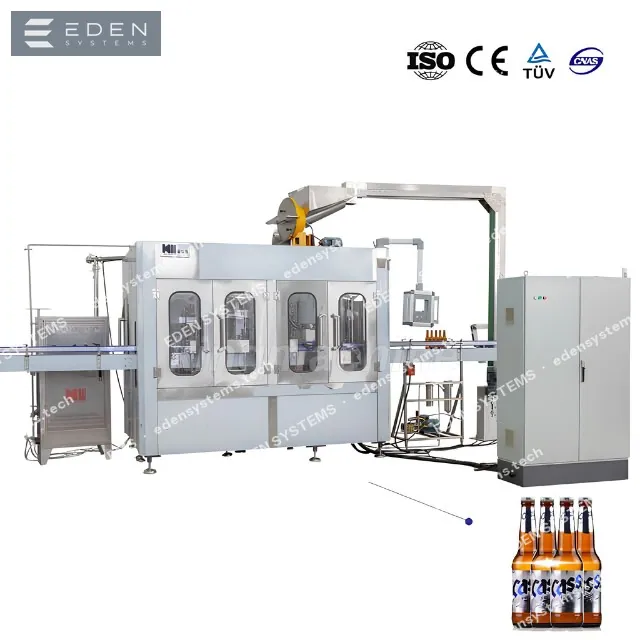
The glass beer filling line is built around an isobaric filling block: the bottle undergoes double pre-evacuation under CO2, reducing foaming and gas loss, and after capping the product may pass through tunnel pasteurization.
Key line features
- Isobaric filling under CO2 or nitrogen counter-pressure: no bottle — no pre-evacuation and no fill
- Double air pre-evacuation reduces oxidation and carbon dioxide loss
- Electromagnetic capping heads for crown caps or screw caps
- Modular pasteurization tunnel with Siemens control, stepped heating and cooling
- Output 400–25,000 btl/h, container 200–2,000 mL
- Fast changeover to another bottle by swapping starwheels and guide rails
- Product-contact parts in stainless steel; conveyors adapt to container geometry
Full cycle with tunnel pasteurization after filling — for products with extended shelf life.
- 1Glass bottle depalletizing
- 2Bottle rinser (water + sterile air)
- 3Isobaric filling block under CO2
- 4Crown cap capping machine
- 5Fill level and capping inspection
- 6Pasteurization tunnel
- 7Cold glue labeling machine
- 8Date coding / batch marking
- 9Shrink film packing and palletizing
Key line stations
What sits behind the nameplate output: contact-part execution, operating logic and service points for every station.
Rinsing heads
Container preparation
- AISI 304/316 stainless nozzles and manifold with fan-jet spray: lower water consumption and more even rinsing over the entire inner surface.
- Neck-grip gripper with a polymer insert holds the bottle by the finish, minimizing the risk of preform crushing or scratching.
- Rinsing pump and piping in sanitary design, the circuit disassembles without tools.
- Rinse-water recirculation with filtration — up to 30% savings compared to drain discharge.
Core machines of the line
Equipment of the “Beer Bottling Line (Glass)” layout: each tile opens the catalog with series, specifications and a quote request for that machine.
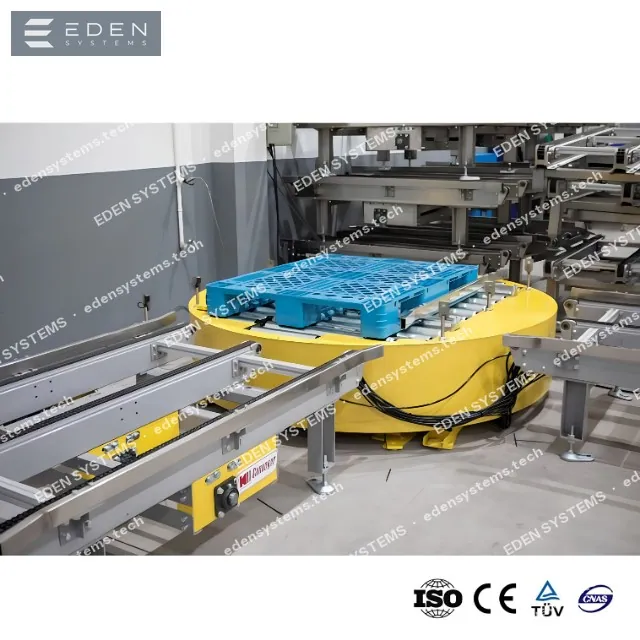
Glass bottle depalletizer
Removes bottle layers from the pallet and feeds the conveyor without impact loads on the neck.
Bottle rinser
Dual-circuit rinsing with water and sterile air; flare-spray nozzles cut water consumption by a third.
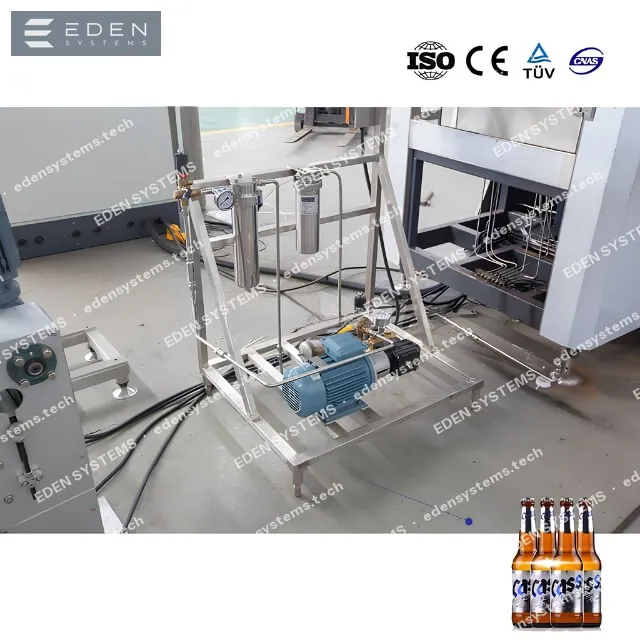
Isobaric filling block
Counter-pressure filling with CO2 or nitrogen using rinse — CO2 into bottle — vacuum — CO2 — fill — cap sequence, minimizing foam and CO2 loss.
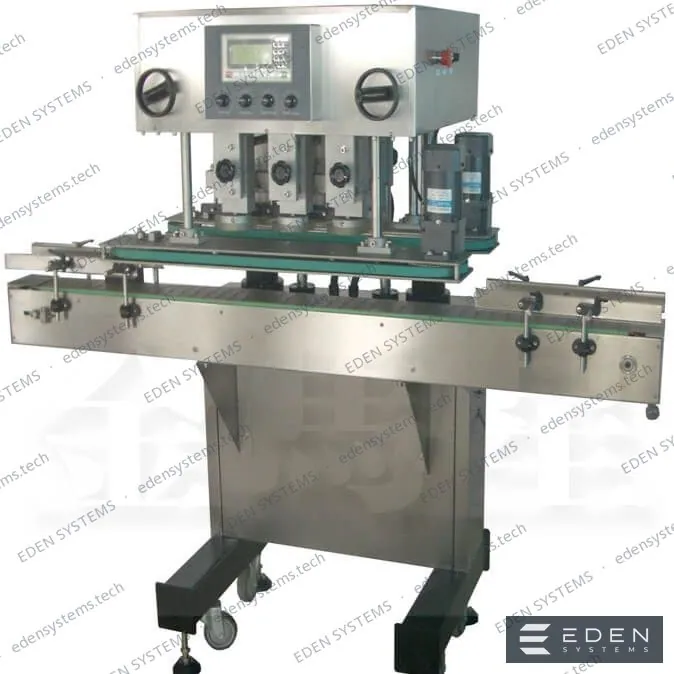
Crown cap capping machine
Electromagnetic heads with torque clutch; a missing bottle blocks cap feed and the capping cycle.
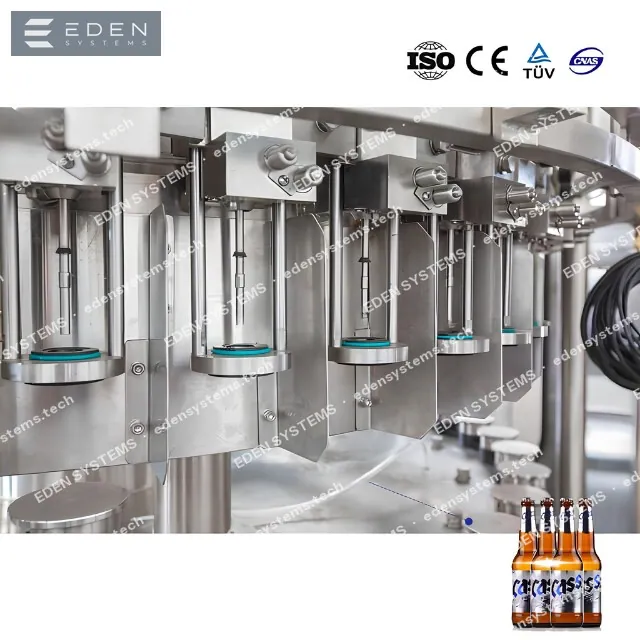
Pasteurization tunnel
Modular single-deck tunnel with precise Siemens control, stepped heating and cooling by zone.
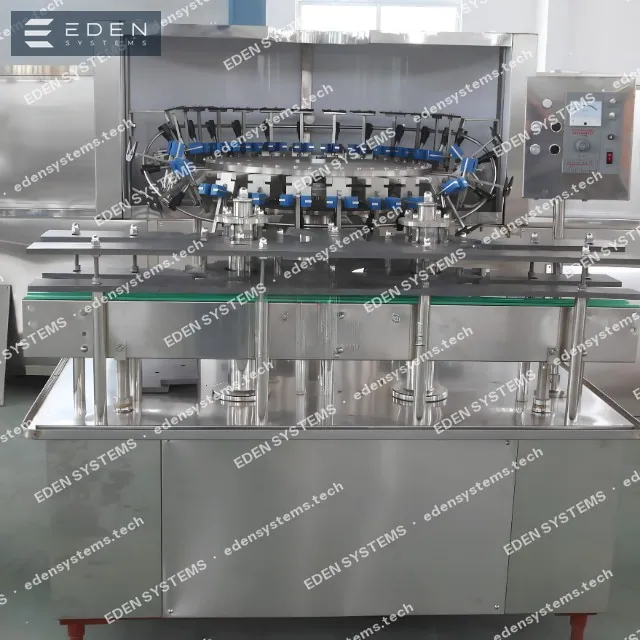
Fill level and capping inspector
Backlight inspection of fill level and crown cap seating, automatic rejection of bottles on the conveyor.
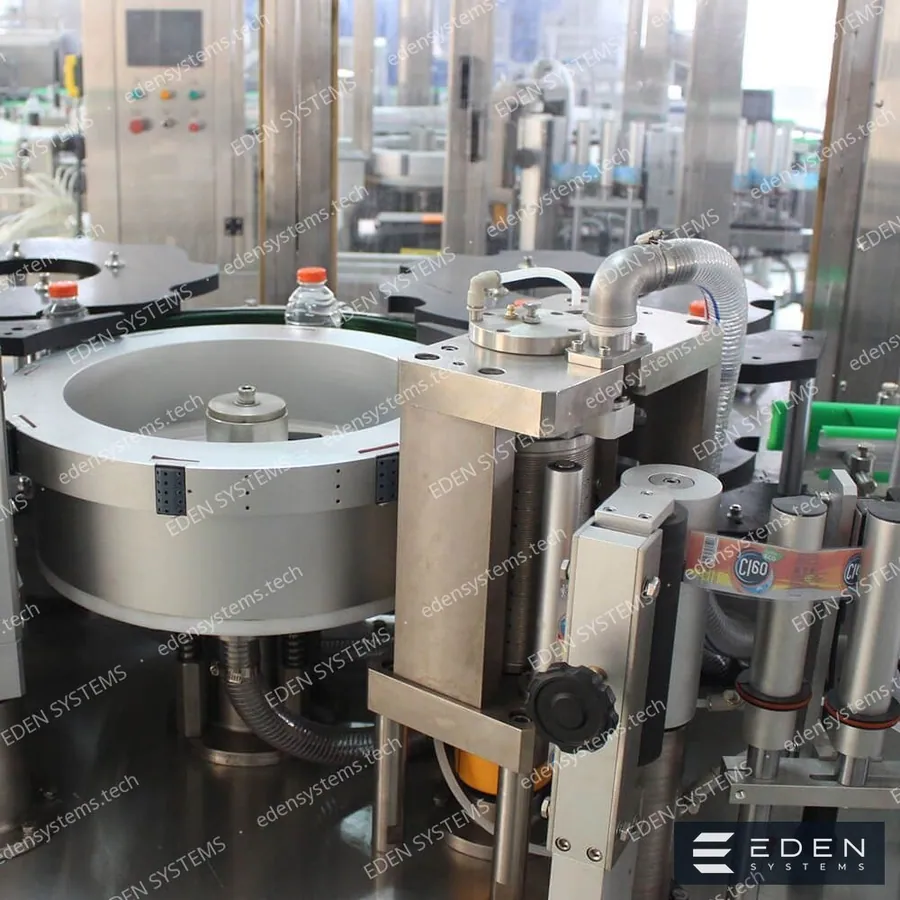
Cold glue labeling machine
Applies neck, back, and front labels on cylindrical bottles, full or partial foil on request.
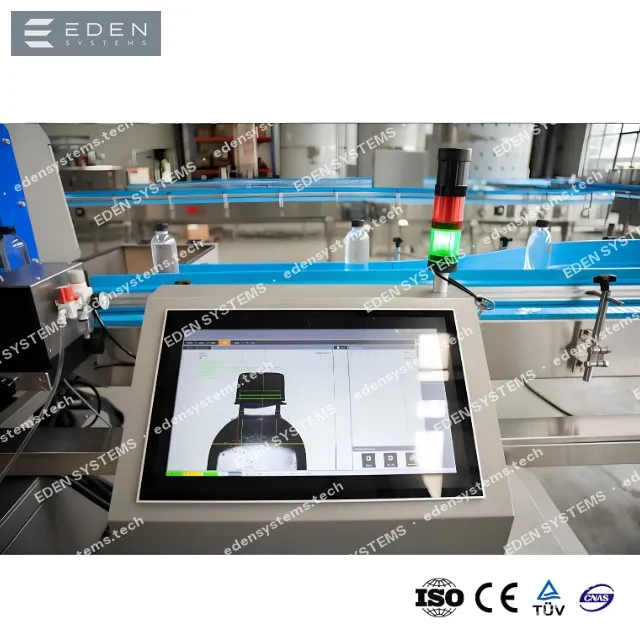
Date coder and batch marking
Continuous inkjet printing of fill date and batch on the bottle and case with code readability verification.
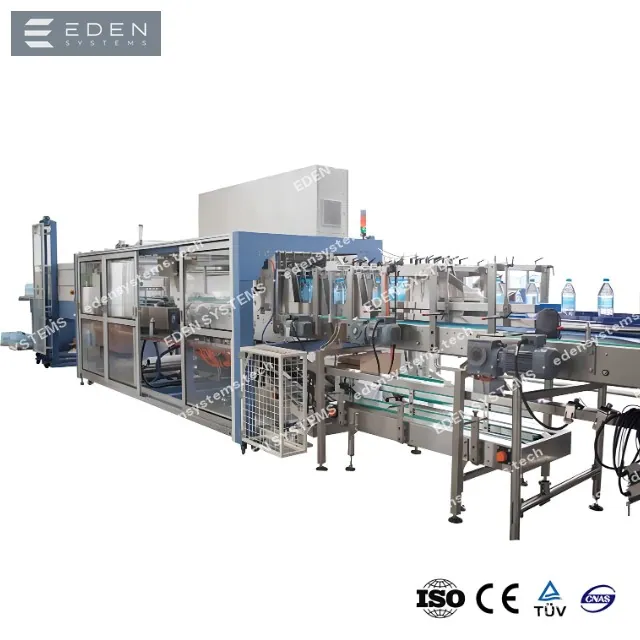
Shrink film packer
Group packing of 1×2, 2×3, 3×4, 3×5, or 4×6 bottles in PE film with a shrink tunnel.
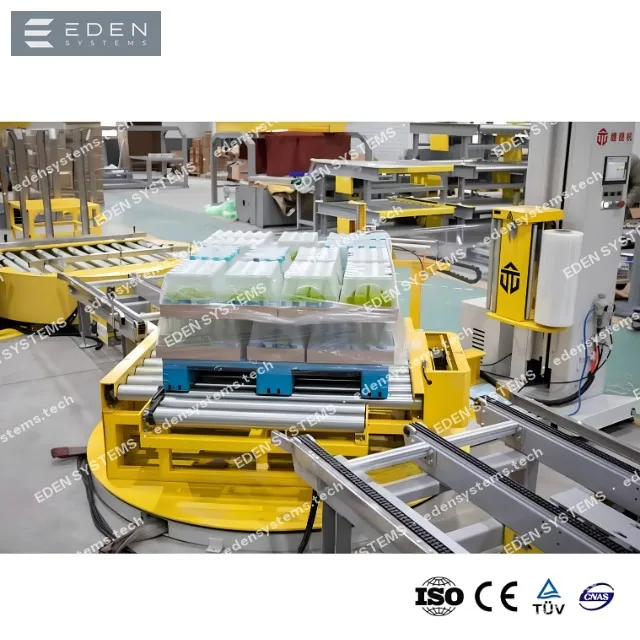
Palletizer and stretch wrapper
Layer-by-layer pallet formation and stretch film wrapping with pre-stretch before warehouse dispatch.
Which closure do you use
The cap type defines the capping block: heads, feeding and orientation of the closure, torque or press-on force. State your option in the request and we will select the head and sorter for it.
26 mm, 21 teeth
Crown cork
Beer, soda, cider. Crimping over the finish with force control — seal integrity up to 4 bar in-bottle pressure.
Capping unit: Crown head with magnetic chuck
26 mm twist
Twist-off crown cork
Differs in crimp profile: the bottle opens by hand without an opener, requiring tighter finish geometry tolerances.
Capping unit: Crown head (lower force)
28×18, 30×60 (ROPP)
Aluminum screw cap
The thread is rolled directly onto the bottle neck, the skirt is crimped over the finish — tamper-evidence without an extra seal.
Capping unit: ROPP thread-rolling head
PVC, PET, polylam
Heat-shrink/polylaminate capsule
Decorative finishing over the closure: capsule placement, crimping over the finish, hot-air shrinking.
Capping unit: Capsule dispenser + heat tunnel or roller crimping
Auxiliary systems of the line
The engineering utilities without which a line never reaches its rated output: water and product preparation, sanitation, container handling.
Returnable bottle washer
The key station for a returnable-glass line.
- Bottle washer with soak, caustic and triple-rinse zones
- Label removal with screw discharge of paper pulp, solution filtration
- Automatic caustic concentration and zone-temperature control
- Empty-bottle inspector: finish chips, residual liquid, foreign objects
Bright beer tanks and CO₂ loop
Beer delivery to isobaric filling.
- Jacketed bright-beer tanks, delivery temperature 0–2 °C
- Dissolved CO₂ and oxygen monitoring in the product before filling
- Bottle counter-pressure and evacuation before filling — low oxygen pickup
- Deaerated-water snift injection before capping to purge air
Tunnel pasteurizer
Product stability in the bottle.
- Heating, holding and cooling zones with PU-unit control
- No more than 20 °C between zones — protects glass from thermal breakage
- Zone-by-zone water recirculation with biocide dosing
- Process parameters logged per batch
CIP station (clean-in-place)
Wash of bright tanks, lines and the filler carousel.
- Alkali, acid and hot-water tanks holding temperature within ±2 °C
- Recipe-driven wash programs: phase time, concentration and flow are logged
- Flow meter on the supply line — actual flow is verified, not assumed from the nameplate
- Filtered detergent return to the tanks; discharge only once the solution is spent
Coding and inspection
Date, batch and fill-level control on dark glass.
- Inkjet or laser coder: date, shift, batch number, traceability code
- Fill-level, cap presence and seating inspection with automatic reject to a pocket
- Good/reject product counters logged per shift hour
- Ready for mandatory marking: case and pallet aggregation at the line outfeed
Packing and palletizing
Crate or case packing, palletizing and wrapping.
- Shrink film pack or corrugated case, format tailored to the retailer's requirements
- Layer palletizer to a defined pattern, robotic version for constrained floor space
- Pallet wrapper with pre-stretch film: lower film consumption, pallet withstands transport
- SSCC pallet label printing and application, data handoff to the ERP system
Plant utilities
Chilled water, CO₂ and steam for the brewing area.
- Steam circuit or electric heating sized against peak thermal load
- Chilled water: chiller and glycol loop with a buffer tank
- Process-water piping, floor drains with traps and slope, condensate removal
- Line power panel sized per station load with a reserve for expansion
FAQ
Why is TPO so important?
Oxygen triggers oxidation and cardboard off-flavors. Above 150 ppb TPO, beer stability drops sharply and flavor changes within the first weeks of storage.
Does craft beer need pasteurization?
Not always. Many breweries choose cold filling with filtration and a short shelf life. For regional distribution, pasteurization is nearly mandatory.
How much does the Beer Bottling Line (Glass) cost?
Price on request: the budget depends on output, container type, line composition and the level of automation. After a short brief we send a preliminary estimate within 1–2 working days and a full quotation broken down by machine within 3–5 days.
What are the delivery and commissioning lead times?
Standard machines ship 8–12 weeks after the specification is confirmed, complete lines 12–20 weeks. Transport takes 2–6 weeks depending on the route; installation and commissioning on site take 2–4 weeks, with operator training included.
What output does this line reach?
The working range is 2,000–24,000 bph. Exact output is confirmed against your container, product and shift plan: we calculate the line balance and keep a margin on the bottleneck machine.
Request a quote: Beer Bottling Line (Glass)
Tell us the product, the container and the target output — we will return the line composition, a layout, a budget range and a delivery schedule.
Related solutions
Lines with a similar equipment set — useful when you plan several products on one site.
2,000–36,000 bph
Drinking Water Filling Line, 0.33–1 L
Rinser-filler-capper monobloc for PET, water treatment, labelling and shrink packing.
Open solution1,500–12,000 bph
Juice Filling Line, Glass
Glass rinsing, hot filling, twist-off capping and tunnel pasteurisation.
Open solution1,000–8,000 bph
Wine Bottling Line (Glass)
Level filling under inert gas, corking or screw capping, capsule application.
Open solutionServices for this line
Engineering, logistics, installation and service that turn this line into a working production site.
Digital layer
Any line can be supplied with a digital layer
SCADA, MES, OEE monitoring, batch traceability and integration with plant systems — engineered together with the line, not bolted on later.