

Hot-Fill Juice Line, PET
Hot fill for juices, iced tea and fruit drinks: the product is filled hot and sterilises the bottle and cap itself, with no preservatives and no aseptic chamber.
- Product
- Juices, nectars, iced tea, fruit drinks, isotonics, dairy and coffee drinks
- Container
- Heat-resistant PET 0.25–2.5 L
- Output
- 1,000–24,000 bph
- Filling valves
- 12–80 (RCGF, rinser-filler-capper monobloc)
- Filling temperature
- 85–92 °C
- Dosing accuracy
- ±1% by volume
- Pasteurisation
- Tubular or plate (UHT), hold 15–30 s
- Inverter
- Cap sterilisation, 15–30 s
- Cooling
- Stepped cooling tunnel down to 35–40 °C
- Materials
- AISI 316L in product contact, AISI 304 frame
- Control
- PLC and touchscreen, Siemens / Mitsubishi / Omron / Schneider components
- Changeover
- Format change with changeover parts in 30–60 minutes
Line parameters
About the solution
Product is heated in a tubular pasteuriser to 92–95 °C, held, and delivered to the filler at 85–90 °C. The hot liquid sterilises the inside of the bottle; after capping, the container is inverted for 15–30 seconds to treat the inside of the cap.
The container is a heat-resistant PET bottle with vacuum-compensation panels: the product contracts as it cools, and a bottle without panels deforms. We agree the preform and bottle geometry with the container supplier before mould ordering.
Built into the design
No preservatives
Heat treatment and hot filling give a shelf life of 9–12 months without chemical preservatives.
Heat-resistant product path
Filler, conveyors and capping heads are rated for continuous operation at 90 °C.
Stepped cooling
Three to four temperature zones in the tunnel: the bottle avoids thermal shock and keeps its shape.
Product return loop
Continuous recirculation of hot product through the filler keeps temperature stable even during line stops.
Line composition along the product flow
8 positions along the product flow. Every unit opens in the catalog: series, specifications, scope of supply and a quote request.
- 1
1. Product preparation
Concentrate reconstitution, blending, deaeration and homogenisation.
Water treatment →
- 2
2. Pasteurisation
Heating to 92–95 °C with holding time and heat recovery.
Juice and pulp drink filling →
- 3
3. Heat-resistant bottle blow moulding
Blow moulding with a hot mould and vacuum-compensation panels.
PET stretch blow moulding equipment →
- 4
4. Hot-fill monobloc
Rinsing, filling at 85–92 °C and capping on a shared frame.
Juice and pulp drink filling →
- 5
5. Bottle inverter
Bottle tilted for 15–30 seconds to sterilise the inside of the cap.
Juice and pulp drink filling →
- 6
6. Cooling tunnel
Stepped shower cooling to 35–40 °C and body drying.
Juice and pulp drink filling →
- 7
7. Labelling and date coding
Roll-fed or PVC sleeve labelling, date and batch coding.
Labelling equipment →
- 8
8. Packing and palletising
Shrink packing, palletiser and stretch-wrap.
Packing and palletising →
Line model selection
Selecting a hot-fill tri-block for juice
Output is given for a 500 mL container, container range 0.25–2.5 L. Fill accuracy within ±1%.
| Model | Rinsers / valves / capping heads | Output (500 mL) | Installed power |
|---|---|---|---|
| EDS-HOT3-24-24-8 | 24 / 24 / 8 | 6,000-8,000 btl/h | 120 kW |
| EDS-HOT3-32-32-10 | 32 / 32 / 10 | 10,000-12,000 btl/h | 160 kW |
| EDS-HOT3-40-40-12 | 40 / 40 / 12 | 14,000-18,000 btl/h | 200 kW |
| EDS-HOT3-50-50-15 | 50 / 50 / 15 | 20,000-24,000 btl/h | 260 kW |
Power is given for the hot-fill block excluding water treatment and the blending room. Line output range — 1,000-24,000 btl/h.
Blending and cooking block
Preparation of juice from concentrate, puree, or direct press before hot filling.
| Unit | Purpose | Material |
|---|---|---|
| Mixing vessel with high-shear emulsifier | Dissolving concentrate and sugar, homogenization | AISI 304 |
| Plate heat exchanger + UHT sterilizer | Heating the product to fill temperature and deaeration | AISI 316 |
| Jacketed buffer tank | Maintaining temperature before feeding to the tri-block | AISI 304 |
| CIP station | Programmed circulation cleaning with alkali and acid | AISI 304 |
The blending block composition is selected based on the raw material type: concentrate, pulp-containing puree, or direct press.
Packing and date coding
| Packaging type | Pack patterns | Marking |
|---|---|---|
| Shrink PE film | 2×3 / 3×4 / 4×6 | Inkjet printing of date and batch |
| Cardboard case | 6 / 12 / 24 bottles | Thermal transfer printing on the case |
Power supply 380 V ±5%, 3-phase, 50 Hz; control circuits 24 V. Steam and chilled water are supplied via separate circuits.
Line process flow
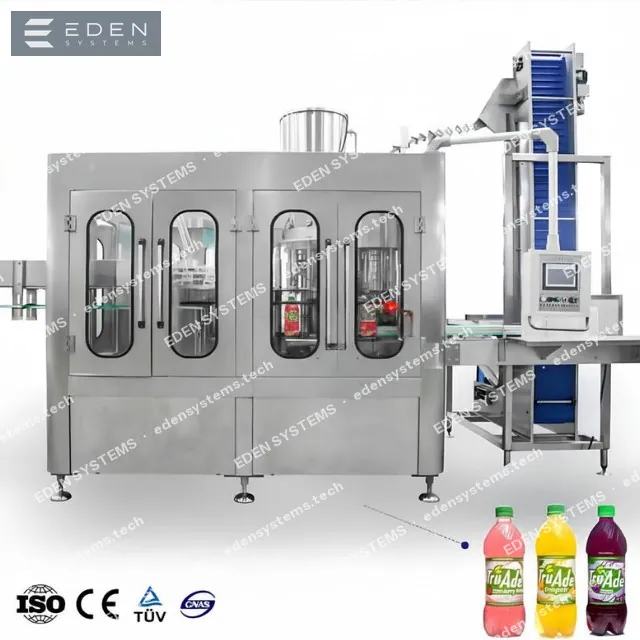
The PET juice filling line is built around a 3-in-1 hot-fill tri-block: rinsing, filling at 85–92 °C, and capping are performed on one frame, with product preparation, container blow molding, and bottle cooling added before and after it.
Key features of hot juice filling
- 3-in-1 rinse-fill-cap technology on a single rotor, with no intermediate bottle transfer
- Volumetric filling with fine dose adjustment, the same level in every bottle
- Contact parts and tank in AISI 304/316, polished with no dead zones, easy to clean
- Magnetic capping heads: no bottle — no cap, automatic stop when containers run short
- Inverting the bottle with the product's own heat sterilizes the inner surface of the cap
- Key electrical components by Mitsubishi, OMRON, Siemens; fill accuracy ±1%
- Container range 0.25-2.5 L, format changeover by swapping a small number of parts
- Output 1,000-24,000 btl/h for a 500 mL container
Base layout for reconstituted juice: concentrate is diluted with water and sugar syrup before sterilization.
- 1Water treatment station
- 2Dissolving concentrate and sugar in the mixing vessel
- 3Plate heat exchanger and UHT sterilization
- 4Heat-resistant PET blow-molding machine
- 5Air conveyor for containers
- 63-in-1 hot-fill tri-block (rinse-fill-cap)
- 7Bottle inverter (cap sterilization)
- 8Shower cooling tunnel
- 9Fill level and cap inspection
- 10Labeling, date coding, packing
Key line stations
What sits behind the nameplate output: contact-part execution, operating logic and service points for every station.
Blending and UHT block
Product preparation
- High-shear blending unit: sugar, concentrate and stabilizer disperse without clumping.
- Tubular or plate heat exchanger, holding and cooling on a set curve.
- Homogenizer up to 200 bar — a stable emulsion with no separation in the bottle.
- Jacketed buffer tank maintains the filling-supply temperature.
Core machines of the line
Equipment of the “Hot-Fill Juice Line, PET” layout: each tile opens the catalog with series, specifications and a quote request for that machine.
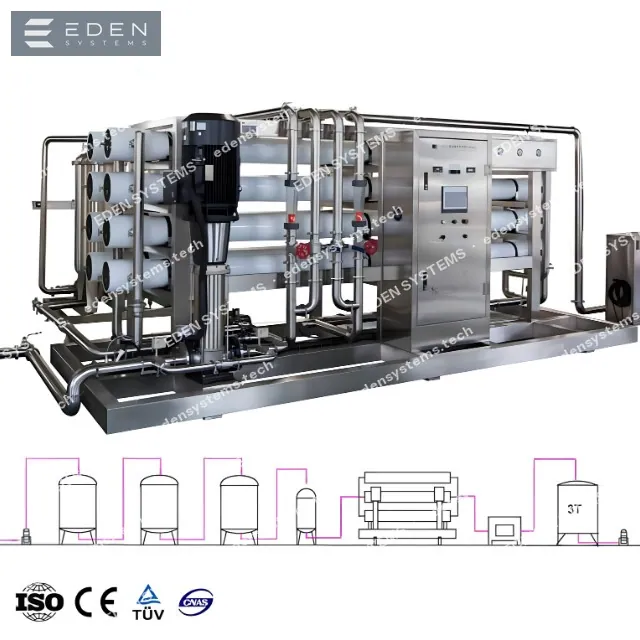
Water treatment station
Filtration, softening, reverse osmosis, and UV disinfection of water for the blending room and container rinsing.
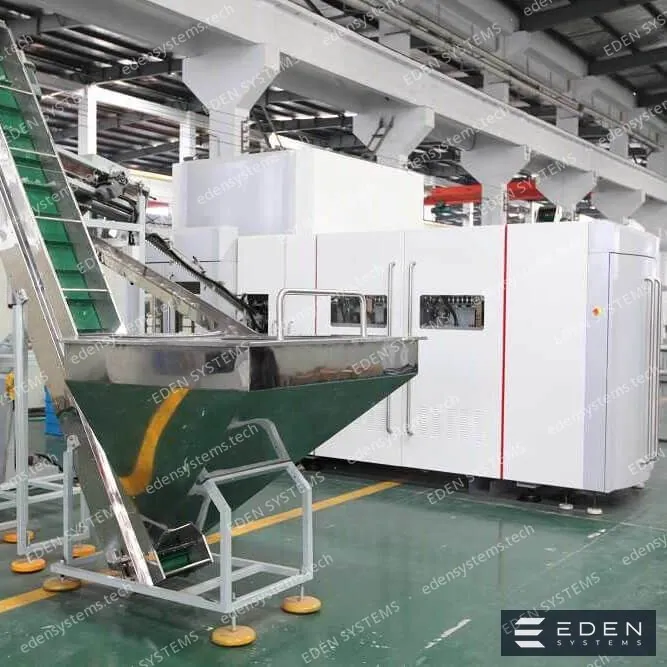
Heat-resistant PET blow-molding machine
Blow-molds the bottle from a heat-resistant preform for hot filling at 85–92 °C; reinforced base and shoulders withstand vacuum shrinkage without deforming.
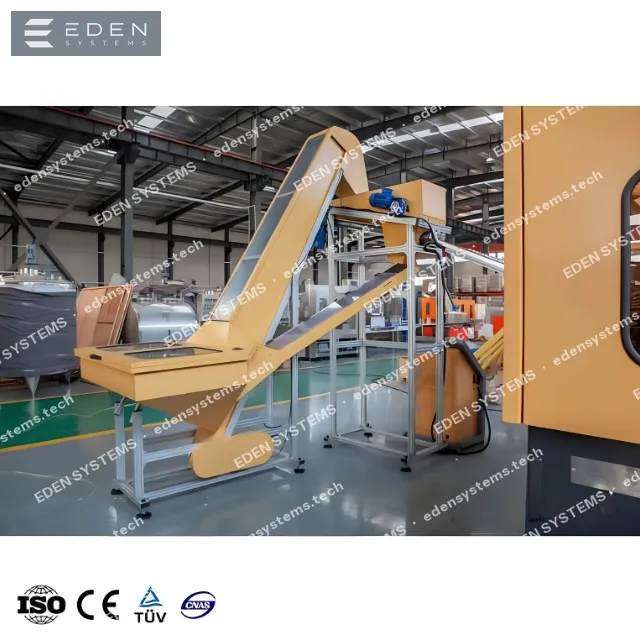
Air conveyor for containers
The bottle travels by its neck flange on a stream of filtered air from the blow molder to the tri-block without body contact with surfaces.
3-in-1 hot-fill tri-block
Rinsing, volumetric juice filling at 85–92 °C, and capping on one frame; contact parts and tank in AISI 304/316 with no dead zones.
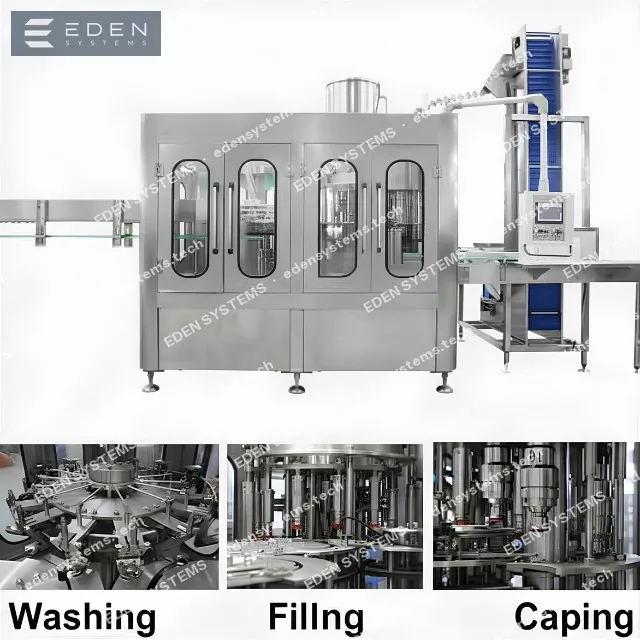
Bottle inverter (cap sterilization)
A brief inversion of the filled bottle uses the product's own heat to sterilize the inner surface of the cap and improve seal integrity.
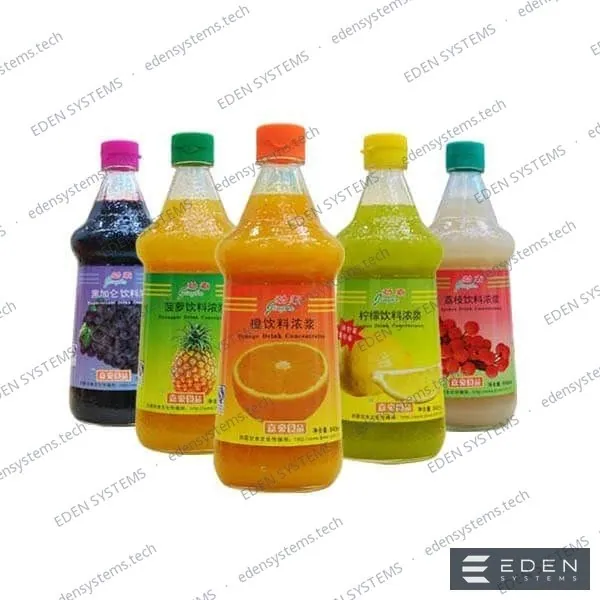
Shower cooling tunnel
Stepped cooling of the bottle after hot filling with water nozzles providing uniform coverage, with a hinged top for maintenance.
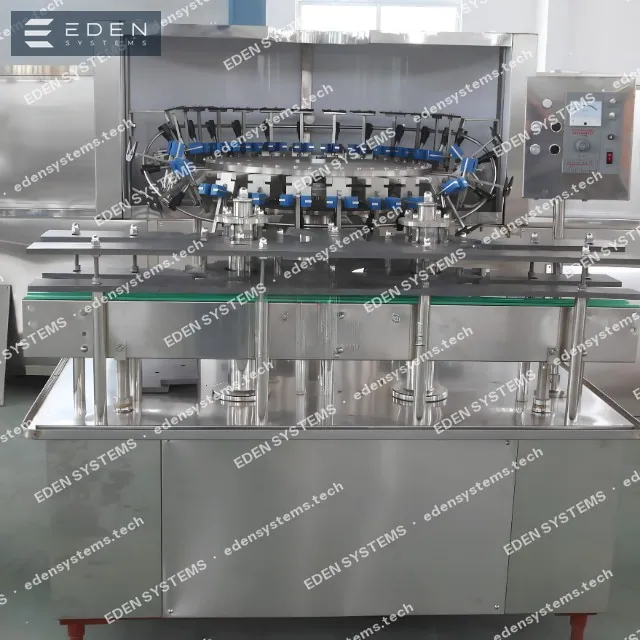
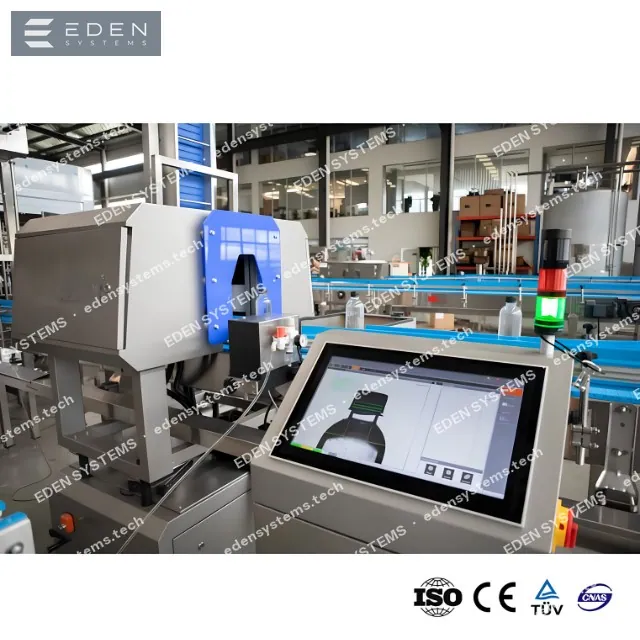
Fill level and cap inspector
Backlight inspection of fill level and cap seating, with rejection on the conveyor before labeling.
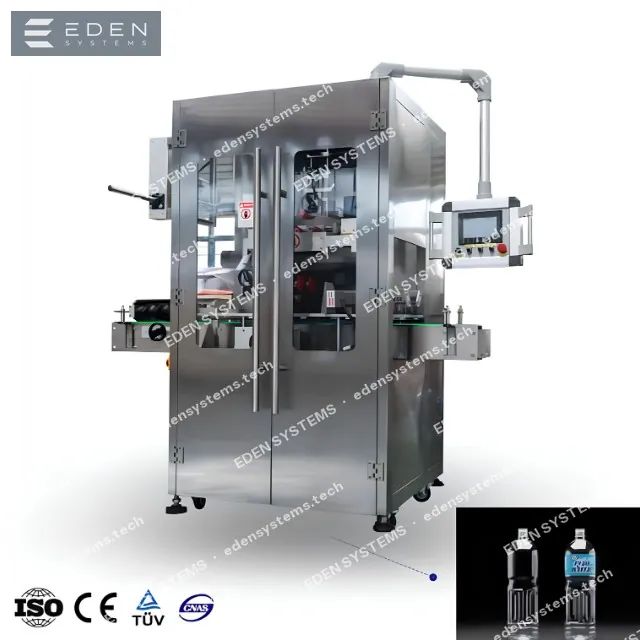
Labeling machine
Roll-fed hot-glue, PVC shrink sleeve, or self-adhesive label depending on package design.
Date coder and batch marking
Inkjet printing of the fill date, shift, and batch number on the bottle and case with code readability checking.
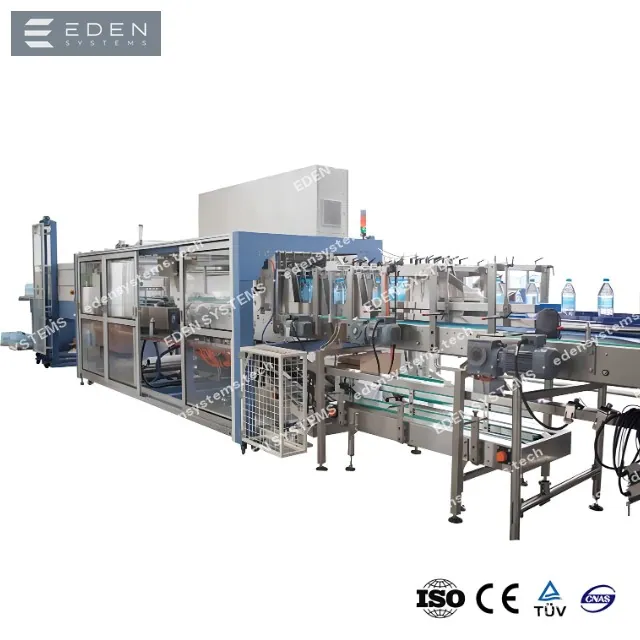
Packing and palletizing
Group shrink-wrap packing or case loading, followed by pallet formation and wrapping.
Which closure do you use
The cap type defines the capping block: heads, feeding and orientation of the closure, torque or press-on force. State your option in the request and we will select the head and sorter for it.
PCO 1881 / 28 mm / 38 mm
Plastic screw cap
The tamper-evident band tears on opening. Torque is set on the HMI and monitored on every chuck.
Capping unit: Magnetic screwing head
PCO 1810 / 28 mm
Sport push-pull cap
Drinking water and isotonic drinks. The spout is fed oriented, torque 1.2–2.0 N·m, logged in the report.
Capping unit: Magnetic screwing head
foil 0.2–0.9 mm
Induction liner under the cap
The liner is welded to the finish after capping — tamper protection and seal integrity during transport.
Capping unit: In-line induction sealer
FAQ
Hot fill or aseptic filling?
Hot filling is cheaper to invest in and simpler to operate, but requires heat-resistant containers and gives a more pronounced "cooked" taste. Aseptic filling preserves flavour and allows standard PET containers, but is more expensive and more demanding on personnel.
Does the bottle need to be special?
Yes, a heat-resistant PET bottle with vacuum-compensation panels and a crystallised neck finish is required. A standard bottle deforms as the product cools.
How much does the Hot-Fill Juice Line, PET cost?
Price on request: the budget depends on output, container type, line composition and the level of automation. After a short brief we send a preliminary estimate within 1–2 working days and a full quotation broken down by machine within 3–5 days.
What are the delivery and commissioning lead times?
Standard machines ship 8–12 weeks after the specification is confirmed, complete lines 12–20 weeks. Transport takes 2–6 weeks depending on the route; installation and commissioning on site take 2–4 weeks, with operator training included.
What output does this line reach?
The working range is 2,000–18,000 bph. Exact output is confirmed against your container, product and shift plan: we calculate the line balance and keep a margin on the bottleneck machine.
Request a quote: Hot-Fill Juice Line, PET
Tell us the product, the container and the target output — we will return the line composition, a layout, a budget range and a delivery schedule.
Related solutions
Lines with a similar equipment set — useful when you plan several products on one site.
2,000–36,000 bph
Drinking Water Filling Line, 0.33–1 L
Rinser-filler-capper monobloc for PET, water treatment, labelling and shrink packing.
Open solution600–3,600 bph
Water Filling Line, 3–10 L
Filling of large-format handled PET containers, capping and shrink packing.
Open solution3,000–36,000 bph
Carbonated Soft Drink Filling Line, PET
Mixer-carbonator, isobaric filling, capping and labelling.
Open solutionServices for this line
Engineering, logistics, installation and service that turn this line into a working production site.
Digital layer
Any line can be supplied with a digital layer
SCADA, MES, OEE monitoring, batch traceability and integration with plant systems — engineered together with the line, not bolted on later.