

Wine Bottling Line (Glass)
A wine line built for gentle product handling, an inert atmosphere, consistent fill level and capping with natural cork, screw cap or muselet for sparkling wine.
- Product
- Still and sparkling wines, vermouths, spirits
- Container
- Glass, 0.187–1.5 L
- Output
- 1,000–8,000 bph
- Filling
- Gravity or vacuum level filling; isobaric for sparkling
- Inerting
- Nitrogen or CO₂ purge before filling and into the neck
- Capping
- Natural and agglomerated cork, screw cap, muselet
- Capsule
- Polylaminate or tin, roller spinning
- Materials
- AISI 316L in product contact
Line parameters
About the solution
For wine, what matters most is fill level and minimal oxygen contact. Filling is performed by level valves: the product flows by gravity to a set mark, and any excess returns to the tank. Before filling, the bottle is purged with nitrogen or carbon dioxide.
After capping, the bottle passes through a capsule applicator and roller-spinning head, then labeling with a body label, back label and neck band. For sparkling wines, an isobaric filler, muselet application and pressure guards are added.
Built into the design
Precise fill level
The level valve gives an identical product height in every bottle — a visual quality mark on the wine shelf.
Inert atmosphere
Nitrogen purging of the bottle and neck reduces dissolved oxygen and protects aroma.
Flexible capping
Switching heads between cork, screw cap and muselet is done within a shift.
Small batches
Fast format and recipe changeover — the line is designed to handle several varietals a week.
Line composition along the product flow
8 positions along the product flow. Every unit opens in the catalog: series, specifications, scope of supply and a quote request.
- 1
1. Depalletizing and rinsing
Bottle feeding, ionized-air blow-off or rinsing with drying.
Wine and spirits filling →
- 2
2. Container inerting
Nitrogen or CO₂ purge before filling to displace air.
Wine and spirits filling →
- 3
3. Level filler
Gravity or vacuum filling with excess return to the tank.
Wine and spirits filling →
- 4
4. Corking or capping
Cork-insertion head with neck evacuation, or screw-cap application.
Capping equipment →
- 5
5. Capsule applicator and spinning
Fitting the capsule and roller-head spinning with polishing.
Capping equipment →
- 6
6. Labeling
Body label, back label and neck band on a single machine with positioning control.
Labelling equipment →
- 7
7. Date coding and marking
Printing the bottling date and batch number on the bottle and case.
Marking and quality inspection →
- 8
8. Case packing and palletizing
Case forming, partitioned packing, sealing and palletizing.
Packing and palletising →
Line model selection
Selecting a wine filling triblock
Gravity filling with low vacuum at room temperature, containers 350-2,000 mL.
| Model | Washers / valves / heads | Output | Drive power |
|---|---|---|---|
| EDS-WW12-12-4 | 12 / 12 / 4 | 800-2,500 btl/h | 2.5 kW |
| EDS-WW18-18-6 | 18 / 18 / 6 | 3,000-6,000 btl/h | 4 kW |
| EDS-WW24-24-8 | 24 / 24 / 8 | 6,000-12,000 btl/h | 6.5 kW |
| EDS-WW32-32-10 | 32 / 32 / 10 | 12,000-20,000 btl/h | 9 kW |
| EDS-WW50-50-15 | 50 / 50 / 15 | 20,000-30,000 btl/h | 11 kW |
| EDS-WW70-70-25 | 70 / 70 / 25 | 30,000-36,000 btl/h | 13.5 kW |
Container diameter 50-92 mm, height 150-340 mm. Format changeover - by replacing star wheels and guides for the specific bottle.
Capping options
The type of cork or cap determines the composition of the feeding unit and the capping head.
| Capping type | Application |
|---|---|
| Natural cork | Still wines, bottle aging |
| Sparkling wine cork | Champagne and sparkling wines under a wire cage |
| Aluminum screw cap | Young wines, export batches |
| T-cork decorative closure | Premium segment, visual presentation |
| Crown cap / crown-twist | Budget wines and wine drinks in short containers |
Compressed air consumption for capping is about 20 Nm³/h. Power supply 380 V ±5%, 3-phase, 50 Hz ±1%.
Line process flow
The glass wine bottling line is built around a triblock with gravity filling under low vacuum: the bottle is rinsed by a 180° inversion, filled at room temperature and sealed with one of several cork or cap types depending on the product segment.
Key line features
- Gravity filling with low vacuum at room temperature - the wine is not subjected to thermal stress
- Rinsing by inverting the bottle 180° with a nylon neck holder
- Vibratory tray orientor for corks or caps with presence sensors
- A universal capping unit for cork, T-cork closure, screw cap or crown cap
- Output 800-36,000 btl/h, containers 350-2,000 mL
- Format changeover - by replacing star wheels and guides, without stopping for unit retooling
- Overload protection on infeed and outfeed star wheels, touchscreen control panel
Base layout with natural cork or screw cap for table and premium still wines.
- 1Glass container depalletizing
- 2Bottle rinser (180° inversion)
- 3Triblock: rinsing - gravity filling - capping
- 4Cork or screw cap feeding unit
- 5Ionized air neck blow-off
- 6Fill level and capping inspection
- 7Cold glue labeling machine
- 8Inkjet batch marking
- 9Case packing and palletizing
Key line stations
What sits behind the nameplate output: contact-part execution, operating logic and service points for every station.
Rinsing heads
Container preparation
- AISI 304/316 stainless nozzles and manifold with fan-jet spray: lower water consumption and more even rinsing over the entire inner surface.
- Neck-grip gripper with a polymer insert holds the bottle by the finish, minimizing the risk of preform crushing or scratching.
- Rinsing pump and piping in sanitary design, the circuit disassembles without tools.
- Rinse-water recirculation with filtration — up to 30% savings compared to drain discharge.
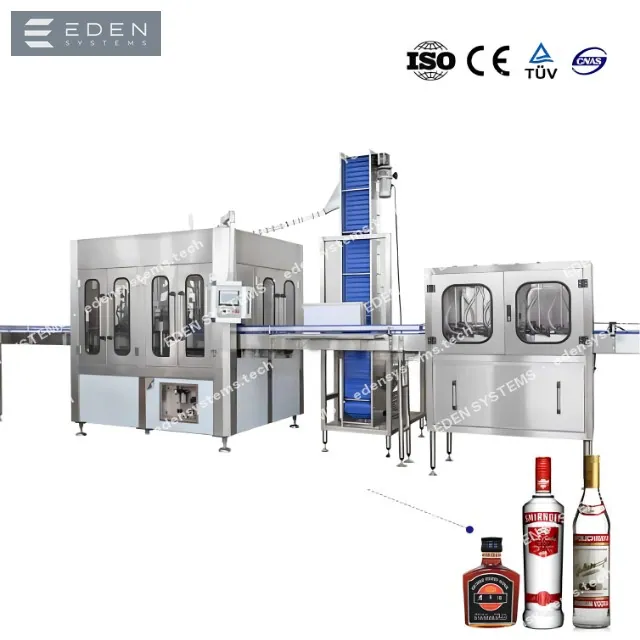
Core machines of the line
Equipment of the “Wine Bottling Line (Glass)” layout: each tile opens the catalog with series, specifications and a quote request for that machine.
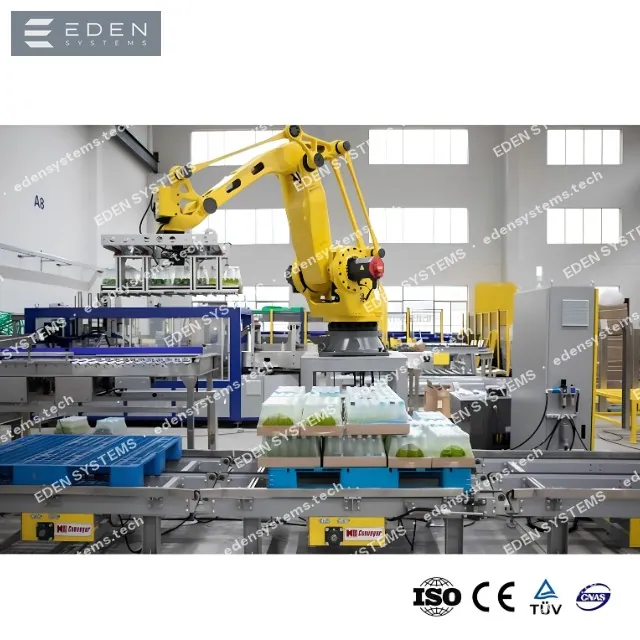
Glass container depalletizer
Removes layers of bottles from the pallet and feeds them onto the line conveyor without impact loads on the neck.
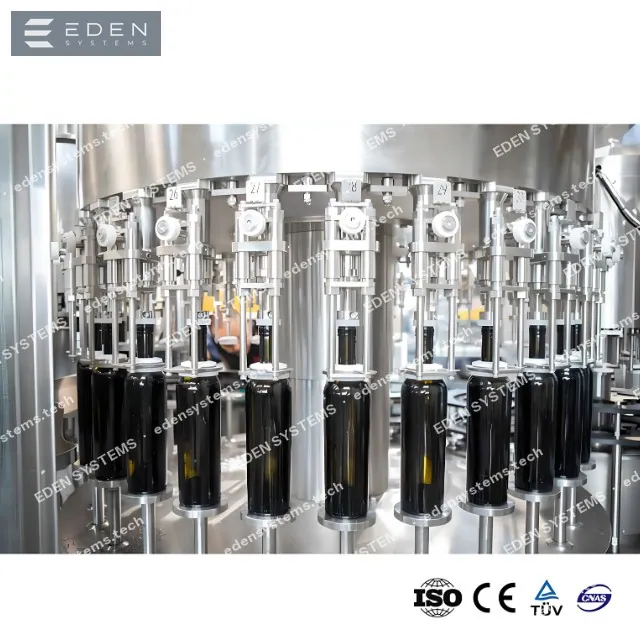
Bottle rinser
The bottle is gripped by the neck with a nylon holder, inverted 180° for internal rinsing, and returned to its original position.
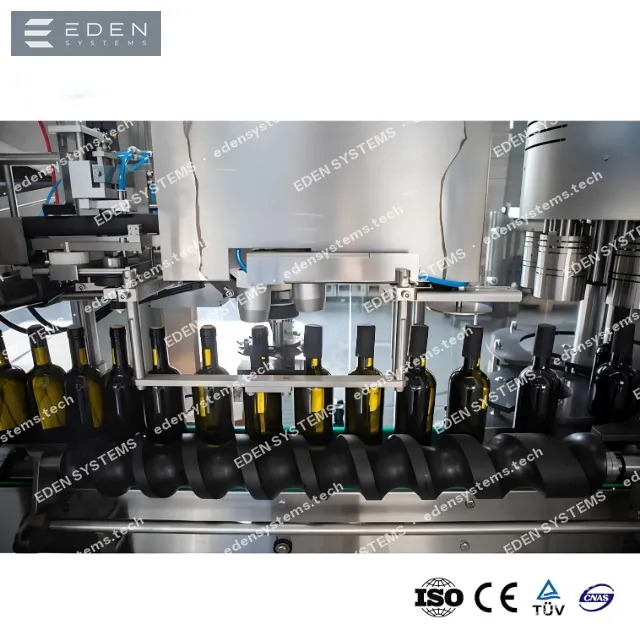
Rinsing-filling-capping triblock
Gravity filling with low vacuum at room temperature; a lifting device raises the bottle to open the filling valve.
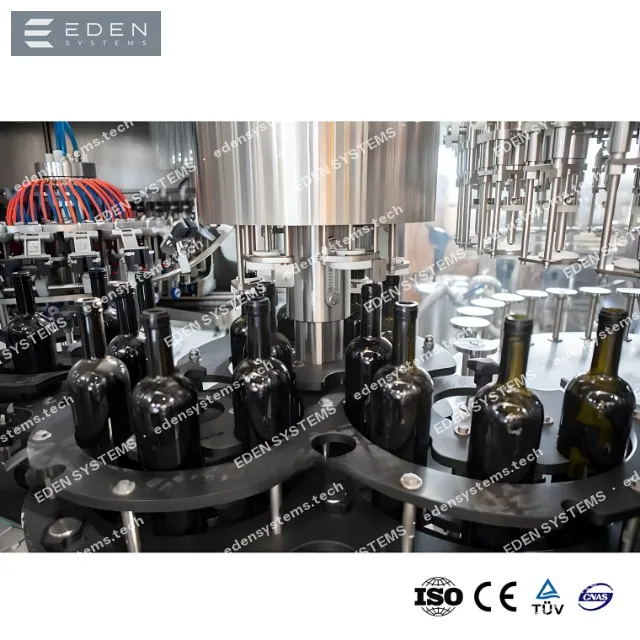
Cork or cap feeding unit
A vibratory tray orientor arranges corks; natural cork, T-cork or aluminum screw cap are fed under a presence sensor.
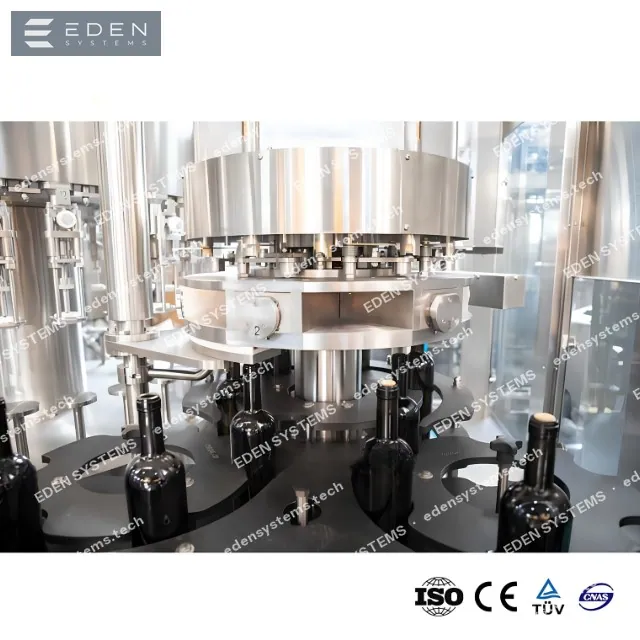
Air blow-off machine (blow-dry)
Blow-off of the bottle neck and body with ionized air before labeling removes moisture and static charge.
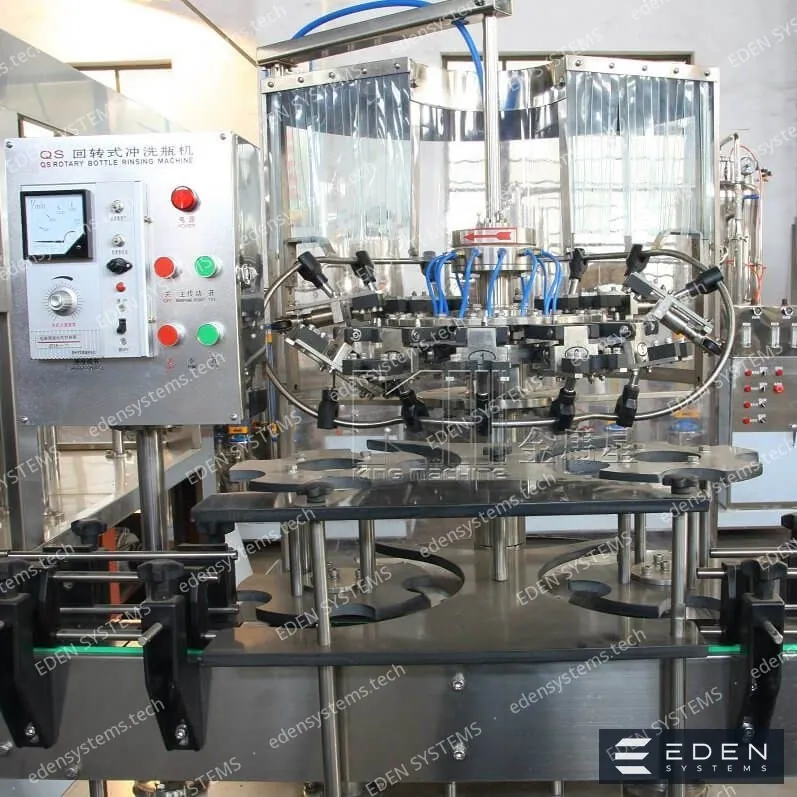
Fill level and capping inspector
Checks fill level and cork or cap seating by transmitted light, with rejection on the conveyor.
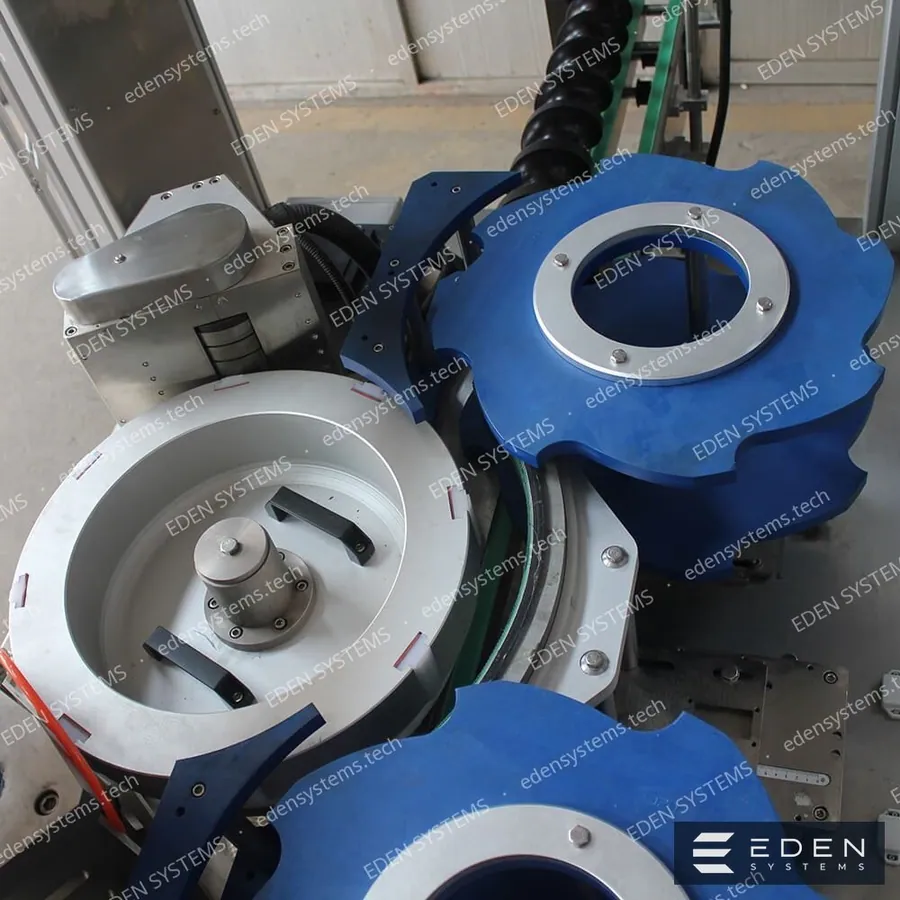
Cold glue labeling machine
Applies front label, back label and neck band to the shaped wine bottle, full or partial foil.
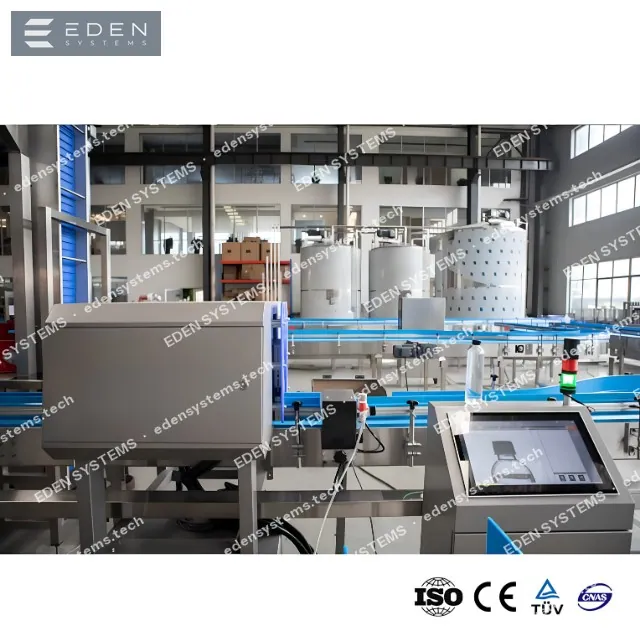
Inkjet printer
Prints the fill date, batch and code on the bottle or cap with automatic legibility verification.
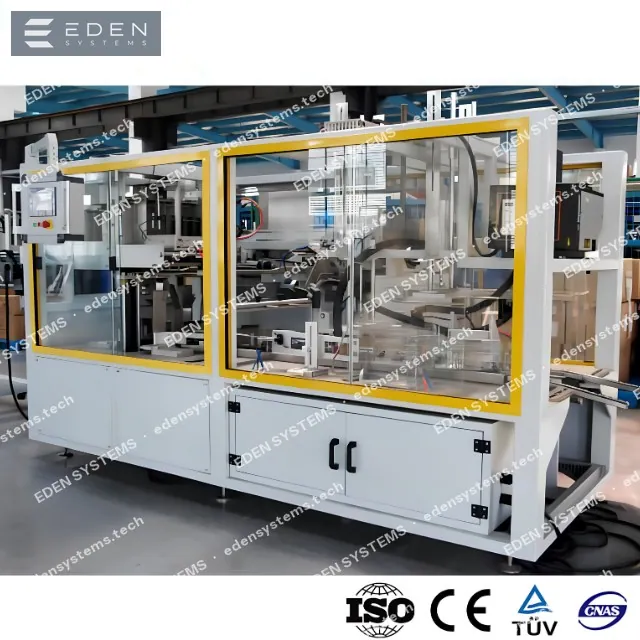
Case packer
Positions bottles and loads them into the case under PLC control, with a lockout when a container or case is missing.
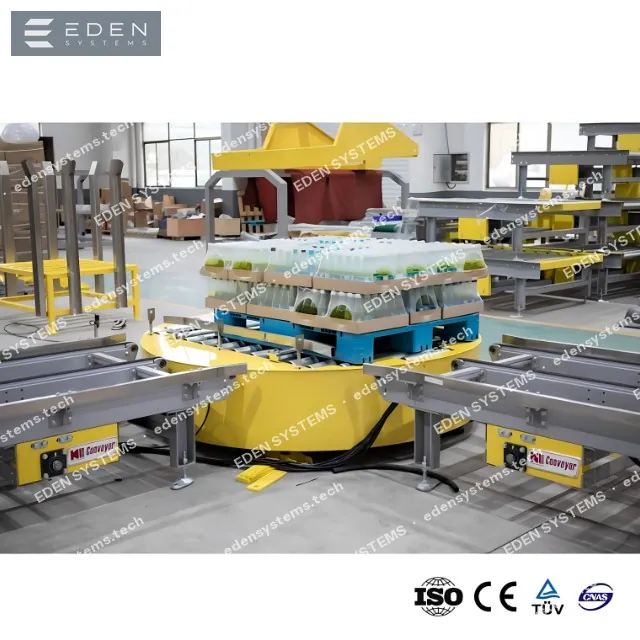
Case sealer and palletizer
Tape-seals the case, forms the pallet layer by layer and wraps it with stretch film before shipment.
Which closure do you use
The cap type defines the capping block: heads, feeding and orientation of the closure, torque or press-on force. State your option in the request and we will select the head and sorter for it.
24×44, 24×38
Cylindrical wine cork
Neck vacuuming before cork insertion removes the air cushion and prevents cork ejection.
Capping unit: Cork-driving unit (4 jaws)
cork + wire hood
Sparkling wine cork with wire hood
The cork is compressed by jaws and driven into the neck, then the cap is placed and the wire cage is twisted — four and a half turns.
Capping unit: Cork-driving unit + wire-hooding head
28×18, 30×60 (ROPP)
Aluminum screw cap
The thread is rolled directly onto the bottle neck, the skirt is crimped over the finish — tamper-evidence without an extra seal.
Capping unit: ROPP thread-rolling head
stopper (bar top)
T-cork with wood/cork head
For spirits and premium segment products. Logo orientation on the head is set by a rotation camera sensor.
Capping unit: Press head with orientation
CAMUZ
T-shaped decorative plastic cap
Applied by press-fit, height position controlled by a servo drive: the decorative skirt is not deformed.
Capping unit: Press head, 30–120 kgf
Guala, 31.5 mm
Plastic press-on cap (Guala-type)
A tamper-evident, one-piece dosing insert with an anti-refill valve — standard for vodka and strong spirits.
Capping unit: Press-on + tightening
26 mm, 21 teeth
Crown cork
Beer, soda, cider. Crimping over the finish with force control — seal integrity up to 4 bar in-bottle pressure.
Capping unit: Crown head with magnetic chuck
26 mm twist
Twist-off crown cork
Differs in crimp profile: the bottle opens by hand without an opener, requiring tighter finish geometry tolerances.
Capping unit: Crown head (lower force)
PVC, PET, polylam
Heat-shrink/polylaminate capsule
Decorative finishing over the closure: capsule placement, crimping over the finish, hot-air shrinking.
Capping unit: Capsule dispenser + heat tunnel or roller crimping
Auxiliary systems of the line
The engineering utilities without which a line never reaches its rated output: water and product preparation, sanitation, container handling.
Wine preparation for filling
Filtration and oxygen protection.
- Tangential or cartridge filtration down to 0.45 μm before filling
- Bottle nitrogen purging and evacuation before product transfer
- Dissolved-oxygen monitoring at the filler carousel inlet and outlet
- Product tank with a nitrogen blanket and sanitary fittings
Glass rinsing and inspection
New or returnable bottles before filling.
- Rinsing with filtered water or an alcohol solution, with drying
- Finish-chip and foreign-material inspection
- Gentle star-wheel handoff with polymer inserts
- Accumulation buffer before filling on the slat conveyor
Capping and finishing
Cork, cap, capsule and label.
- Corking unit with a vacuum chamber, or screw-cap closing
- Shrink-capsule applicator and its crimping station
- Self-adhesive labeling with bottle orientation by seam mark
- Label presence and skew inspection with rejection
CIP station (clean-in-place)
Sanitation of the product path between batches.
- Alkali, acid and hot-water tanks holding temperature within ±2 °C
- Recipe-driven wash programs: phase time, concentration and flow are logged
- Flow meter on the supply line — actual flow is verified, not assumed from the nameplate
- Filtered detergent return to the tanks; discharge only once the solution is spent
Coding and inspection
Laser batch coding on glass or on the capsule.
- Inkjet or laser coder: date, shift, batch number, traceability code
- Fill-level, cap presence and seating inspection with automatic reject to a pocket
- Good/reject product counters logged per shift hour
- Ready for mandatory marking: case and pallet aggregation at the line outfeed
Packing and palletizing
Corrugated case with dividers and palletizing.
- Shrink film pack or corrugated case, format tailored to the retailer's requirements
- Layer palletizer to a defined pattern, robotic version for constrained floor space
- Pallet wrapper with pre-stretch film: lower film consumption, pallet withstands transport
- SSCC pallet label printing and application, data handoff to the ERP system
FAQ
Cork or screw cap?
Technically the line supports both: only the capping head changes. The choice is a marketing one; screw caps are cheaper to run and more consistently airtight.
Can sparkling wine be filled on this line?
Only with an isobaric filler and muselet capping. We build in these stations if sparkling wine is planned in the range.
How much does the Wine Bottling Line (Glass) cost?
Price on request: the budget depends on output, container type, line composition and the level of automation. After a short brief we send a preliminary estimate within 1–2 working days and a full quotation broken down by machine within 3–5 days.
What are the delivery and commissioning lead times?
Standard machines ship 8–12 weeks after the specification is confirmed, complete lines 12–20 weeks. Transport takes 2–6 weeks depending on the route; installation and commissioning on site take 2–4 weeks, with operator training included.
What output does this line reach?
The working range is 1,000–8,000 bph. Exact output is confirmed against your container, product and shift plan: we calculate the line balance and keep a margin on the bottleneck machine.
Request a quote: Wine Bottling Line (Glass)
Tell us the product, the container and the target output — we will return the line composition, a layout, a budget range and a delivery schedule.
Related solutions
Lines with a similar equipment set — useful when you plan several products on one site.
2,000–36,000 bph
Drinking Water Filling Line, 0.33–1 L
Rinser-filler-capper monobloc for PET, water treatment, labelling and shrink packing.
Open solution2,000–24,000 bph
Beer Bottling Line (Glass)
Isobaric filling with low TPO, crown capping and tunnel pasteurization.
Open solution1,000–20,000 bph
Vegetable Oil Filling Line
Weight or volumetric oil filling into PET, glass and tinplate with capping, induction sealing, labelling and case packing.
Open solutionServices for this line
Engineering, logistics, installation and service that turn this line into a working production site.
Digital layer
Any line can be supplied with a digital layer
SCADA, MES, OEE monitoring, batch traceability and integration with plant systems — engineered together with the line, not bolted on later.