

Carbonated Soft Drink Filling Line, PET
A CSD line in PET: syrup preparation, deaeration and carbonation of water, cooling and isobaric filling under counter-pressure without CO₂ loss.
- Product
- Lemonades, colas, tonics, energy drinks, sparkling water
- Container
- PET 0.25–2.5 L
- Output
- 3,000–36,000 bph
- Carbonation
- 3.0–6.0 g/L CO₂, online monitoring
- Filling temperature
- 4–8 °C
- Filling type
- Isobaric, counter-pressure up to 4 bar
- Model range
- DCGF14-12-5 … DCGF60-60-15
- Brix accuracy
- ±0.1 °Bx
Line parameters
About the solution
A carbonated drink cannot be filled by gravity: when pressure drops, CO₂ comes out of solution and the product foams. So the bottle is first purged and pressurised with carbon dioxide up to tank pressure, then the fill valve opens and product flows with no pressure differential.
Drink quality is set before filling — in the mixer. A deaerator removes dissolved oxygen, dosing pumps hold the syrup-to-water ratio by Brix, and the carbonator saturates the product to 3–6 g/L CO₂ at reduced temperature.
Built into the design
Mixer with deaeration
Removal of oxygen from water before carbonation — stable flavour and extended shelf life.
Isobaric valve
Purge, pressurise, fill and slow pressure release in four stages — no gas loss or foaming at the neck.
CO₂ and Brix control
Online sensors in the mixer loop with batch value logging and automatic dosing correction.
Refrigeration loop
Plate heat exchanger and chiller hold product temperature at a level where CO₂ stays reliably in solution.
Line composition along the product flow
8 positions along the product flow. Every unit opens in the catalog: series, specifications, scope of supply and a quote request.
- 1
1. Water treatment
Filtration, softening, reverse osmosis and disinfection of process water.
Water treatment →
- 2
2. Syrup room
Sugar dissolving, filtration, pasteurisation and holding of simple and blended syrup.
Water treatment →
- 3
3. Mixer-carbonator
Deaeration, syrup and water dosing by Brix, cooling and CO₂ saturation.
Carbonated soft drink filling →
- 4
4. PET bottle blow moulding
Rotary blow moulding rated for gas pressure: preform and base geometry are engineered for the drink's internal pressure.
PET stretch blow moulding equipment →
- 5
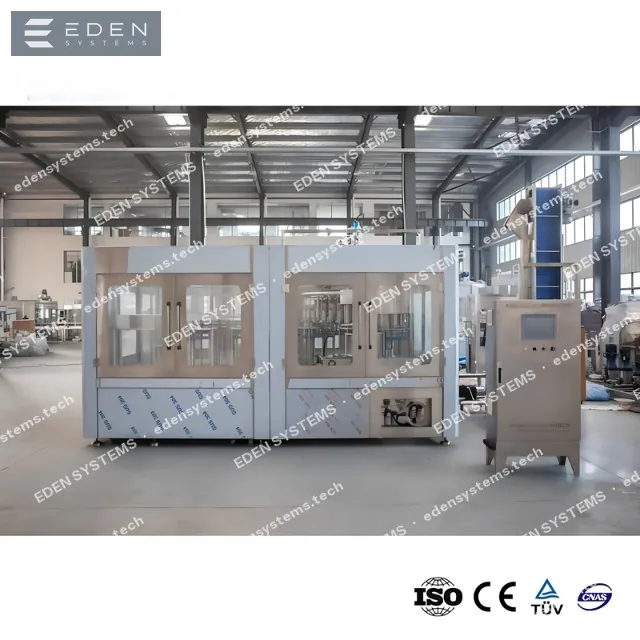
5. Isobaric filler monobloc
Rinsing, counter-pressure filling and capping on a shared frame.
Carbonated soft drink filling →
- 6
6. Level and cap inspection
Control of underfill, cap seating and seal integrity after capping.
Marking and quality inspection →
- 7
7. Labelling
Hot-melt roll-fed or PVC sleeve with heat tunnel.
Labelling equipment →
- 8
8. Packing and palletising
Shrink group packing, palletiser and stretch-wrap.
Packing and palletising →
Line model selection
Selecting the isobaric filling triblock
Output is given for a 500 mL container. Changeover from 0.5 L to 1.5 L takes 20–30 minutes.
| Model | Rinsers / valves / heads | Output (0.5 L) | Installed power |
|---|---|---|---|
| EDS-DCX 06-32-08 | 6 / 32 / 8 | 10,000 btl/h | 60 kW |
| EDS-DCX 08-40-10 | 8 / 40 / 10 | 15,000 btl/h | 75 kW |
| EDS-DCX 10-50-10 | 10 / 50 / 10 | 18,000 btl/h | 90 kW |
| EDS-DCX 12-60-12 | 12 / 60 / 12 | 21,000 btl/h | 110 kW |
| EDS-DCX 14-60-15 | 14 / 60 / 15 | 24,000 btl/h | 130 kW |
| EDS-DCX 16-80-15 | 16 / 80 / 15 | 27,000 btl/h | 150 kW |
| EDS-DCX 18-90-18 | 18 / 90 / 18 | 30,000 btl/h | 170 kW |
| EDS-DCX 20-108-20 | 20 / 108 / 20 | 36,000 btl/h | 190 kW |
Valve choice: mechanical isobaric or electronic volumetric — the electronic version is 5–6 times more accurate in dosing.
Mixer-carbonator
In-line carbonation and syrup dosing, brix mixing accuracy ≤2%.
| Parameter | Value |
|---|---|
| Output | 5,000–36,000 L/h of finished product |
| CO₂ saturation | up to 8 g/L |
| Syrup dosing | Electronic, no part changes for recipe changeover |
| Product-contact parts | Stainless steel, CIP ball in every tank |
Container, packing, and palletizing
The group packing scheme is selected based on container volume and retailer requirements.
| Container | Packing patterns | Palletizing |
|---|---|---|
| PET 0.33–1.0 L | 2×3, 3×4, 4×6 in PE film | Robotic palletizer or manual |
| PET 1.5–2.0 L | 1×6, 2×3 in PE film or case | Gantry palletizer |
Power supply 380 V ±5%, 3-phase, 50 Hz; control circuits 24 V. Operating conditions: 10–40 °C, no condensation.
Line process flow
The CSD PET line is built around an isobaric filling triblock: product travels under pressure from the mixer-carbonator to capping without contacting the atmosphere. Layouts differ based on whether the bottle is blown separately on the line or a combiblock combines blowing, filling, and capping in one unit.
Key features of CSD filling
- Isobaric (counter-pressure) filling: minimal CO₂ loss and foaming
- Filling at 12–15 °C instead of 4 °C — noticeable savings on refrigeration
- Electronic volumetric valve — dosing accuracy 5–6 times higher than mechanical
- Tubular filling bowl with no stagnant zones, automatic CIP with no manual switching
- Format change without replacing discharge tubes — changeover within one line cycle
- Product-contact parts and product tank in polished AISI 304/316 stainless steel
- In-line brix monitoring with feedback to the syrup doser
Classic layout: the blow molder and isobaric filling triblock operate separately, connected by an air conveyor and buffer.
- 1Water treatment station
- 2Syrup room and batching block
- 3Mixer-carbonator
- 4PET blow molding from preform
- 5Empty container air conveyor
- 6Isobaric filling triblock (3-in-1)
- 7Fill and capping inspection
- 8Labeling machine (PVC sleeve, roll-fed)
- 9Shrink film packing and palletizing
Key line stations
What sits behind the nameplate output: contact-part execution, operating logic and service points for every station.
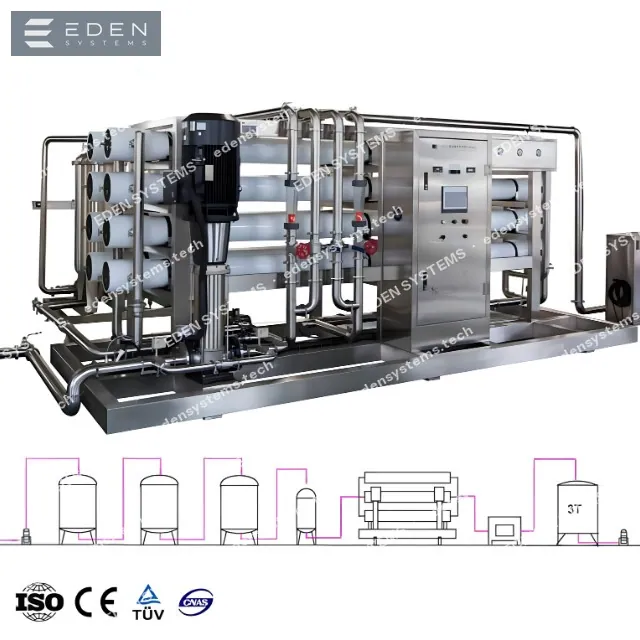
Water treatment station
Process-grade water
- Mechanical and carbon filtration, softening, reverse osmosis — the scheme is built from the raw-water analysis.
- Membranes with a flush system and VFD pump start: longer membrane life, no water hammer.
- UV and ozone disinfection, storage tank in AISI 316.
- Station capacity sized with a 20% margin over the line's peak demand.
Core machines of the line
Equipment of the “Carbonated Soft Drink Filling Line, PET” layout: each tile opens the catalog with series, specifications and a quote request for that machine.
Water treatment station
Mechanical filtration, softening, reverse osmosis, and UV disinfection prepare water for syrup and batching before carbonation.
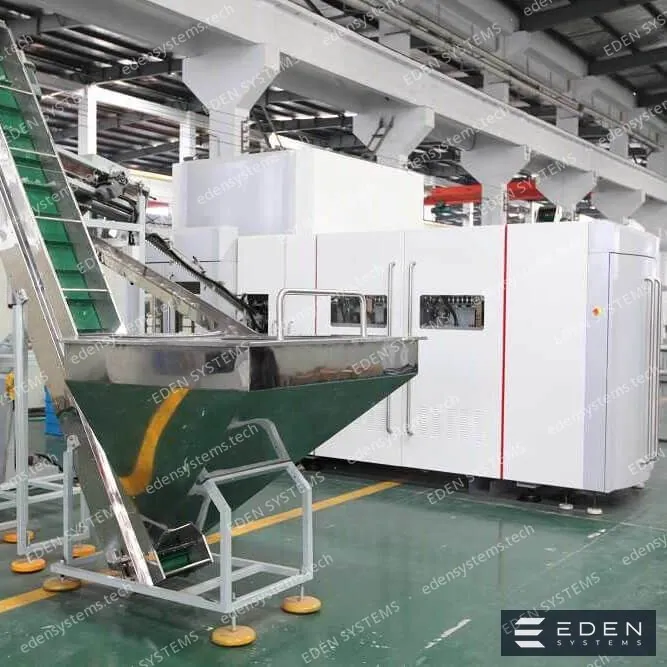
PET blow molding machine
Rotary preform blowing in sync with filling: a buffer accumulator smooths out the output difference between blowing and the triblock.
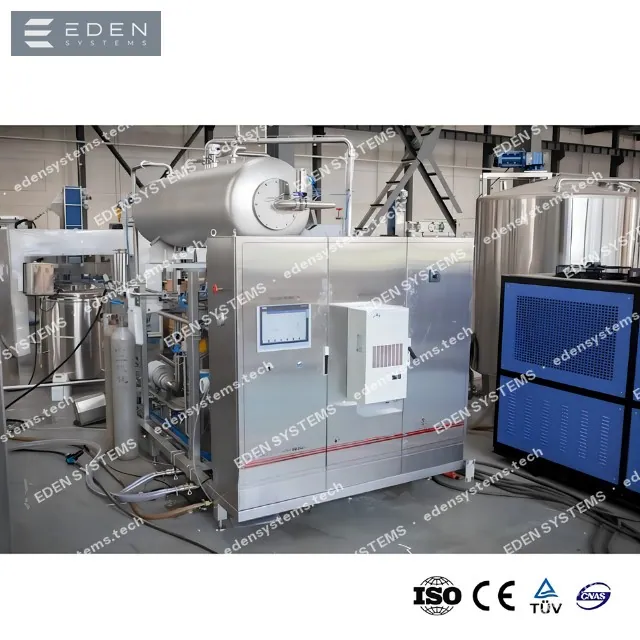
Mixer-carbonator
Water deaeration, precise recipe-based syrup dosing, and CO₂ dissolution up to 8 g/L before isobaric filling.
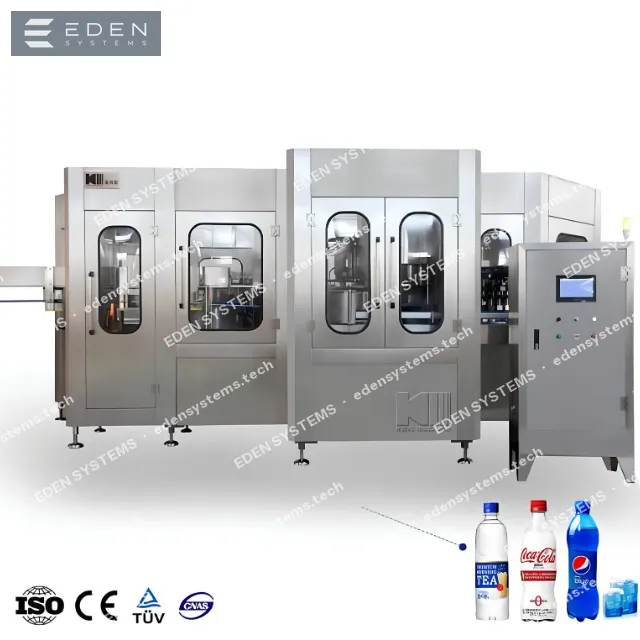
Isobaric filling triblock
Rinsing, counter-pressure filling, and capping on one frame: the product does not contact the atmosphere, CO₂ losses are minimal.
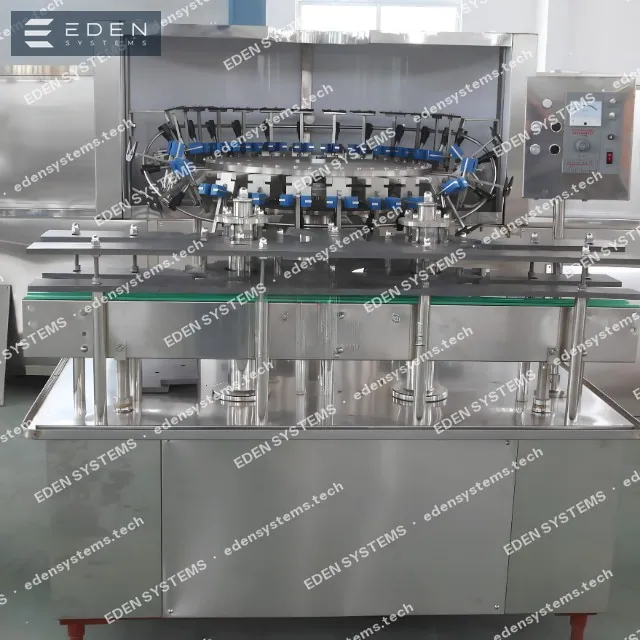
Air bottle conveyor
The empty bottle travels from the blow molder to the triblock by the neck support ring in a stream of filtered air, without touching the body.
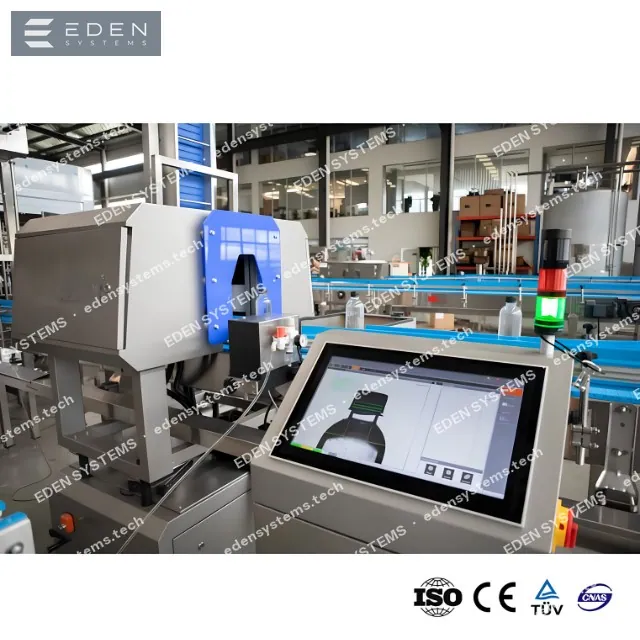
Fill and capping inspector
Backlight inspection of product level and cap presence and seating right after capping, defects removed before labeling.
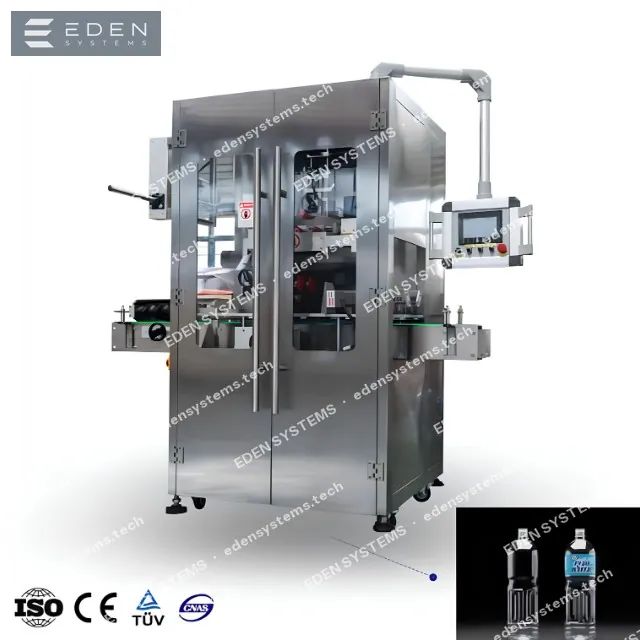
Labeling machine
PVC shrink sleeve with tunnel, glue roll-fed, or self-adhesive label — selected to match packaging design.
Date coder and batch marking
Continuous inkjet printing of fill date, shift, and batch number on the bottle with automatic code readability verification.
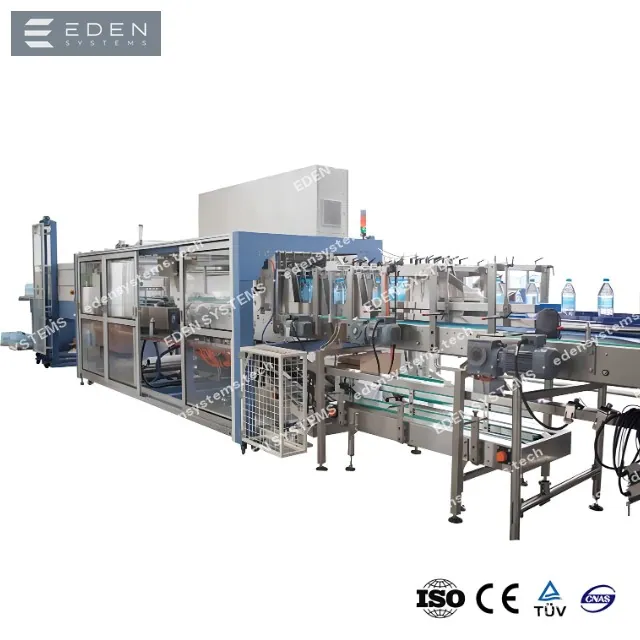
Shrink film packer
Group packing of 2×3, 3×4, or 4×6 in PE film with a shrink tunnel; case packing available for retail orders.
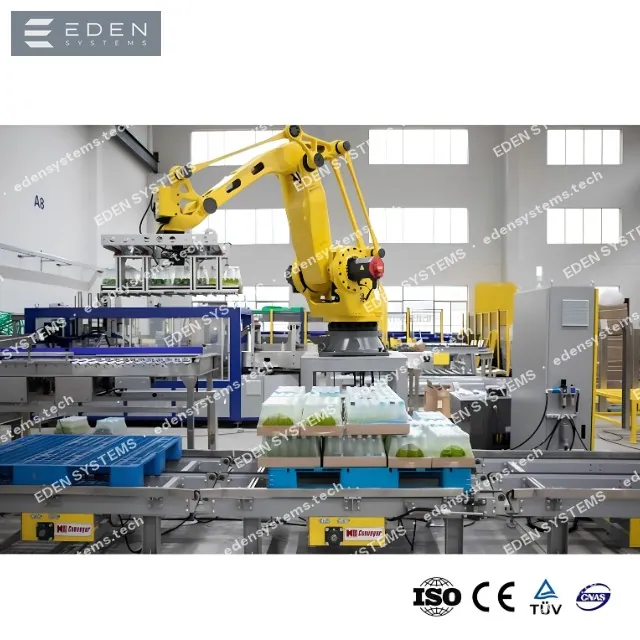
Palletizer and stretch wrapper
Layer-by-layer pallet formation and stretch film wrapping with pre-stretch — the finished pallet leaves for the warehouse without manual labor.
Which closure do you use
The cap type defines the capping block: heads, feeding and orientation of the closure, torque or press-on force. State your option in the request and we will select the head and sorter for it.
PCO 1881 / 28 mm / 38 mm
Plastic screw cap
The tamper-evident band tears on opening. Torque is set on the HMI and monitored on every chuck.
Capping unit: Magnetic screwing head
PCO 1810 / 28 mm
Sport push-pull cap
Drinking water and isotonic drinks. The spout is fed oriented, torque 1.2–2.0 N·m, logged in the report.
Capping unit: Magnetic screwing head
Auxiliary systems of the line
The engineering utilities without which a line never reaches its rated output: water and product preparation, sanitation, container handling.
Water treatment
Deaerated water is mandatory for a carbonated product.
- The scheme is built from a feed-water analysis: mechanical filtration, carbon, softening, reverse osmosis
- Station output sized with a 20% margin over peak line consumption and wash cycles
- Membranes with automatic flushing and VFD-driven pumps — no water hammer
- UV and ozone disinfection, AISI 316 buffer tank with a breather filter
Syrup-room and blending block
Syrup preparation and mixing with water.
- Jacketed cooking kettle with agitator, hot-syrup filtration
- Blending tank with Brix control and a deaerator
- Mass-based dosing of flavors and acid, recipe stored in the controller
- Jacketed buffer tank with a CO₂ blanket
Carbonator and CO₂ loop
Carbonating the product before filling.
- Water deaeration and in-line blending with syrup/water ratio control
- Carbonation to 2.5–4.5 volumes of CO₂ at 2–4 °C
- Pressure and temperature control along the entire path to the filling valve
- CO₂ pressure-reduction skid with filters and a sterile barrier
CIP station (clean-in-place)
Syrup and product loop wash between recipes.
- Alkali, acid and hot-water tanks holding temperature within ±2 °C
- Recipe-driven wash programs: phase time, concentration and flow are logged
- Flow meter on the supply line — actual flow is verified, not assumed from the nameplate
- Filtered detergent return to the tanks; discharge only once the solution is spent
Conveying systems
Container conveying accounting for internal bottle pressure.
- Air conveyor for empty containers with air filtration and neck guide rails
- Slat-top conveyor with independent drives and accumulation buffers between stations
- AISI 304 frame, Siemens / Schneider drives and controls, Sick photo sensors
- Photoelectric jam detection with automatic section stop before a line stoppage
Coding and inspection
Date coding, fill-level and cap-seal integrity checks.
- Inkjet or laser coder: date, shift, batch number, traceability code
- Fill-level, cap presence and seating inspection with automatic reject to a pocket
- Good/reject product counters logged per shift hour
- Ready for mandatory marking: case and pallet aggregation at the line outfeed
Packing and palletizing
Multipack shrink-wrap and palletizing.
- Shrink film pack or corrugated case, format tailored to the retailer's requirements
- Layer palletizer to a defined pattern, robotic version for constrained floor space
- Pallet wrapper with pre-stretch film: lower film consumption, pallet withstands transport
- SSCC pallet label printing and application, data handoff to the ERP system
PET container blow-molding
Pressure-rated bottle blow-molding with a reinforced petaloid base.
- Infrared oven with zoned heating for even wall-thickness distribution
- Two-stage blow with high-pressure air recovery, saving up to 30%
- Mold change to another volume by two operators, from 30 minutes
- Blow-molder output synchronized with the filler, container buffer on the air conveyor
Plant utilities
Chilled water, steam and CO₂ utilities for carbonated filling.
- Steam circuit or electric heating sized against peak thermal load
- Chilled water: chiller and glycol loop with a buffer tank
- Process-water piping, floor drains with traps and slope, condensate removal
- Line power panel sized per station load with a reserve for expansion
FAQ
Why is a deaerator needed?
Oxygen in water oxidises flavour compounds and shortens shelf life, and also makes it harder to hold CO₂ steady. Deaeration is a mandatory step for quality CSD production.
Can the line also fill still beverages?
Yes, the isobaric filler works without counter-pressure as well. The reverse is not true: a gravity filler cannot handle carbonated drinks.
How much does the Carbonated Soft Drink Filling Line, PET cost?
Price on request: the budget depends on output, container type, line composition and the level of automation. After a short brief we send a preliminary estimate within 1–2 working days and a full quotation broken down by machine within 3–5 days.
What are the delivery and commissioning lead times?
Standard machines ship 8–12 weeks after the specification is confirmed, complete lines 12–20 weeks. Transport takes 2–6 weeks depending on the route; installation and commissioning on site take 2–4 weeks, with operator training included.
What output does this line reach?
The working range is 3,000–36,000 bph. Exact output is confirmed against your container, product and shift plan: we calculate the line balance and keep a margin on the bottleneck machine.
Request a quote: Carbonated Soft Drink Filling Line, PET
Tell us the product, the container and the target output — we will return the line composition, a layout, a budget range and a delivery schedule.
Related solutions
Lines with a similar equipment set — useful when you plan several products on one site.
2,000–36,000 bph
Drinking Water Filling Line, 0.33–1 L
Rinser-filler-capper monobloc for PET, water treatment, labelling and shrink packing.
Open solution600–3,600 bph
Water Filling Line, 3–10 L
Filling of large-format handled PET containers, capping and shrink packing.
Open solution2,000–18,000 bph
Hot-Fill Juice Line, PET
Pasteurisation, filling at 85–92 °C, cooling tunnel and labelling.
Open solutionServices for this line
Engineering, logistics, installation and service that turn this line into a working production site.
Digital layer
Any line can be supplied with a digital layer
SCADA, MES, OEE monitoring, batch traceability and integration with plant systems — engineered together with the line, not bolted on later.