

Turnkey water bottling line for PET 0.33–1 L: 2,000–36,000 bph
A classic PET drinking and mineral water line: from water treatment to the pallet. The CGF8-8-3 … CGF60-40-15 monobloc range is sized to the throughput you need.
- Product
- Drinking, spring, mineral and flavoured water
- Container
- PET 0.25–2.5 L, round or square
- Model range
- CGF8-8-3, CGF14-12-4, CGF18-18-6, CGF24-24-8, CGF32-32-10, CGF40-40-12, CGF60-40-15
- Output
- 2,000–36,000 bph at 500 mL
- Filling accuracy
- ±1%
- Materials
- AISI 304 / AISI 316 in product contact
- Plant area
- from 300 m² (3,000 bph) to 2,500 m² (18,000 bph)
- Installed power
- 100–500 kVA depending on model
- Operators per shift
- 6–8 people
- Power supply
- 380 V ±5%, 3-phase, 50 Hz
Line parameters
About the solution
Gravity filling with a mechanical level valve is the most predictable way to handle still water: product flows by gravity from an annular tank, dose is set by level in the bottle rather than by time, and there is no timing drift. Volume accuracy is within ±1%, the product path is short, and there are no dead zones.
Rinsing, filling and capping are combined into one block with overhead bottle transfer by the neck ring. The container never touches a surface with its body, and format changeover is limited to swapping neck grippers and loading a recipe on the operator panel.
Built into the design
Three operations in one block
Rinser, filler and capper on a shared frame with one drive — minimum contact time between product and the surrounding environment.
Water-efficient rinsing
Spray-type nozzles and polymer-lined grippers keep rinse water use low and container breakage practically eliminated.
Magnetic capping
Torque-clutch heads with a "no bottle — no cap" function keep capping rejects at 0.2% or below.
Proven electrics
Siemens, Mitsubishi and Omron PLCs and drives, touchscreen panel with SKU-based recipes and an alarm log.
Line composition along the product flow
9 positions along the product flow. Every unit opens in the catalog: series, specifications, scope of supply and a quote request.
- 1
1. Water treatment
Mechanical filtration, softening, carbon filtration, reverse osmosis, UV disinfection and ozonation as per your water analysis.
Water treatment →
- 2
2. PET bottle blow moulding
Linear or rotary blow moulder synchronised with the filler; a buffer accumulator smooths the throughput difference.
PET stretch blow moulding equipment →
- 3
3. Air conveyor for empty containers
Empty bottles transferred by the neck ring, no body contact and no dust ahead of the monobloc.
PET stretch blow moulding equipment →
- 4
4. Rinser-filler-capper monobloc
Rinsing, gravity filling with level control and cap screwing on one frame.
Drinking water bottling lines →
- 5
5. Cap feeding and orientation
Hopper elevator, orientor and feed chute with cap-presence control before the head.
Capping equipment →
- 6
6. Level and cap inspection
Camera or photocell control of fill level, cap presence and seating, reject on the conveyor.
Marking and quality inspection →
- 7
7. Labelling
Hot-melt roll-fed, PVC sleeve with heat tunnel, or self-adhesive labelling — matched to your packaging design.
Labelling equipment →
- 8
8. Date coding
Continuous inkjet printer applies date, shift and batch number to bottle and case.
Marking and quality inspection →
- 9
9. Shrink packing and palletising
Group packing 2×3, 3×4, 4×6 into PE film or a case, then a palletiser and stretch-wrap.
Packing and palletising →
Line model selection
Water filling triblock model selection
Output is given for 500 mL containers. Floor space includes water treatment, preform storage, and finished product areas.
| Model | Output (500 mL) | Floor space | Installed power | Operators per shift |
|---|---|---|---|---|
| CGF8-8-3 | 2,000–3,000 btl/h | 300 m² | 100 kVA | 8 |
| CGF14-12-4 | 3,000–4,000 btl/h | 400 m² | 100 kVA | 8 |
| CGF18-18-6 | 6,000–8,000 btl/h | 600 m² | 200 kVA | 6 |
| CGF24-24-8 | 8,000–10,000 btl/h | 1,000 m² | 300 kVA | 6 |
| CGF32-32-10 | 12,000–15,000 btl/h | 2,000 m² | 450 kVA | 6 |
| CGF40-40-12 | 16,000–18,000 btl/h | 2,500 m² | 500 kVA | 6 |
Values are approximate: final floor space and power requirements are confirmed after agreeing on the plant layout and the set of auxiliary systems.
Blow–fill–cap combi block for water
If floor space is limited, the "blow molder + air conveyor + triblock" chain is replaced with a single combi block.
| Model | Blow molding cavities | Filling valves | Capping heads | Output 1.5 L / 1 L / 0.5 L |
|---|---|---|---|---|
| EDS-CGX06-18-06 | 6 | 18 | 6 | 5,500 / 8,000 / 12,000 btl/h |
| EDS-CGX08-24-08 | 8 | 24 | 8 | 7,000 / 10,000 / 16,000 btl/h |
| EDS-CGX10-32-10 | 10 | 32 | 10 | 9,000 / 13,500 / 20,000 btl/h |
| EDS-CGX10-40-10 | 10 | 40 | 10 | 12,000 / 18,000 / 20,000 btl/h |
| EDS-CGX12-40-15 | 12 | 40 | 15 | 12,000 / 15,000 / 24,000 btl/h |
| EDS-CGX14-45-15 | 14 | 45 | 15 | 13,000 / 20,000 / 28,000 btl/h |
| EDS-CGX16-50-15 | 16 | 50 | 15 | 15,000 / 21,000 / 30,000 btl/h |
| EDS-CGX18-60-20 | 18 | 60 | 20 | 20,000 / 24,000 / 30,000 btl/h |
Line process flow
A drinking water line is built around a rinse–fill–cap triblock, but the composition of the "head" and "tail" depends on whether you blow mold the bottle on-site, use a combi block, or work with ready-made containers and carbonated water.
Key features of water filling
- Gravity filling by level: the dose is set by bottle geometry, accuracy within ±1 %
- Neck-handling container transfer — the bottle body never touches surfaces
- Flare-spray nozzles and rinse water recirculation — rinsing water consumption is about a third lower
- Electromagnetic capping heads with torque clutch, cap rejection rate below 0.2 %
- Contact parts and product tank made of AISI 304/316 with mirror polishing, no dead zones
- Siemens / Mitsubishi / Omron PLC and drives, format recipes and alarm log on the operator panel
Base layout for 2,000–36,000 btl/h: the preform goes into the blow molder, and the finished bottle travels by air conveyor straight to the triblock.
- 1Water treatment station (filtration, softening, reverse osmosis, UV and ozonation)
- 2PET blow molder from preform
- 3Empty container air conveyor
- 43-in-1 triblock: rinse — fill — cap
- 5Cap feeding and orientation
- 6Fill level and cap seating inspection
- 7Labeling machine (roll-fed, PVC sleeve or self-adhesive)
- 8Coder / batch marking
- 9Heat-shrink wrap packaging in PE film
- 10Palletizer and stretch wrapper
Key line stations
What sits behind the nameplate output: contact-part execution, operating logic and service points for every station.
Water treatment station
Process-grade water
- Mechanical and carbon filtration, softening, reverse osmosis — the scheme is built from the raw-water analysis.
- Membranes with a flush system and VFD pump start: longer membrane life, no water hammer.
- UV and ozone disinfection, storage tank in AISI 316.
- Station capacity sized with a 20% margin over the line's peak demand.
Core machines of the line
Equipment of the “Drinking Water Filling Line, 0.33–1 L” layout: each tile opens the catalog with series, specifications and a quote request for that machine.
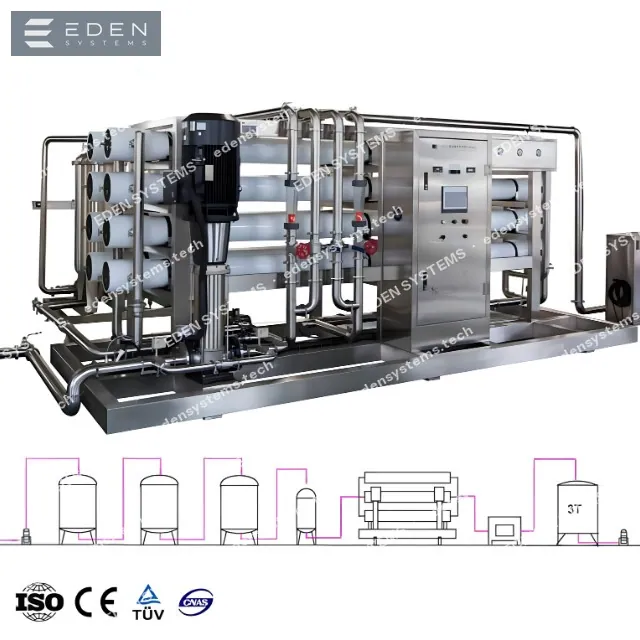
Water treatment station
Mechanical filtration, softening, carbon filter, reverse osmosis, UV and ozonation according to your water analysis protocol.
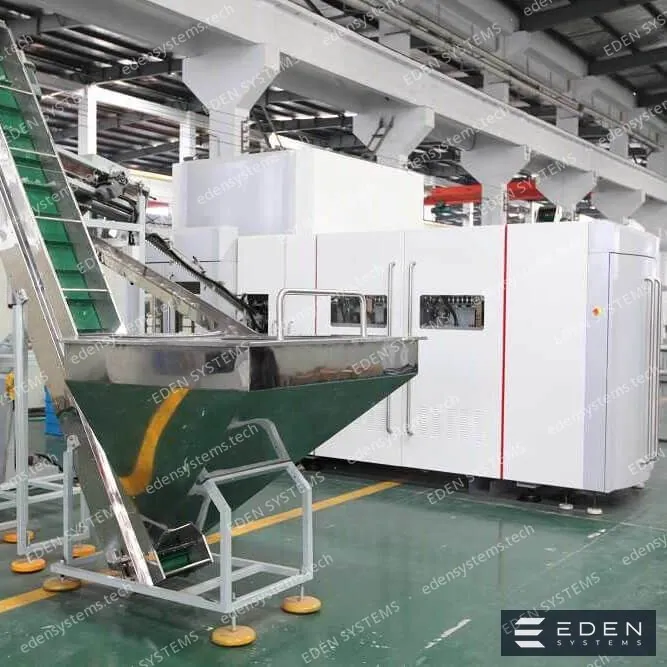
PET blow molder
Rotary or linear blow molding from preform synchronized with filling; a buffer accumulator smooths out output differences.
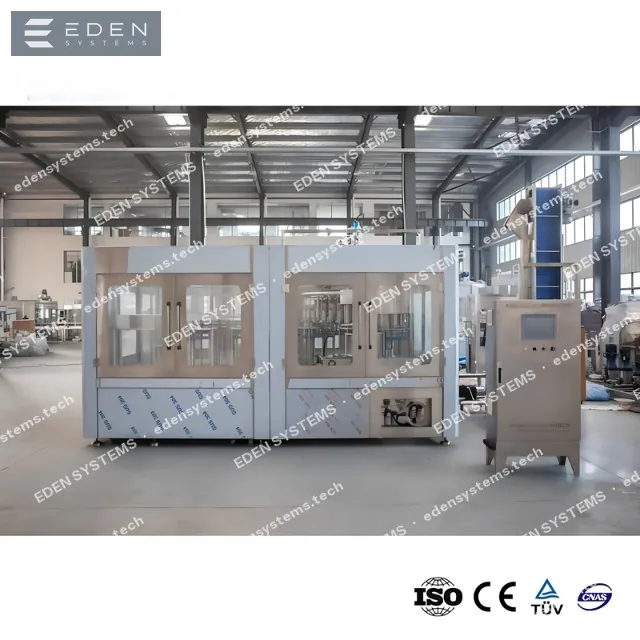
Air container conveyor
The bottle travels by its neck ring under a stream of filtered air: the body never touches surfaces, and no dust enters the container.
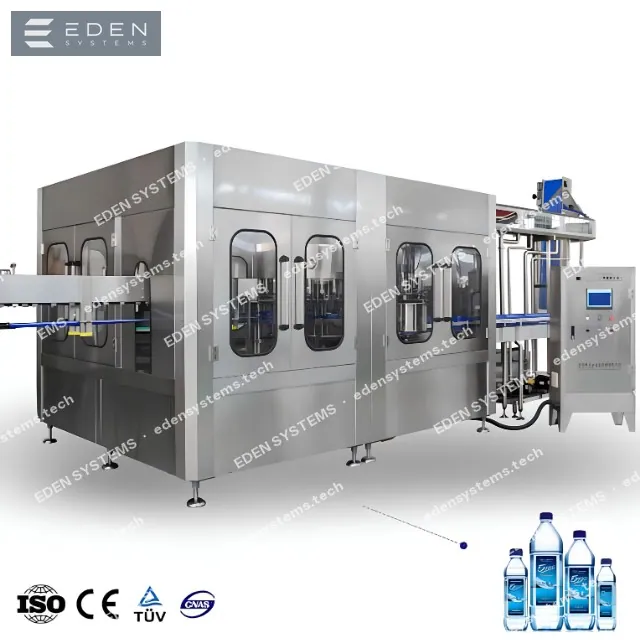
3-in-1 triblock (rinse — fill — cap)
Nozzle rinsing, gravity level filling and cap tightening on a single frame with a shared drive.
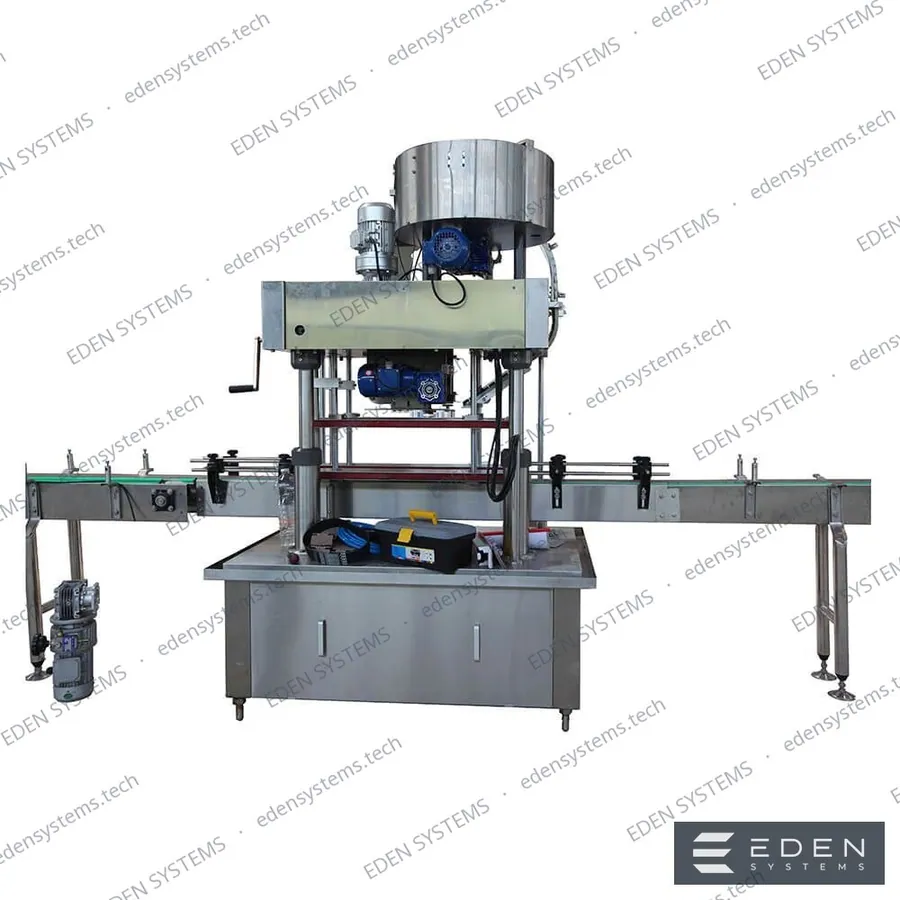
Cap feeding and orientation
Hopper elevator, orienter and feed chute with cap-presence control before each head.
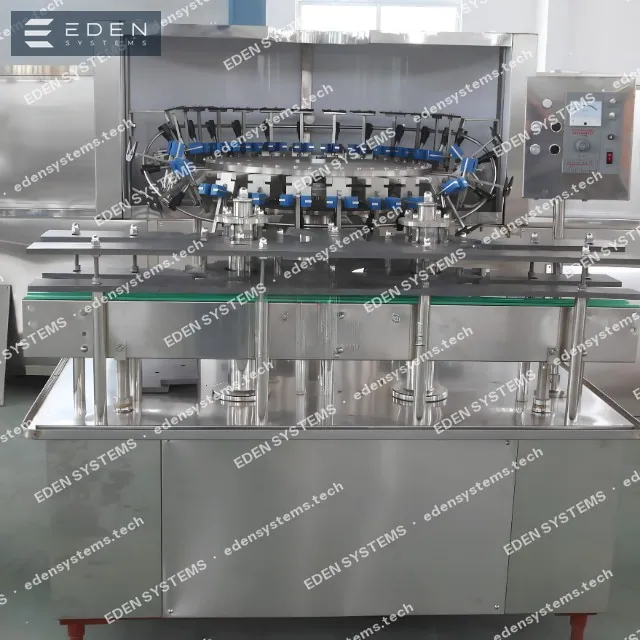
Fill level and capping inspector
Checks fill level and cap presence/seating against a light source, with automatic rejection on the conveyor.
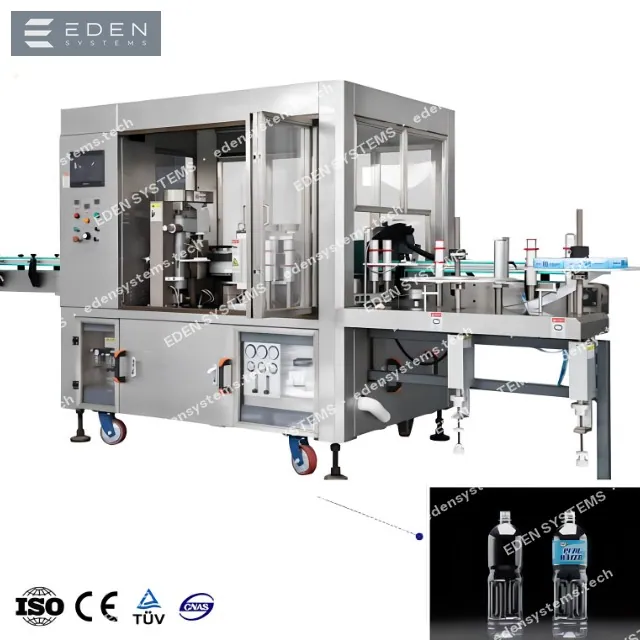
Labeling machine
Hot-melt roll-fed, heat-shrink PVC sleeve with a tunnel, or self-adhesive label — matched to your packaging design.
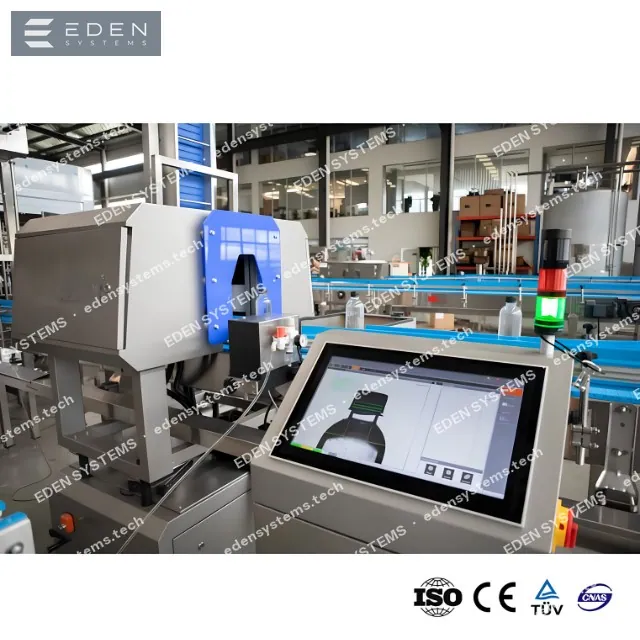
Coder and batch marking
Continuous inkjet printing of fill date, shift and batch number on the bottle and case with code legibility check.
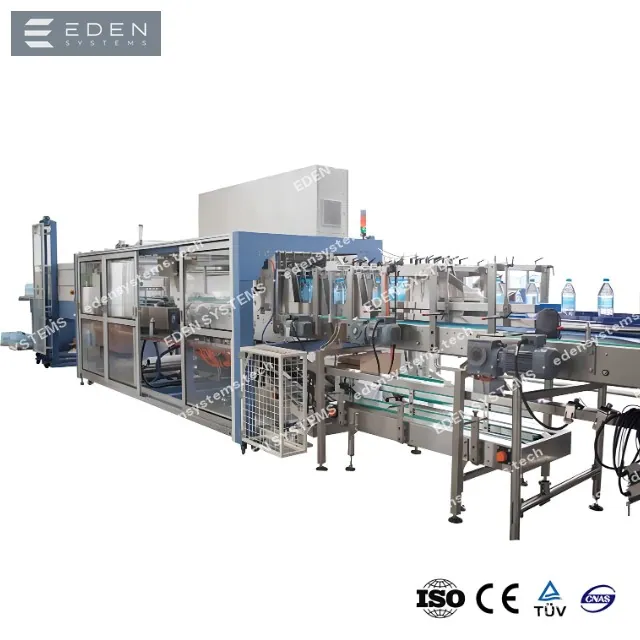
Heat-shrink wrapper
Group packaging in 2×3, 3×4 or 4×6 patterns using PE film with a shrink tunnel, with a half-pallet option if needed.
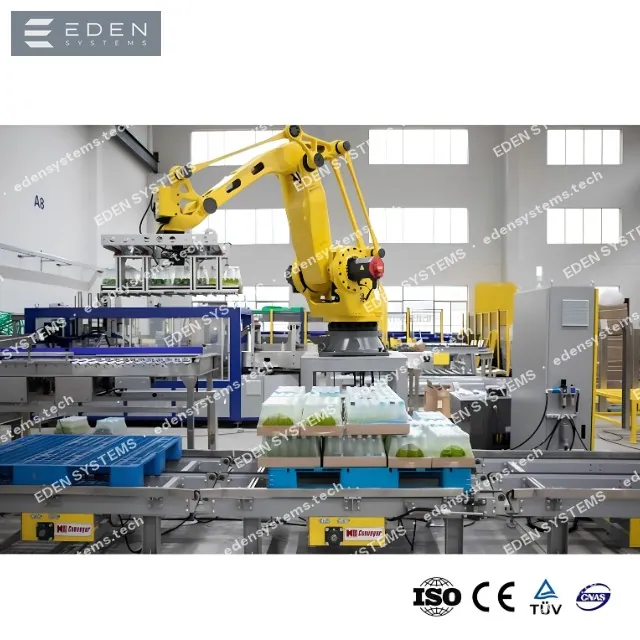
Palletizer and wrapper
Layer-by-layer pallet formation and stretch-film wrapping with pre-stretch — the finished pallet goes straight to the warehouse.
Which closure do you use
The cap type defines the capping block: heads, feeding and orientation of the closure, torque or press-on force. State your option in the request and we will select the head and sorter for it.
PCO 1881 / 28 mm / 38 mm
Plastic screw cap
The tamper-evident band tears on opening. Torque is set on the HMI and monitored on every chuck.
Capping unit: Magnetic screwing head
PCO 1810 / 28 mm
Sport push-pull cap
Drinking water and isotonic drinks. The spout is fed oriented, torque 1.2–2.0 N·m, logged in the report.
Capping unit: Magnetic screwing head
28×18, 30×60 (ROPP)
Aluminum screw cap
The thread is rolled directly onto the bottle neck, the skirt is crimped over the finish — tamper-evidence without an extra seal.
Capping unit: ROPP thread-rolling head
Auxiliary systems of the line
The engineering utilities without which a line never reaches its rated output: water and product preparation, sanitation, container handling.
Water treatment
The key station of the line: water is both the product and the container-wash medium.
- The scheme is built from a feed-water analysis: mechanical filtration, carbon, softening, reverse osmosis
- Station output sized with a 20% margin over peak line consumption and wash cycles
- Membranes with automatic flushing and VFD-driven pumps — no water hammer
- UV and ozone disinfection, AISI 316 buffer tank with a breather filter
Ozonation and sterile loop
Microbiological safety before filling.
- Ozone generator with in-line dissolution and residual concentration control
- UV sterilizers on the feed to the filler and on the return from the tank
- Sterile air filters on tank breather valves
- Sanitary fittings and welds polished to Ra ≤ 0.8 μm
CIP station (clean-in-place)
Scheduled wash of tanks and the filler carousel.
- Alkali, acid and hot-water tanks holding temperature within ±2 °C
- Recipe-driven wash programs: phase time, concentration and flow are logged
- Flow meter on the supply line — actual flow is verified, not assumed from the nameplate
- Filtered detergent return to the tanks; discharge only once the solution is spent
Conveying systems
Air conveyor from the blow-molder to the tri-block, slat conveyor at the outfeed.
- Air conveyor for empty containers with air filtration and neck guide rails
- Slat-top conveyor with independent drives and accumulation buffers between stations
- AISI 304 frame, Siemens / Schneider drives and controls, Sick photo sensors
- Photoelectric jam detection with automatic section stop before a line stoppage
Coding and inspection
Date coding and fill-level control at line speed.
- Inkjet or laser coder: date, shift, batch number, traceability code
- Fill-level, cap presence and seating inspection with automatic reject to a pocket
- Good/reject product counters logged per shift hour
- Ready for mandatory marking: case and pallet aggregation at the line outfeed
Packing and palletizing
Shrink-wrap of 6/12 bottles and automatic palletizing.
- Shrink film pack or corrugated case, format tailored to the retailer's requirements
- Layer palletizer to a defined pattern, robotic version for constrained floor space
- Pallet wrapper with pre-stretch film: lower film consumption, pallet withstands transport
- SSCC pallet label printing and application, data handoff to the ERP system
PET container blow-molding
Blow-molding of 0.25–2.5 L PET bottles directly in-line.
- Infrared oven with zoned heating for even wall-thickness distribution
- Two-stage blow with high-pressure air recovery, saving up to 30%
- Mold change to another volume by two operators, from 30 minutes
- Blow-molder output synchronized with the filler, container buffer on the air conveyor
Compressed air and pneumatics
40-bar blow air and process air for the line.
- Separate low-pressure process air and 40-bar blow-air circuits
- Dryer, in-line filters and receiver, dew point set for food-contact requirements
- Oil-free compressors for circuits contacting product and the container's inner surface
- Stainless steel piping with take-off points and shut-off valves at every station
FAQ
What output is needed for a start-up?
New producers usually go with 6,000–8,000 bph: the line pays back on a regional volume and leaves headroom for demand growth. Below 3,000 bph makes sense only if the sales market is clearly limited.
Can sweetened beverages be filled on this line?
Yes, by adding a few stations: a syrup mixer and, for carbonated drinks, a saturator with isobaric filling. We build in this option in advance if you plan to expand the range.
Is water treatment included in the supply?
Yes, the treatment station is sized against the analysis of your well or intake water and is included in the overall line specification.
How much does the Drinking Water Filling Line, 0.33–1 L cost?
Price on request: the budget depends on output, container type, line composition and the level of automation. After a short brief we send a preliminary estimate within 1–2 working days and a full quotation broken down by machine within 3–5 days.
What are the delivery and commissioning lead times?
Standard machines ship 8–12 weeks after the specification is confirmed, complete lines 12–20 weeks. Transport takes 2–6 weeks depending on the route; installation and commissioning on site take 2–4 weeks, with operator training included.
What output does this line reach?
The working range is 2,000–36,000 bph. Exact output is confirmed against your container, product and shift plan: we calculate the line balance and keep a margin on the bottleneck machine.
Request a quote: Drinking Water Filling Line, 0.33–1 L
Tell us the product, the container and the target output — we will return the line composition, a layout, a budget range and a delivery schedule.
Project budget
What drives the cost of a water filling line
The price is set by a combination of factors, not a single line item. We build the budget around your task and show the cost structure node by node — no hidden positions.
Output
Target bottles per hour define the machine class: from compact monoblocks to high-speed lines with automatic packaging.
Container and format
PET 0.33–1 L, PET 3–10 L, 19 L polycarbonate, glass — different tooling, capping and conveying.
Water treatment
Raw water analysis defines the train: filtration, softening, reverse osmosis, mineralisation, disinfection.
Automation level
Semi-automatic, automatic, or a line with robotic palletising and SCADA — a different budget and headcount.
End-of-line packaging
Labelling, coding, shrink wrapping, case packing, palletiser — each unit is added when it is needed.
Logistics and commissioning
Delivery, customs, supervised installation, operator training and the service package are part of the final quote.
Publishing average figures would be misleading: projects with similar output can differ several times over. Price is on request, and we quote against your actual input data.
Request a budget estimateRelated solutions
Lines with a similar equipment set — useful when you plan several products on one site.
600–3,600 bph
Water Filling Line, 3–10 L
Filling of large-format handled PET containers, capping and shrink packing.
Open solution3,000–36,000 bph
Carbonated Soft Drink Filling Line, PET
Mixer-carbonator, isobaric filling, capping and labelling.
Open solution2,000–18,000 bph
Hot-Fill Juice Line, PET
Pasteurisation, filling at 85–92 °C, cooling tunnel and labelling.
Open solutionServices for this line
Engineering, logistics, installation and service that turn this line into a working production site.
Digital layer
Any line can be supplied with a digital layer
SCADA, MES, OEE monitoring, batch traceability and integration with plant systems — engineered together with the line, not bolted on later.
Your next step
Move from equipment selection to a turnkey project scope and a budget estimate.