

Packing and Palletizing Solution
The final section of the line: group packing into shrink film or cases, palletizing and wrapping. This is where overall line throughput is most often lost.
- Group packing
- PE shrink film, tray + film, cardboard case
- Pack patterns
- 2×3, 3×4, 4×6, 3×5 and custom to spec
- Output
- up to 36,000 bottles/h at the infeed
- Palletizing
- Gantry palletizer or robotic arm
- Palletizer speed
- up to 120 pallets per shift
- Wrapping
- Pallet wrapper with film pre-stretch
- Marking
- Case and pallet label applicator
- Control
- PLC with recipes for SKU and pack patterns
Line parameters
About the solution
The packing section must run faster than the filler — otherwise the line stops on accumulation. We build in a 10–15 % throughput margin and buffer accumulators ahead of every machine.
The packing scheme is chosen to match the sales channel: a 2×3 or 3×4 shrink multipack for retail, a cardboard case for distribution, a tray with film for HoReCa. Palletizing is done by a gantry palletizer or a robotic arm.
Built into the design
Cycle-time margin
Each machine in the section outpaces the previous one — packing never slows down filling.
Fast pattern changeover
The pack pattern is stored as a recipe: switching between case formats requires no mechanical adjustment.
Robot instead of gantry
The robotic arm takes up less space and can serve several lines at once.
Pack-quality control
Checking that every bottle is present in the pack, film-seal integrity and correct pallet pattern.
Line composition along the product flow
7 positions along the product flow. Every unit opens in the catalog: series, specifications, scope of supply and a quote request.
- 1
1. Accumulator and grouping
A buffer table and grouper form the required pattern block without stopping the flow.
Packing and palletising →
- 2
2. Shrink wrapper
Wrapping the block in PE film and shrinking in a tunnel with temperature control.
Packing and palletising →
- 3
3. Case former (alternative)
Forming the case from a blank, loading product and sealing with tape or glue.
Packing and palletising →
- 4
4. Case marking
Printing and applying a label with batch composition and barcode.
Marking and quality inspection →
- 5
5. Palletizer
Gantry or robotic stacking of blocks onto the pallet in the specified pattern.
Packing and palletising →
- 6
6. Slip sheets
Automatic insertion of slip sheets between layers for pallet stability.
Packing and palletising →
- 7
7. Stretch-wrapping
Pallet wrapper with pre-stretch and top pressing, applying the pallet label.
Packing and palletising →
Line model selection
Selecting a group packaging method
The packaging method determines block stability during transport and packaging material cost per container.
| Packaging method | Material | Applicability | Output |
|---|---|---|---|
| PE film shrink wrap | polyethylene film | up to 3,000 btl/h (semi-automatic) | up to 3,000 btl/h |
| PE film shrink wrap | polyethylene film | automatic line | up to 12,000 btl/h |
| Shrink wrap with tray | film + cardboard tray | heavy or tall containers | up to 9,000 btl/h |
| Wrap-around case | corrugated cardboard | premium packaging, branding | up to 6,000 btl/h |
| Corrugated case (case pack) | corrugated cardboard | glass, cans, heavy containers | up to 6,000 units/h |
For containers with a high center of gravity (glass, large PET), packaging with a tray or a case is recommended instead of plain shrink wrap.
Palletizing
| Parameter | Value |
|---|---|
| Stacking method | robotic arm or layer-based mechanical palletizer |
| Pallet height | up to 2.2 m (agreed to match transport and warehouse) |
| Interleaf sheets | cardboard between layers on request |
| Wrapping | pre-tensioned stretch film, top press |
| Output | up to 120 pallets/shift depending on the model |
The stacking pattern (number of cases per layer, orientation) is programmed for a specific SKU and stored in the controller memory.
Line process flow
The choice of packaging solution depends on container type and transport stability requirements: lightweight PET containers usually go into shrink film, heavy glass and large cans into corrugated cases or wrap-around packaging, and a palletizer with stretch wrap completes the line.
Key features of the packing module
- Electronic piece counting of containers before forming the block - no losses or excess film
- Shrink tunnel with even temperature distribution across the full width of the block
- Fast changeover of stacking patterns (1×2, 2×3, 3×4, 4×6) via recipes on the operator panel
- Case forming from a die-cut flat blank matching the customer's brand
- Interleaf cardboard sheets between pallet layers for heavy glass containers
- The robotic palletizer stores several stacking algorithms for different container types
- Pre-tensioned stretch wrap with a top press - the pallet keeps its shape during transport
Layout for lightweight containers in large batches: water, CSD, juice, canned goods.
- 1Forming a row and block of containers with an electronic counter
- 2Film feed and wrapping the block
- 3Shrink tunnel
- 4Block cooling on the outfeed conveyor
- 5Date coder / batch marking of the block (optional)
- 6Forming a layer of blocks on the pallet table
- 7Robotic palletizer: layer-by-layer stacking
- 8Pallet stretch wrap
Key line stations
What sits behind the nameplate output: contact-part execution, operating logic and service points for every station.
Group packing and palletizing
Line output
- Shrink-wrap or corrugated case packing — format to retailer requirements.
- Palletizer with layer-by-layer stacking to a set pattern, robotic option for limited floor space.
- Pallet wrapper with film pre-stretch: lower film consumption, the pallet withstands transport.
- Finished-pallet count and SSCC label printing at the output.
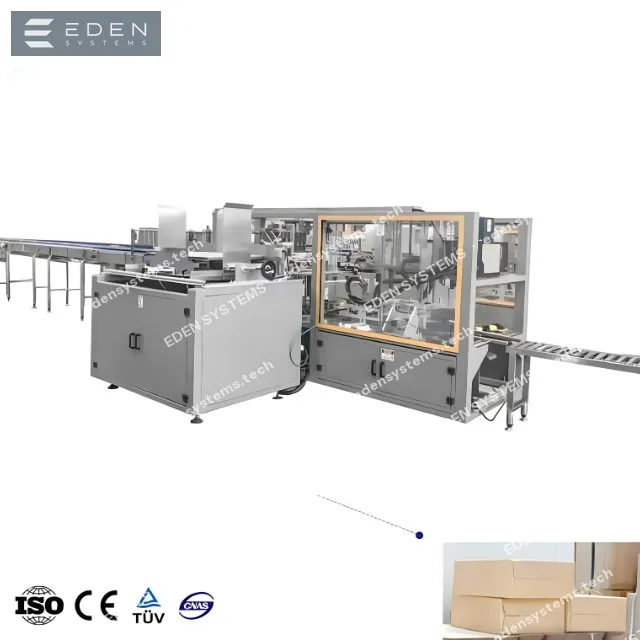
Core machines of the line
Equipment of the “Packing and Palletizing Solution” layout: each tile opens the catalog with series, specifications and a quote request for that machine.
Semi-automatic shrink wrap packer
Manual assembly of the container block followed by automatic film shrinking - a solution for lines up to 3,000 btl/h or where labor cost is low.
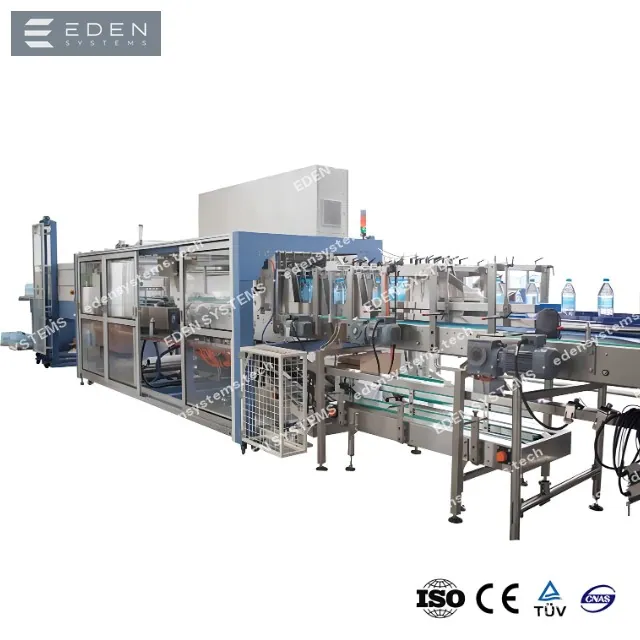
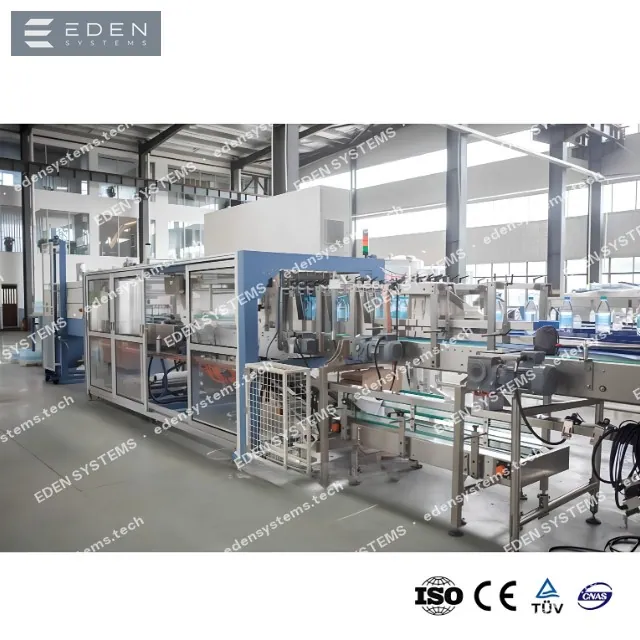
Automatic PE film wrapper
Group packaging of round, square or flat containers into shrink film with electronic piece counting and a shrink tunnel.
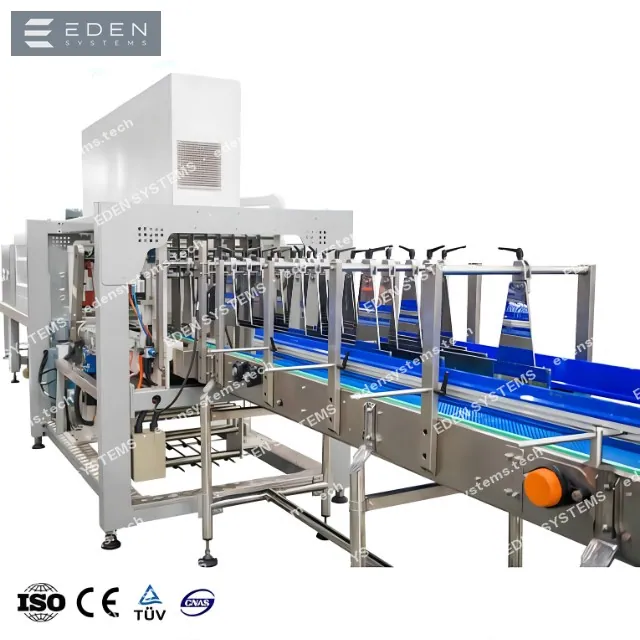
Half-tray wrapper
Containers are placed on a cardboard tray before film shrinking - improved block stability during transport and stacking.
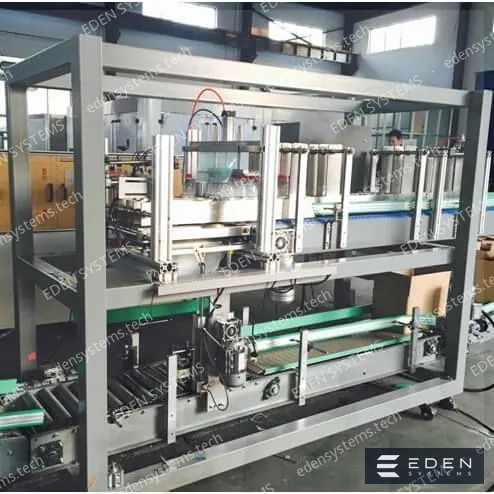
Wrap-around case packer
The case is formed around the grouped containers from a die-cut flat cardboard blank - holds shape better than film and suits branding needs.
Case packer
Case forming from a flat blank, bottle loading by manipulator or guide rails, tape sealing.
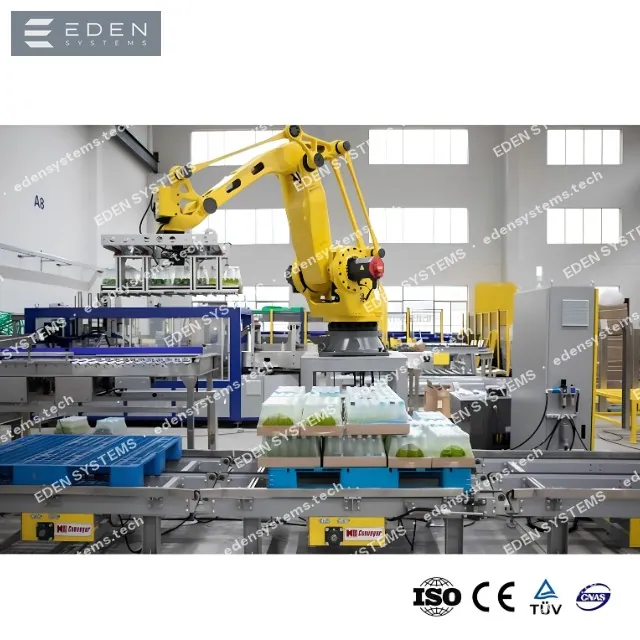
Robotic palletizer
Layer-by-layer pallet forming with interleaf sheets according to a set stacking algorithm - stores several patterns in memory for different container types.
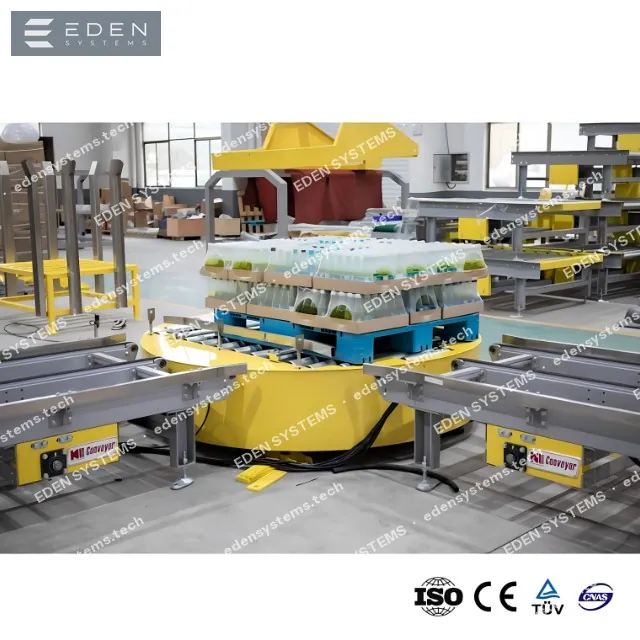
Depalletizer
Removes empty returnable containers or case blanks from a pallet and feeds them to the line without manual labor.
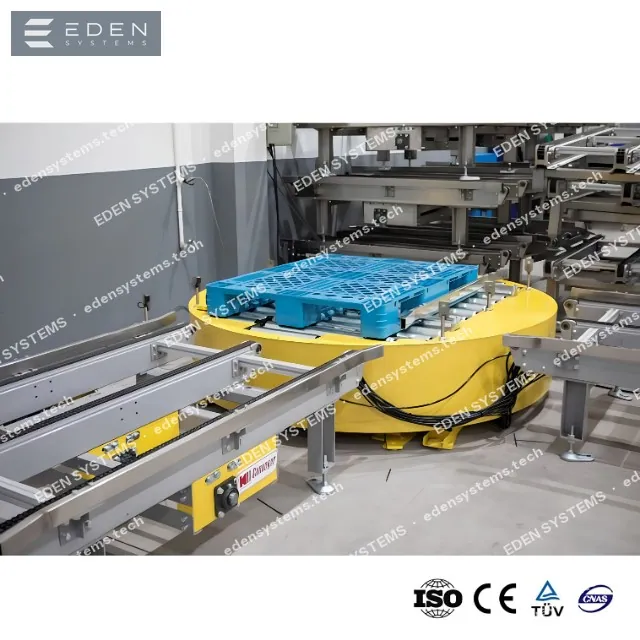
Pallet stretch wrapper
Wraps the formed pallet with pre-tensioned film and a top press - the pallet reaches the warehouse without shifting or losing packaging.
Auxiliary systems of the line
The engineering utilities without which a line never reaches its rated output: water and product preparation, sanitation, container handling.
Accumulation and grouping
The packing area inlet.
- Accumulation table or buffer loop smooths out packing-line stops
- Grouping into a defined matrix: 2×3, 3×4, 4×6
- Servo-driven dividers and pushers, gentle container handoff
- Count sensors and group-completeness checks before packing
Shrink-wrap and case forming
Forming the transport pack.
- Heat tunnel with heating and cooling zones, adjustable for film thickness
- Choice of cardboard tray, wrap-around or shelf-ready case
- Hot-melt gluing with spot application to save adhesive
- Format change via panel recipe and guide-rail repositioning
Palletizing
The line's handoff to the warehouse.
- Gantry or robotic palletizer with layer-by-layer stacking
- Stacking patterns for Euro pallets and non-standard sizes
- Automatic pallet and slip-sheet feeding between layers
- Wrapper with pre-stretch film and a top-press plate
Coding and inspection
Case label and SSCC pallet label.
- Inkjet or laser coder: date, shift, batch number, traceability code
- Fill-level, cap presence and seating inspection with automatic reject to a pocket
- Good/reject product counters logged per shift hour
- Ready for mandatory marking: case and pallet aggregation at the line outfeed
Conveying systems
Roller and chain conveyors for finished product.
- Air conveyor for empty containers with air filtration and neck guide rails
- Slat-top conveyor with independent drives and accumulation buffers between stations
- AISI 304 frame, Siemens / Schneider drives and controls, Sick photo sensors
- Photoelectric jam detection with automatic section stop before a line stoppage
FAQ
Shrink film or case?
Film is cheaper and faster; a case protects the product better in long-haul logistics and is more convenient at the retail checkout format. Lines often provide for both options.
Do we need a robot, or is a gantry enough?
A gantry palletizer is cheaper and simpler to maintain for a single pack pattern. A robot pays off when there are many patterns or it serves two lines at once.
How much does the Packing and Palletizing Solution cost?
Price on request: the budget depends on output, container type, line composition and the level of automation. After a short brief we send a preliminary estimate within 1–2 working days and a full quotation broken down by machine within 3–5 days.
What are the delivery and commissioning lead times?
Standard machines ship 8–12 weeks after the specification is confirmed, complete lines 12–20 weeks. Transport takes 2–6 weeks depending on the route; installation and commissioning on site take 2–4 weeks, with operator training included.
What output does this line reach?
The working range is up to 36,000 units/h at the infeed. Exact output is confirmed against your container, product and shift plan: we calculate the line balance and keep a margin on the bottleneck machine.
Request a quote: Packing and Palletizing Solution
Tell us the product, the container and the target output — we will return the line composition, a layout, a budget range and a delivery schedule.
Related solutions
Lines with a similar equipment set — useful when you plan several products on one site.
1,000–20,000 bph
Vegetable Oil Filling Line
Weight or volumetric oil filling into PET, glass and tinplate with capping, induction sealing, labelling and case packing.
Open solution2,000–36,000 bph
Drinking Water Filling Line, 0.33–1 L
Rinser-filler-capper monobloc for PET, water treatment, labelling and shrink packing.
Open solution100–1,200 bph
19-Litre Bottle Water Filling Line
Washing, disinfection and filling of returnable polycarbonate containers with capping and seal application.
Open solutionServices for this line
Engineering, logistics, installation and service that turn this line into a working production site.
Digital layer
Any line can be supplied with a digital layer
SCADA, MES, OEE monitoring, batch traceability and integration with plant systems — engineered together with the line, not bolted on later.