

Turnkey 19 L returnable-bottle water line: 100–1,200 bph
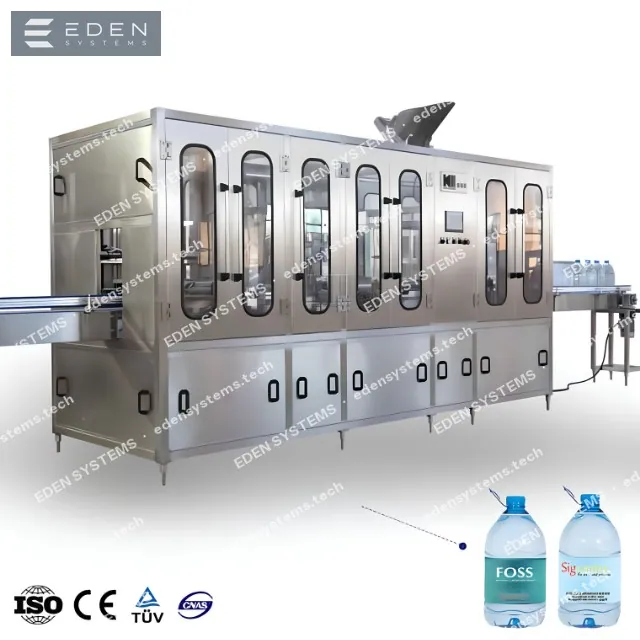
A complete cycle for returnable 18.9 L containers: decapping, external and internal brush washing, disinfection, filling, capping, shrink seal and palletising.
- Container
- Polycarbonate and PET 11.3 / 18.9 L (3 and 5 gallon)
- Output
- 100, 300, 600, 900, 1,200 bph
- Wash cycle
- External brush, internal brush, 3-stage rinse, disinfection
- Filling
- Gravity, with a fast large-bore valve
- Capping
- Cap press-on + heat-shrink seal
- Inspection
- Light inspection before and after filling
- Materials
- AISI 304 housing, AISI 316 product path
- Operators
- 2–4 people per shift
Line parameters
About the solution
The main task of a returnable-container line is not filling but guaranteed sanitation: the bottle comes back from the field, so the cycle includes an external brush, removal of the old cap, internal brush washing, three stages of washing with detergent and disinfectant solution, and a final rinse with finished product.
After filling, the bottle passes through a light inspection, a tamper-evident cap is fitted and shrunk on, the date is applied, and the container moves to the palletiser. The process is fully enclosed, eliminating secondary contamination.
Built into the design
Automatic decapping
The old cap is removed by the machine — the operator never touches the neck of the returned container.
Internal and external brush washing
Rotating brushes remove biofilm and scale that jet rinsing alone cannot clear.
Multi-stage washing
Alkaline solution, disinfectant and final rinse with finished product, in separate recirculating loops.
Tamper seal and traceability
Heat-shrink cap seal and batch coding confirm the bottle was not opened after filling.
Line composition along the product flow
8 positions along the product flow. Every unit opens in the catalog: series, specifications, scope of supply and a quote request.
- 1
1. Empty bottle infeed
Depalletising or manual loading onto the conveyor with container-integrity control.
11–19 L bottled water filling →
- 2
2. Decapping
Automatic removal of the old cap into a collection bin.
11–19 L bottled water filling →
- 3
3. External washing
Brushes and spray on the body and base, removing dirt from previous use.
11–19 L bottled water filling →
- 4
4. Internal washing and disinfection
Brush washing, alkaline solution, disinfectant, rinse with treated water.
11–19 L bottled water filling →
- 5
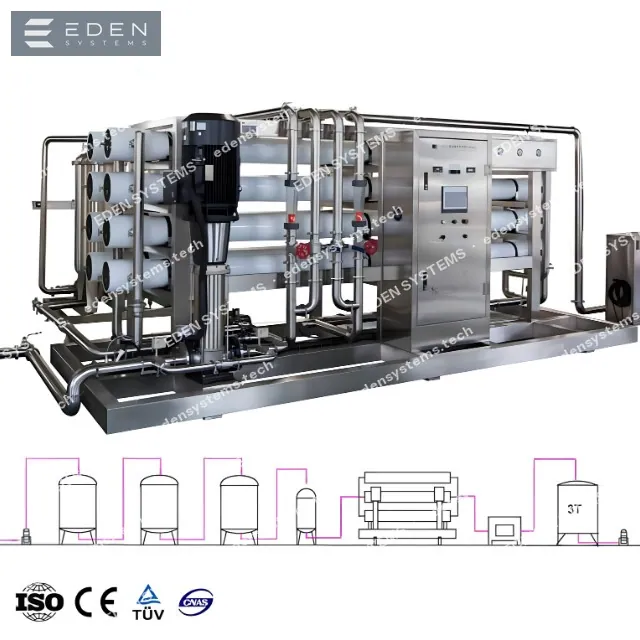
5. Water treatment
Reverse osmosis, UV and ozonation of the product before filling.
Water treatment →
- 6
6. Filling and capping
Gravity filling to 18.9 L and cap press-on in an enclosed zone.
11–19 L bottled water filling →
- 7
7. Seal and date coding
Fitting of a heat-shrink cap seal, shrink tunnel, date and batch marking.
Marking and quality inspection →
- 8
8. Inspection and palletising
Light inspection for level and foreign matter, stacking onto the pallet.
Packing and palletising →
Line model selection
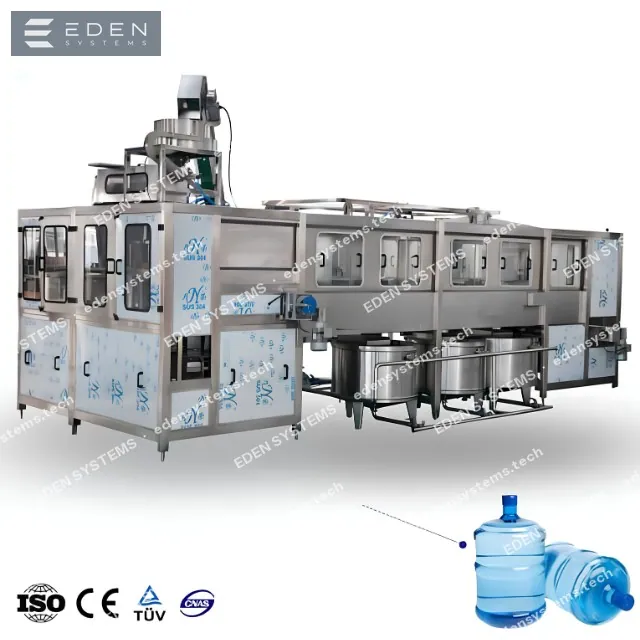
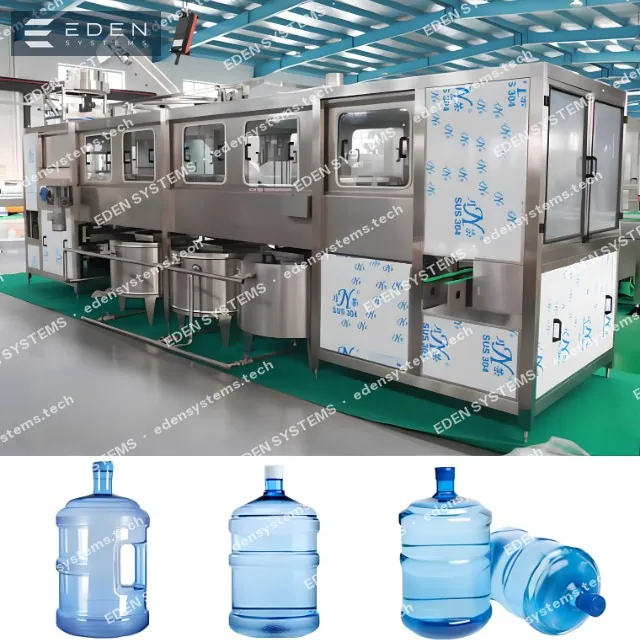
3-5 gallon bottle filling line
Gravity filling at ambient temperature, container material is polycarbonate or PET, round or square shape.
| Parameter | Value |
|---|---|
| Output | 60-1,200 btl/h |
| Container material | PC / PET |
| Bottle volume | 3-5 gallons (11.4-18.9 L) |
| Bottle size | diameter 276 mm, height 490 mm |
| Fill type | Gravity, at room temperature |
| Conveying | Belt conveyor |
Changeover parts and a container-dividing unit are purchased additionally for other bottle sizes and square containers.
Selection by output
The triblock model is selected by the number of washing, filling and capping positions.
| Washers / valves / heads | Output | Operators per shift |
|---|---|---|
| 6 / 6 / 2 | 60-200 btl/h | 3-4 |
| 8 / 8 / 4 | 200-450 btl/h | 4-5 |
| 12 / 12 / 4 | 450-800 btl/h | 5-6 |
| 16 / 16 / 6 | 800-1,200 btl/h | 6 |
Values are indicative and are refined once the line composition and source water quality are agreed.
Container, labeling and operating conditions
| Parameter | Value |
|---|---|
| Label | Self-adhesive, shrink sleeve or direct printing |
| Operating temperature | 10-40 °C, no condensation |
| Power supply | 380 V ±5%, 3-phase, 50 Hz ±1% |
| Packaging | Heat shrink neck band, manual or semi-automatic stacking |
A container-dividing unit is additionally installed before washing for square containers.
Line process flow
A 3-5 gallon returnable bottle line works with a multi-use container: each cycle includes receiving empty containers, double washing (external and internal), filling and inspection before shipment.
Key features of the gallon bottle line
- Double washing: external brush wash and internal high-pressure wash with caustic, disinfectant and ozonated water
- Every bottle is checked for cracks, deformation and foreign odor before washing
- A wash-fill-cap triblock in an enclosed zone reduces the risk of secondary contamination
- Caps are fed and washed with disinfectant and ozonated water before capping
- The filled bottle is inspected on a light box before labeling
- A heat-shrink neck band guarantees tamper evidence for the end consumer
- Optional connection to a shop-floor accounting and remote monitoring system
Standard layout for reusable PC/PET bottles with a full washing cycle.
- 1Receiving and depalletizing empty containers
- 2Cap remover
- 3Inspection for cracks, deformation and odor
- 4External brush washing
- 5Internal high-pressure washing (caustic, disinfectant, ozonated water)
- 63-in-1 triblock: rinsing - filling - capping
- 7Light-box inspection of the filled bottle
- 8Labeling and heat-shrink neck band
- 9Palletizing the finished product
Key line stations
What sits behind the nameplate output: contact-part execution, operating logic and service points for every station.
Water treatment station
Process-grade water
- Mechanical and carbon filtration, softening, reverse osmosis — the scheme is built from the raw-water analysis.
- Membranes with a flush system and VFD pump start: longer membrane life, no water hammer.
- UV and ozone disinfection, storage tank in AISI 316.
- Station capacity sized with a 20% margin over the line's peak demand.
Core machines of the line
Equipment of the “19-Litre Bottle Water Filling Line” layout: each tile opens the catalog with series, specifications and a quote request for that machine.
Bottle depalletizer
Layer-by-layer removal of empty returnable containers from the pallet and feeding onto the conveyor without manual labor.
Decapper
Automatically removes the old cap from the 55 mm neck and diverts it to a waste bin.
Leak and odor inspector
Checks bottles for cracks, deformation and foreign odor — unsuitable containers are rejected before washing.
External brush washer
Rotating brushes on the body, shoulders and base, plus a warm-water shower: removes dust and transport residue.
High-pressure washer
Internal treatment by station: alkaline wash, disinfectant, rinse with product-grade water and steam nozzle sterilization.
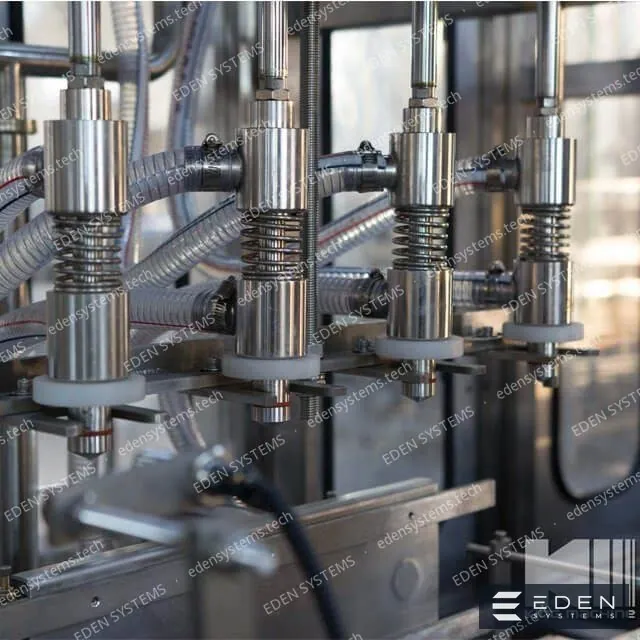
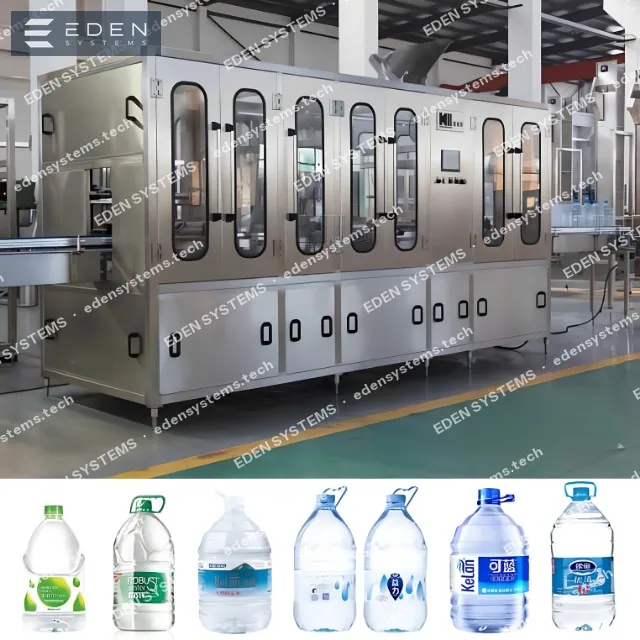
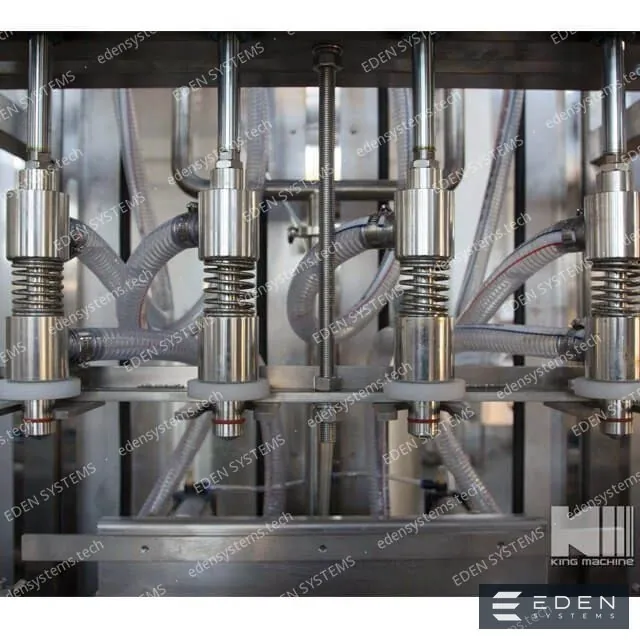
3-in-1 triblock
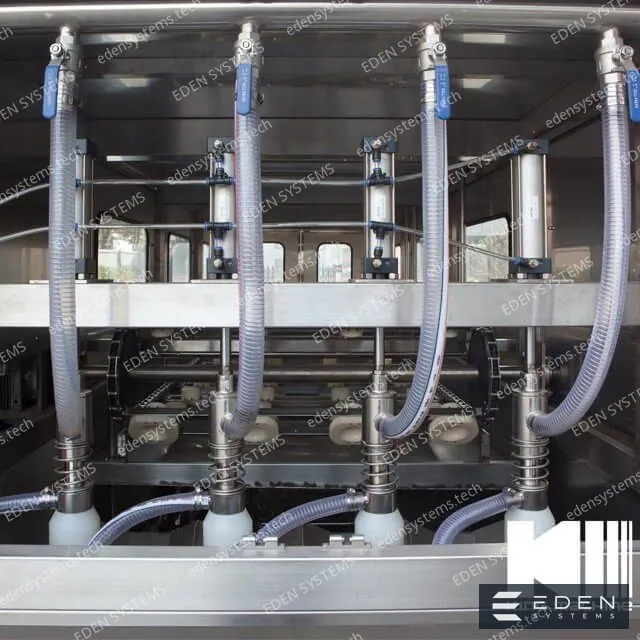
Washing, gravity filling of 18.9 L and cap press-fitting in an enclosed zone on a single frame.
Labeler and coder
Applies a body label and prints the filling date, shift number and expiration date.
Tamper-evident cap sleeving
Fits a thermal cap over the neck and shrinks it in a heat tunnel — guarantees a first-open seal.
Palletizer
Forms rows, stacks them layer by layer on a pallet, and hands off to stretch wrapping.
Which closure do you use
The cap type defines the capping block: heads, feeding and orientation of the closure, torque or press-on force. State your option in the request and we will select the head and sorter for it.
55 mm (smart cap)
Cap for 5-gallon (19 L) bottle
Press-fit onto the neck collar, with a shrink tamper-evident band applied over it.
Capping unit: Press head with shrink-seal band
Auxiliary systems of the line
The engineering utilities without which a line never reaches its rated output: water and product preparation, sanitation, container handling.
Water treatment
Water for filling and for washing returnable polycarbonate bottles.
- The scheme is built from a feed-water analysis: mechanical filtration, carbon, softening, reverse osmosis
- Station output sized with a 20% margin over peak line consumption and wash cycles
- Membranes with automatic flushing and VFD-driven pumps — no water hammer
- UV and ozone disinfection, AISI 316 buffer tank with a breather filter
Returnable bottle washer
The defining station for an 18.9 L line.
- Caustic wash, disinfection and triple-rinse sections
- Internal and external brushes with detergent feed, biofilm removal
- Heated solutions with temperature and concentration control
- Backlit visual inspection station before feeding to the filler
Depalletizing and cap removal
The line's inlet for returnable-container flow.
- Automatic cap removal with rejection of damaged bottles
- Accumulation conveyor with a buffer for uneven container returns
- Odor and foreign-liquid residue inspection at the inlet
- Container turnover tracking by batch number and cycle count
CIP station (clean-in-place)
Sanitation of the filling tank and product lines.
- Alkali, acid and hot-water tanks holding temperature within ±2 °C
- Recipe-driven wash programs: phase time, concentration and flow are logged
- Flow meter on the supply line — actual flow is verified, not assumed from the nameplate
- Filtered detergent return to the tanks; discharge only once the solution is spent
Coding and inspection
Fill date and batch number on the cap or neck.
- Inkjet or laser coder: date, shift, batch number, traceability code
- Fill-level, cap presence and seating inspection with automatic reject to a pocket
- Good/reject product counters logged per shift hour
- Ready for mandatory marking: case and pallet aggregation at the line outfeed
Conveying systems
Roller and slat conveying rated for 20 kg containers.
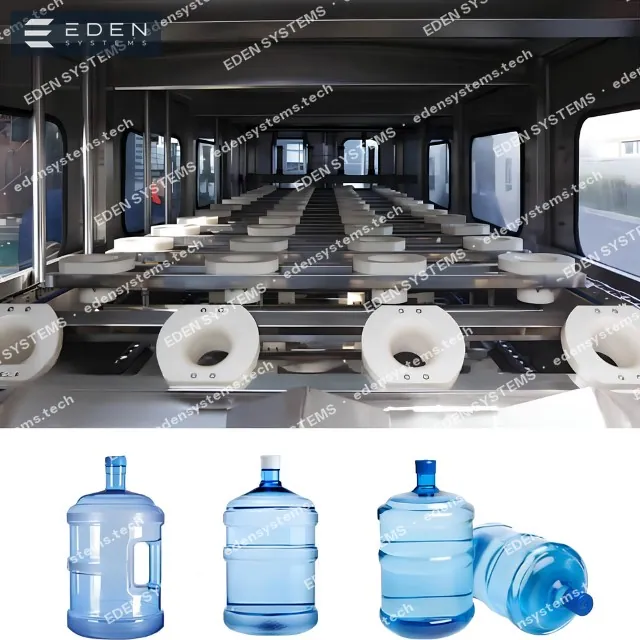
- Air conveyor for empty containers with air filtration and neck guide rails
- Slat-top conveyor with independent drives and accumulation buffers between stations
- AISI 304 frame, Siemens / Schneider drives and controls, Sick photo sensors
- Photoelectric jam detection with automatic section stop before a line stoppage
FAQ
How many wash stages are enough?
For returnable containers we always specify at least three: alkaline wash, disinfection and a rinse with finished product. Cutting stages quickly turns into microbiology complaints.
Can the line handle both new and returnable containers?
Yes, the line is designed with a bypass: new containers go through a shortened rinse cycle, returnable ones go through the full cycle.
How much does the 19-Litre Bottle Water Filling Line cost?
Price on request: the budget depends on output, container type, line composition and the level of automation. After a short brief we send a preliminary estimate within 1–2 working days and a full quotation broken down by machine within 3–5 days.
What are the delivery and commissioning lead times?
Standard machines ship 8–12 weeks after the specification is confirmed, complete lines 12–20 weeks. Transport takes 2–6 weeks depending on the route; installation and commissioning on site take 2–4 weeks, with operator training included.
What output does this line reach?
The working range is 100–1,200 bph. Exact output is confirmed against your container, product and shift plan: we calculate the line balance and keep a margin on the bottleneck machine.
Request a quote: 19-Litre Bottle Water Filling Line
Tell us the product, the container and the target output — we will return the line composition, a layout, a budget range and a delivery schedule.
Project budget
What drives the cost of a water filling line
The price is set by a combination of factors, not a single line item. We build the budget around your task and show the cost structure node by node — no hidden positions.
Output
Target bottles per hour define the machine class: from compact monoblocks to high-speed lines with automatic packaging.
Container and format
PET 0.33–1 L, PET 3–10 L, 19 L polycarbonate, glass — different tooling, capping and conveying.
Water treatment
Raw water analysis defines the train: filtration, softening, reverse osmosis, mineralisation, disinfection.
Automation level
Semi-automatic, automatic, or a line with robotic palletising and SCADA — a different budget and headcount.
End-of-line packaging
Labelling, coding, shrink wrapping, case packing, palletiser — each unit is added when it is needed.
Logistics and commissioning
Delivery, customs, supervised installation, operator training and the service package are part of the final quote.
Publishing average figures would be misleading: projects with similar output can differ several times over. Price is on request, and we quote against your actual input data.
Request a budget estimateRelated solutions
Lines with a similar equipment set — useful when you plan several products on one site.
2,000–36,000 bph
Drinking Water Filling Line, 0.33–1 L
Rinser-filler-capper monobloc for PET, water treatment, labelling and shrink packing.
Open solution600–3,600 bph
Water Filling Line, 3–10 L
Filling of large-format handled PET containers, capping and shrink packing.
Open solution3,000–36,000 bph
Carbonated Soft Drink Filling Line, PET
Mixer-carbonator, isobaric filling, capping and labelling.
Open solutionServices for this line
Engineering, logistics, installation and service that turn this line into a working production site.
Digital layer
Any line can be supplied with a digital layer
SCADA, MES, OEE monitoring, batch traceability and integration with plant systems — engineered together with the line, not bolted on later.
Your next step
Move from equipment selection to a turnkey project scope and a budget estimate.