

Lines by Product Type
19 L Water Filling Line: Returnable Containers and Sanitation
Filling 19-liter polycarbonate bottles is a distinct class of technology. The containers are returnable and come back from the market in unpredictable condition, so half of the line is dedicated not to filling, but to washing and inspection.
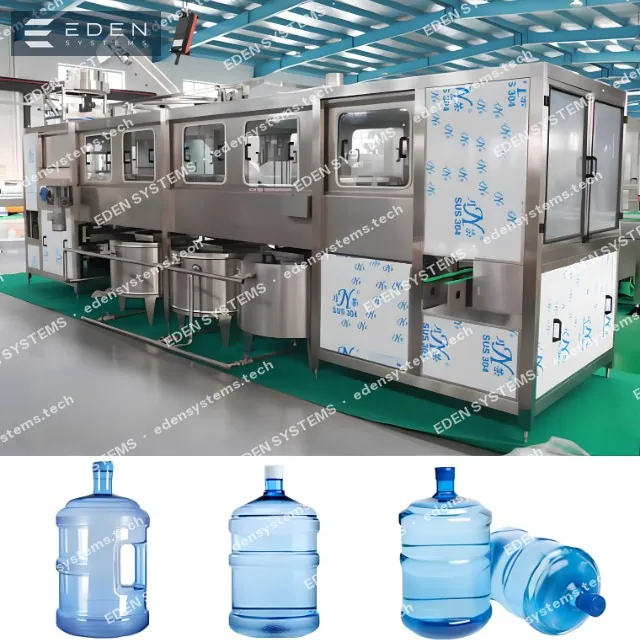
How 19 L Filling Differs from PET Filling
On a conventional line, containers arrive new and clean, and the rinser serves as protection against dust. On a 19 L line, a bottle returns from the consumer after several weeks of use, with residual water, sometimes foreign liquids, scratches, and biofilm on the walls.
The primary units are therefore inspection, multistage washing, and a second inspection. The filling block is relatively simple, while production reliability depends on strict rejection of unsuitable containers.
The second difference is weight and size. A full bottle weighs approximately 20 kg, so all conveying, lifting, and stacking mechanisms are designed for this load. At this weight, manual operations quickly reach the physical limits of personnel.
Line Configuration
- 1
Depalletizing and Feeding
Removing bottles from the pallet and feeding them to the conveyor. Automatic lines use a manipulator or lift.
- 2
Old Cap Removal and Disposal
An automatic cap remover is a separate unit; without it, the entire downstream process depends on a manual operation.
- 3
Initial Inspection
Rejection of bottles with cracks, deep scratches, and traces of foreign liquids. Part of the inspection is performed by an operator and part by an optical inspection system.
- 4
External and Internal Washing
A multi-station washer using an alkaline solution, acid when required, intermediate rinses, and a final rinse with treated water.
- 5
Rinsing with Ozonated Water
Final treatment of the inside surface immediately before filling.
- 6
Post-Wash Inspection
Inspection for cleanliness and residual solution. A bottle that fails inspection is sent through another cycle.
- 7
Filling
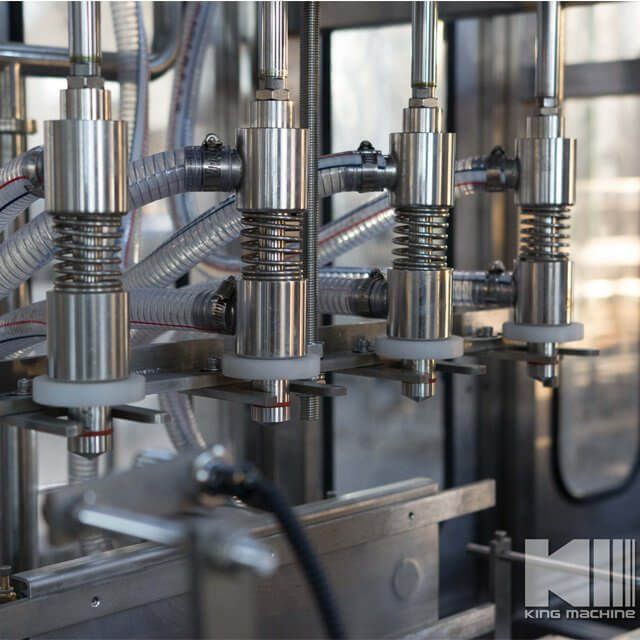
A 2-8-station filling block depending on capacity, using level or volumetric filling.
- 8
Capping
Press-on cap application, shrink-cap installation, and shrinking.
- 9
Date Coding and Tracking
Application of the date and batch number, plus container tracking for the returnable bottle fleet.
- 10
Palletizing
Stacking on a pallet and stretch wrapping.
Typical Capacities
| Automation Level | Capacity | Configuration | Personnel per Shift |
|---|---|---|---|
| Semi-Automatic | 60-150 bottles/hr | Manual or semi-automatic washing, 1-2-station filling | 3-4 |
| Entry-Level Automatic | 150-300 bottles/hr | Bottle washer, 3-6-station triblock | 2-3 |
| Automatic Line | 300-600 bottles/hr | Automatic cap removal, washing, inspection, triblock | 2-3 |
| High-Capacity | from 600 bottles/hr | Full automation, depalletizing, robotic palletizing | 2-3 |
Returnable Container Fleet
The economics of the 19 L business depend not only on water, but also on managing the bottle fleet. Each bottle represents a significant investment, lasts for a limited number of cycles, and is gradually lost at customer locations.
The practical conclusion for line design is that container tracking is required from day one. Applying and reading an identifier on each bottle makes it possible to track cycle count, remove containers from circulation at the proper time, and understand actual losses. Implementing this tracking retroactively is much more difficult.
FAQ
Polycarbonate or PET for 19 L bottles?
Polycarbonate withstands more high-temperature washing cycles and remains the standard for returnable containers. PET is less expensive and lighter but less resistant to alkaline washing and hot water, so it is used less often and requires gentler washing conditions.
Can 19 L filling be combined with small-container filling?
Not on the same line because the conveying mechanisms are fundamentally different. They can be installed at the same facility, which is a common arrangement: a separate 19 L section and a separate PET line sharing the same water treatment system and warehouse.
What water quality is required for washing?
The final rinse uses treated water of the same quality as the product. Using municipal water during the final stage negates the entire preceding cleaning cycle.
Read next
Ready solutions
Equipment catalog
Project services
Related projects
Calculation on the topic
We will calculate your line
Describe the product, packaging formats and planned volume — we will prepare a line scheme, specification and preliminary budget estimate with payback.
- Line scheme and unit specification for your product
- Budget range and payback period
- Site requirements: power, water, personnel