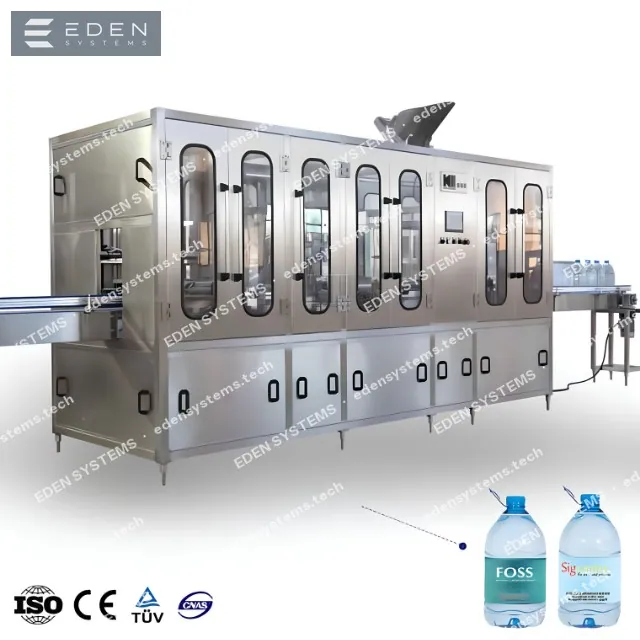

3–5 gallon, 100–1,200 bph

Water bottling equipment catalogue for 11–19 L bottles: 100–1,200 bph

Returnable polycarbonate and single-use PET containers of 11, 12 and 19 litres. The line combines unloading, external and internal washing, disinfection, filling, cap application and heat-shrink cap sleeving — all in one cycle.

Where it is used

  • Drinking water for offices and homes
  • Returnable 19 L polycarbonate containers
  • Single-use 11–12 L PET containers
  • Filling with ozonation and UV disinfection

Engineering highlights

Full wash cycle

1–6 washing stations: brush external wash, caustic internal wash, rinse with finished water.

Level dosing

A wide-bore valve fills 19 L in under 25 seconds with no overflow.

Returnable containers

Bottle light and odour inspection, rejecting unfit containers before washing.

3–5 gallon, 100–1,200 bph

Equipment series — 11–19 L bottled water filling

2

Washing, filling and capping on one frame. A base solution for a local water-delivery plant.

Output
100–300 bph
Container
Bottle 11–19 L
Washing stations
1–3
Filling
Gravity, 2–4 valves
Capping
1–2 heads, 55 mm cap
Power
from 3 kW
More about EDS-GAL-3

An industrial configuration: unloading bottles from the pallet, inspection, six-station washing, filling, capping, cap sleeving and date coding.

Output
600–1,200 bph
Container
Bottle 11–19 L
Washing stations
6
Filling
6–12 valves
Additional
Container inspection, heat-shrink cap application
Control
PLC, recipes and shift tracking
More about EDS-GAL-LINE

FAQ

Does the line work with both returnable and single-use containers?

Yes, switching over is done by changing grippers and the recipe. For single-use PET some washing stations are turned off.

What water is used for the final rinse?

The final rinse uses finished product water after treatment — this is a sanitary requirement and part of our supply.

Request a quotation for 11–19 L bottled water filling

Describe the product, the target output and the container — we will come back with a preliminary specification, a budget range and a delivery schedule. If the task covers more than one machine, we will map out the whole line.

11–19 L bottled water filling
Section
11–19 L bottled water filling
Series in section
2

Preferred channel

Certificate of state registration *

Drag and drop the file here or pick one · PDF, JPG, PNG, up to 10 MB

By submitting you agree to the processing of personal data.

Project budget

What drives the cost of a water filling line

The price is set by a combination of factors, not a single line item. We build the budget around your task and show the cost structure node by node — no hidden positions.

Output

Target bottles per hour define the machine class: from compact monoblocks to high-speed lines with automatic packaging.

Container and format

PET 0.33–1 L, PET 3–10 L, 19 L polycarbonate, glass — different tooling, capping and conveying.

Water treatment

Raw water analysis defines the train: filtration, softening, reverse osmosis, mineralisation, disinfection.

Automation level

Semi-automatic, automatic, or a line with robotic palletising and SCADA — a different budget and headcount.

End-of-line packaging

Labelling, coding, shrink wrapping, case packing, palletiser — each unit is added when it is needed.

Logistics and commissioning

Delivery, customs, supervised installation, operator training and the service package are part of the final quote.

Publishing average figures would be misleading: projects with similar output can differ several times over. Price is on request, and we quote against your actual input data.

Request a budget estimate

Other categories

Any line can be supplied with a digital layer

SCADA, MES, OEE monitoring, batch traceability and integration with plant systems — engineered together with the line, not bolted on later.