

Line Components and Technologies
Water Treatment for Filling: How to Select a Process for the Water Source
A water treatment system is designed based not on the filling line capacity, but on the chemical composition of the specific well water. Two wells in the same area may require different treatment processes, so an off-the-shelf catalog solution will only work some of the time.
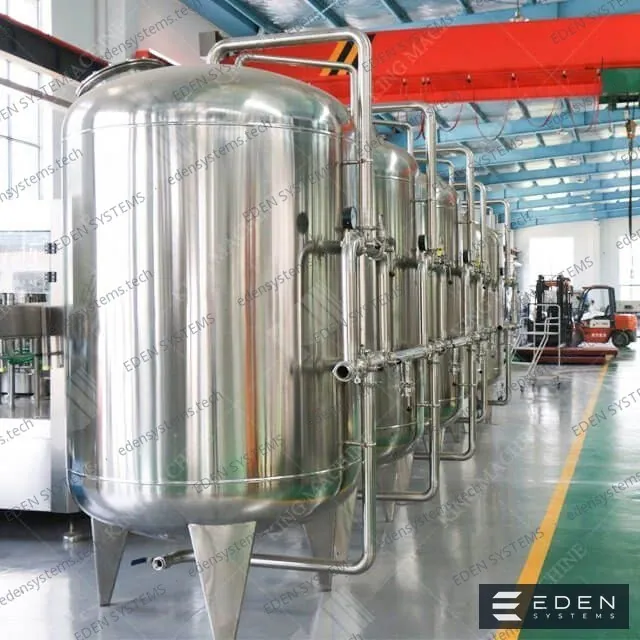
The First Step Is Analysis, Not a Catalog
Before design begins, a comprehensive test report is required: hardness, iron, manganese, hydrogen sulfide, total dissolved solids, oxidizability, and microbiology. A single sample is not enough—the composition of well water changes seasonally, and the process must be designed for the worst-case scenario.
The results determine everything that follows: the treatment stages, volume of filter media, chemical consumption, discharge volume, and ultimately the cost per liter of finished water.
The target water quality must be specified separately. Natural mineral water retains its natural composition and does not undergo deep demineralization. Purified drinking water may undergo reverse osmosis followed by remineralization. These are fundamentally different processes.
Typical Treatment Stages
The actual process is assembled from these modules, with unnecessary stages removed based on the analysis results.
- 1
Mechanical Filtration
Removes suspended solids and sand. Protects all downstream stages from abrasive wear.
- 2
Iron and Manganese Removal
Oxidizes dissolved iron and manganese, followed by filtration. Required for the typical composition of most well water.
- 3
Activated Carbon Adsorption
Removes organic compounds, chlorine, odors, and off-flavors.
- 4
Softening
Ion exchange reduces hardness. Mandatory upstream of membranes; without it, scale quickly forms on them.
- 5
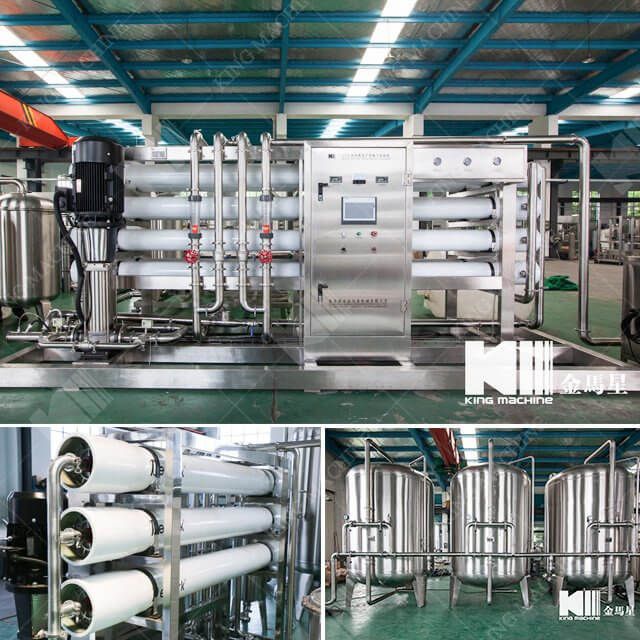
Reverse Osmosis
Deep purification to achieve low total dissolved solids. Produces permeate for purified drinking water and a concentrate stream for discharge.
- 6
Remineralization
Doses minerals to restore flavor and meet regulatory requirements.
- 7
Disinfection
In-line ultraviolet treatment and ozonation in the storage tank.
- 8
Final Filtration
Fine filter cartridges installed directly upstream of the filling unit.
Source Water Problems and Solutions
| Water Constituent | Consequence Without Treatment | Treatment Stage |
|---|---|---|
| Iron | Rusty color and sediment during storage | Oxidation and iron removal |
| Hardness | Scale and rapid membrane failure | Ion-exchange softening |
| Hydrogen sulfide | Odor and equipment corrosion | Aeration and adsorption |
| Organic compounds | Off-flavor and risk of secondary microbial growth | Activated carbon and oxidation |
| High total dissolved solids | Failure to meet standards and poor taste | Reverse osmosis |
| Microbiological contamination | Direct failure to meet safety requirements | UV and ozonation |
Operating Costs
In addition to capital costs, the system creates ongoing expenses: chemicals for softener regeneration, replacement cartridges and filter media, membrane replacement, and electricity for high-pressure pumps.
Water loss must also be calculated separately. Reverse osmosis sends part of the feedwater to the concentrate stream, and when well yield is limited, this may become the defining capacity constraint for the entire line. This calculation must be completed during design, not after startup.
FAQ
Can reverse osmosis be omitted?
Yes, if the source water already meets mineral composition requirements and only iron removal, softening, and disinfection are needed. This process is significantly less expensive to operate. The decision is based on the water analysis report.
How can you tell when the system is no longer performing properly?
The main indicators are rising total dissolved solids at the outlet at the same pressure, declining capacity, deteriorating organoleptic properties, and deviations in laboratory test results. This is why conductivity meters and pressure gauges with logged readings are installed: the trend becomes visible before a deviation appears in the finished product.
Does the system need reserve capacity?
Yes. The system is selected with a margin above the line's peak demand, including water used for container washing, CIP, and rinsing. Calculating capacity based only on the filling volume results in a water shortage when multiple operations occur simultaneously.
Read next
Ready solutions
Equipment catalog
Project services
Related projects
Calculation on the topic
We will calculate your line
Describe the product, packaging formats and planned volume — we will prepare a line scheme, specification and preliminary budget estimate with payback.
- Line scheme and unit specification for your product
- Budget range and payback period
- Site requirements: power, water, personnel