

Lines by Product Type
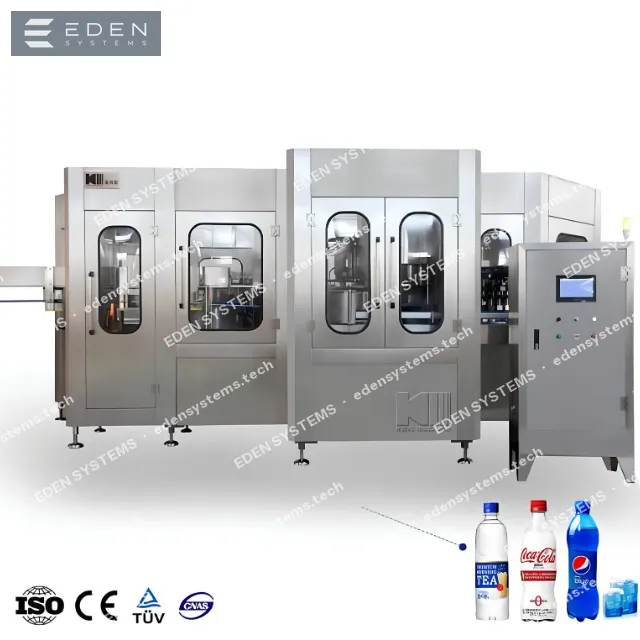
Carbonated Beverage Filling Line: Carbonation and Isobaric Filling
A carbonated beverage must not only be filled—it must retain its carbon dioxide during filling. This requires isobaric filling, a carbonator, deaeration, and tighter product temperature control throughout the entire process path.
The Process Physics in Two Paragraphs
The solubility of carbon dioxide in a liquid increases with pressure and decreases with temperature. Carbonation is therefore performed at a lower product temperature and higher pressure, while the entire downstream path is kept pressurized to prevent the gas from escaping.
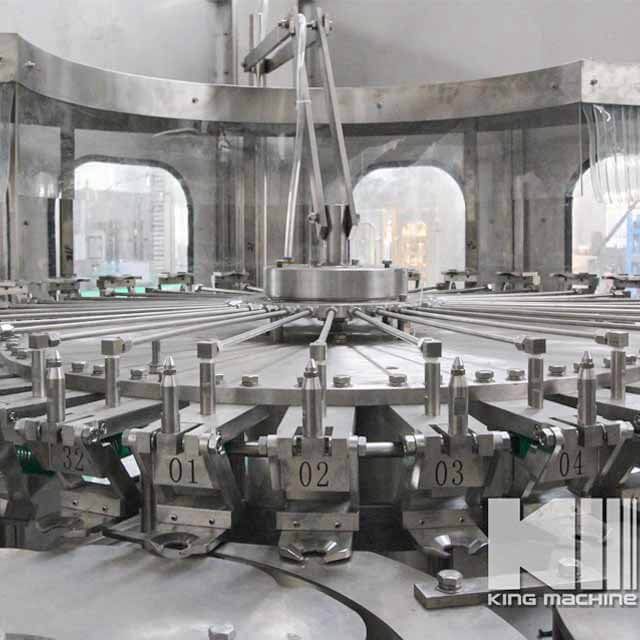
If a carbonated beverage is filled into an open bottle using a standard gravity valve, it will foam violently: the gas will escape as foam, the fill volume will be inaccurate, and the product will lose its specified carbonation. This is why isobaric filling is used—the bottle is first pressurized with gas to the same pressure as the ring bowl, after which the product flows smoothly under the difference in liquid levels.
Process Sequence
- 1
Water Treatment
Purified water serves as the beverage base. The requirements are the same as for drinking water.
- 2
Syrup Room
Sugar syrup preparation, dissolution, filtration, and cooling. Flavoring ingredients and acids are also added here.
- 3
Blending
Mixing syrup with water in the specified ratio and checking the density of the finished blend.
- 4
Deaeration
Removes dissolved oxygen. Oxygen reduces flavor stability and interferes with uniform carbonation.
- 5
Cooling
Lowers the product temperature for efficient gas dissolution.
- 6
Carbonation
Carbonation in a mixer-carbonator with control of the carbon dioxide volume.
- 7
Isobaric Filling
Container pressurization, counter-pressure filling, pressure release, and capping.
- 8
Holding and Inspection
Checks fill level, seal integrity, and actual carbonation in the finished bottle.
Requirements That Do Not Apply to Water
- Pressurized Containers
- A PET bottle for carbonated beverages has a petaloid base and uses a heavier preform. A standard water bottle is not suitable for carbonated beverages.
- Closure and Application Torque
- Internal pressure continuously pushes against the closure. Application torque and seal integrity must be controlled more strictly than for noncarbonated products.
- Temperature Control
- The path from the carbonator to the valve must maintain the product temperature. Product warming on the way to the filler causes foaming directly inside the valve.
- Carbonation Control
- Carbon dioxide volume is a specified product parameter. It is monitored both in-line and through sample testing of finished bottles.
- Syrup Preparation
- A separate area with its own tanks, heat exchangers, and CIP system. Its complexity is comparable to that of the filling unit itself.
Information Required Before Selecting a Line
| Parameter | What It Affects |
|---|---|
| CO2 volume | Carbonator capacity and process pressure |
| Presence of pulp or particles | Valve passage diameter and filtration type |
| Container formats | Number of change-part sets and base design |
| Sugar-based or sweetener-based | Syrup preparation and dissolution process |
| Shelf-life requirements | Need for deaeration and required hygienic level |
FAQ
Can noncarbonated water be filled on an isobaric line?
Yes, an isobaric machine can also operate without counter-pressure. The reverse is not possible: a gravity valve cannot properly fill a carbonated product. Isobaric filling is therefore considered a more versatile solution.
Is a separate line required for kvass and beer?
The filling technology is similar—isobaric counter-pressure filling. Product preparation differs: beer requires its own brewing and filtration area, as well as stricter limits on oxygen in the finished package.
Why do bottles sometimes deform on the pallet?
The most common cause is a combination of excessive carbonation, insufficient preform weight, and high warehouse temperature. All three parameters must be checked, not just the container.
Read next
Ready solutions
Equipment catalog
Project services
Related projects
Calculation on the topic
We will calculate your line
Describe the product, packaging formats and planned volume — we will prepare a line scheme, specification and preliminary budget estimate with payback.
- Line scheme and unit specification for your product
- Budget range and payback period
- Site requirements: power, water, personnel