
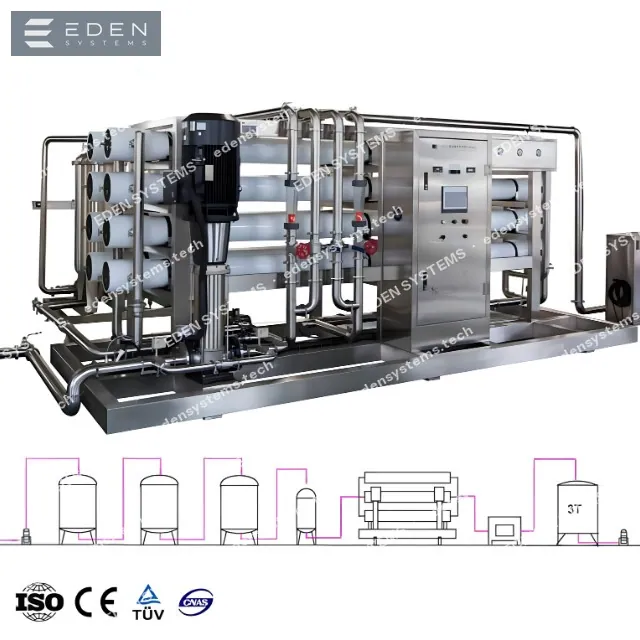
EDS-RO
Reverse osmosis unit
Membrane treatment with automatic flushing and permeate conductivity control.
- Output
- 0.5–50 m³/h
- Container
- —
- Stages
- Single- or two-stage
- Rejection rate
- 97–99%
- Control
- Conductivity, pressure, flow on the HMI
Osmosis, softening, disinfection
The station's composition is set by an analysis of the raw water, not by a catalogue. We design the chain so the water meets the standard for the finished product without paying for unnecessary stages.
Design from the analysis
The scheme is built on a lab report: iron, hardness, organics, microbiology.
Two-stage osmosis
For beverages with strict taste-neutrality requirements.
Disinfection
UV, ozone or a combination with residual-concentration control.
Osmosis, softening, disinfection
Membrane treatment with automatic flushing and permeate conductivity control.
Mechanical filtration, iron removal, softening and a carbon column ahead of the membranes.
The final stage before filling: a UV steriliser, ozone generator and contact tank.
A water analysis report (chemistry and microbiology), the required capacity in m³/h and the target standard for the product. That's enough for a first-pass scheme and budget.
For drinking water — usually yes, to get the right taste and mineral profile. For beverage process water it's often not.
Describe the product, the target output and the container — we will come back with a preliminary specification, a budget range and a delivery schedule. If the task covers more than one machine, we will map out the whole line.
Project budget
The price is set by a combination of factors, not a single line item. We build the budget around your task and show the cost structure node by node — no hidden positions.
Output
Target bottles per hour define the machine class: from compact monoblocks to high-speed lines with automatic packaging.
Container and format
PET 0.33–1 L, PET 3–10 L, 19 L polycarbonate, glass — different tooling, capping and conveying.
Water treatment
Raw water analysis defines the train: filtration, softening, reverse osmosis, mineralisation, disinfection.
Automation level
Semi-automatic, automatic, or a line with robotic palletising and SCADA — a different budget and headcount.
End-of-line packaging
Labelling, coding, shrink wrapping, case packing, palletiser — each unit is added when it is needed.
Logistics and commissioning
Delivery, customs, supervised installation, operator training and the service package are part of the final quote.
Publishing average figures would be misleading: projects with similar output can differ several times over. Price is on request, and we quote against your actual input data.
Request a budget estimateSee how these machines work inside a complete line, and which engineering services cover the project.
Drinking water bottling lines
10 series: PET and glass, 2,000–36,000 bph
Carbonated soft drink filling
Isobaric filling, carbonation
Juice and pulp drink filling
Hot filling and aseptic
Beer and low-alcohol drink filling
Glass, can, keg
Wine and spirits filling
Inert atmosphere, glass
Dairy product filling
ESL and aseptic
Digital layer
SCADA, MES, OEE monitoring, batch traceability and integration with plant systems — engineered together with the line, not bolted on later.
Move from equipment selection to a turnkey project scope and a budget estimate.