

Hot-Fill Juice-with-Pulp Line, PET
Filling of juices with pulp, fruit pieces and aloe: the product is non-homogeneous, so filling is done with a piston doser or a large-bore valve.
- Product
- Juices with pulp, nectars, drinks with aloe and fruit pieces
- Particle size
- up to 8–10 mm
- Container
- Heat-resistant PET 0.2–1.5 L
- Output
- 2,000–12,000 bph
- Dosing type
- Piston doser or large-bore valve
- Filling temperature
- 85–92 °C
- Dosing accuracy
- ±1% by volume
- Pasteurisation
- Tubular, with an enlarged clearance
Line parameters
About the solution
Pulp and particulates clog a standard gravity valve and distribute unevenly across bottles. The solution is a piston doser with a wide channel and an agitator in the supply tank, keeping the suspension uniform from the first bottle to the last in the batch.
Heat treatment runs in a tubular pasteuriser with a wide clearance: a plate heat exchanger clogs quickly on product with particulates. The rest follows a standard hot-fill cycle: hot filling, inversion, stepped cooling.
Built into the design
Suspension uniformity
The tank agitator and product recirculation keep pulp from settling — particle content stays consistent bottle to bottle.
Wide product path
Pipework, valves and seals are sized so particles are not crushed or trapped.
Piston dosing
Volume is set by piston stroke and does not depend on product viscosity or temperature.
Tool-free sanitation
All contact parts disassemble without tools: product with pulp needs manual washing more often than clear juice.
Line composition along the product flow
8 positions along the product flow. Every unit opens in the catalog: series, specifications, scope of supply and a quote request.
- 1
1. Preparation and blending
Concentrate reconstitution, pulp addition, deaeration in an agitated tank.
Water treatment →
- 2
2. Tubular pasteurisation
Heating of product with particulates without damaging pulp structure.
Juice and pulp drink filling →
- 3
3. Heat-resistant bottle blow moulding
PET with an enlarged neck opening for product with particulates.
PET stretch blow moulding equipment →
- 4
4. Piston doser
Metered-volume filling through a large-bore valve at 85–92 °C.
Juice and pulp drink filling →
- 5
5. Capping and inversion
Cap screwing and bottle tilt to sterilise the cap.
Capping equipment →
- 6
6. Cooling tunnel
Stepped cooling to 35–40 °C and drying before labelling.
Juice and pulp drink filling →
- 7
7. Labelling and date coding
Self-adhesive or roll-fed label, inkjet batch marking.
Labelling equipment →
- 8
8. Packing and palletising
Shrink packing, case loading and palletising.
Packing and palletising →
Line model selection
Selecting a monoblock for juice-with-pulp filling
4-in-1 rinse-pulp-fill-cap technology. Output is given for 500 mL containers; container range 0.25-2.5 L.
| Model | Rinsers / pulp dosers / valves / capping heads | Output (500 mL) | Installed power |
|---|---|---|---|
| EDS-PULP4-18-18-18-6 | 18 / 18 / 18 / 6 | 4,000-5,000 btl/h | 100 kW |
| EDS-PULP4-24-24-24-8 | 24 / 24 / 24 / 8 | 6,000-8,000 btl/h | 140 kW |
| EDS-PULP4-32-32-32-10 | 32 / 32 / 32 / 10 | 9,000-11,000 btl/h | 180 kW |
| EDS-PULP4-40-40-40-12 | 40 / 40 / 40 / 12 | 12,000-15,000 btl/h | 220 kW |
Separate dosing of pulp and liquid phase keeps the pulp fraction in the finished bottle within the set range. Line output range - 1,000-32,000 btl/h.
Blending and cooking module for pulp-containing product
| Unit | Purpose | Material |
|---|---|---|
| Puree reconstitution tank with agitator | Puree reconstitution or pulp size reduction to the required fraction | AISI 304 |
| Finisher / pulper | Separation of large particles and pits, pulp fraction calibration | AISI 304 |
| Plate heat exchanger + UHT sterilizer | Heating the liquid phase to a filling temperature of 85-92 °C | AISI 316 |
| Jacketed buffer tanks for pulp and liquid phase | Separate temperature maintenance before the monoblock | AISI 304 |
Pipe and valve bore sizes are calculated for the specific pulp particle size.
Packaging
| Package type | Layout patterns | Marking |
|---|---|---|
| PE shrink film | 2×3 / 3×4 / 4×6 | Inkjet printing of date and batch |
| Cardboard case with dividers | 6 / 12 bottles | Thermal transfer printing on the case |
Power supply 380 V ±5%, 3-phase, 50 Hz; control circuits 24 V. Separate steam and chilled water circuits.
Line process flow
The juice-with-pulp line is built around a 4-in-1 rinse-pulp-fill-cap monoblock: pulp and liquid phase are dosed separately, which keeps their ratio in the bottle constant, while product preparation, container blow molding and cooling are added upstream and downstream of the monoblock.
Key features of juice-with-pulp filling
- 4-in-1 rinse-pulp-fill-cap technology on a single rotor, with no intermediate bottle transfer
- Separate volumetric dosing of pulp and liquid phase with fine adjustment of each dose
- Wide-passage nozzles and valves pass pulp particles and fibers without clogging
- Product-contact parts and tanks in AISI 304/316, polished with no stagnant zones
- Flipping the bottle using the product's own heat sterilizes the inner surface of the cap
- Electromagnetic capping heads: no bottle - no capping, capping defect rate below 0.2%
- Key electrical components from Mitsubishi, OMRON, Siemens; filling accuracy ±1%
- Output 1,000-32,000 btl/h for 500 mL containers, container range 0.25-2.5 L
Base layout: puree is finished and calibrated by particle size before blending with the liquid juice phase.
- 1Water treatment station
- 2Puree reconstitution, finisher and pulp fraction calibration
- 3Plate heat exchanger and UHT sterilization of the liquid phase
- 4Heat-resistant PET bottle blow molder
- 5Air conveyor for containers
- 64-in-1 monoblock: rinsing - pulp - filling - capping
- 7Bottle inverter (cap sterilization)
- 8Spray cooling tunnel
- 9Fill level and capping inspection
- 10Labeling, date coding, packing
Key line stations
What sits behind the nameplate output: contact-part execution, operating logic and service points for every station.
Blending and UHT block
Product preparation
- High-shear blending unit: sugar, concentrate and stabilizer disperse without clumping.
- Tubular or plate heat exchanger, holding and cooling on a set curve.
- Homogenizer up to 200 bar — a stable emulsion with no separation in the bottle.
- Jacketed buffer tank maintains the filling-supply temperature.
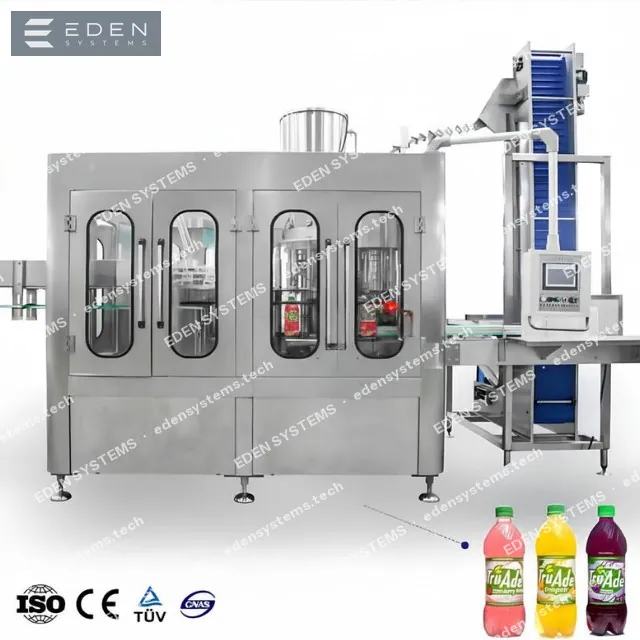
Core machines of the line
Equipment of the “Hot-Fill Juice-with-Pulp Line, PET” layout: each tile opens the catalog with series, specifications and a quote request for that machine.
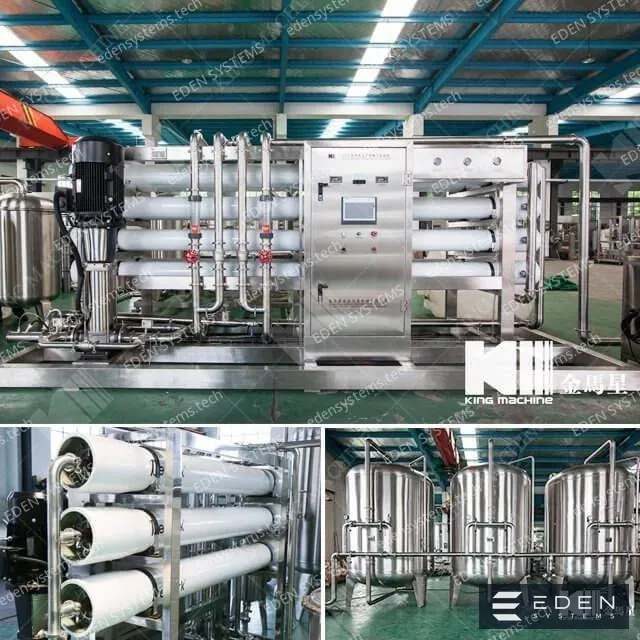
Water treatment station
Mechanical filtration, softening, reverse osmosis and UV disinfection for the blending room and container washing.
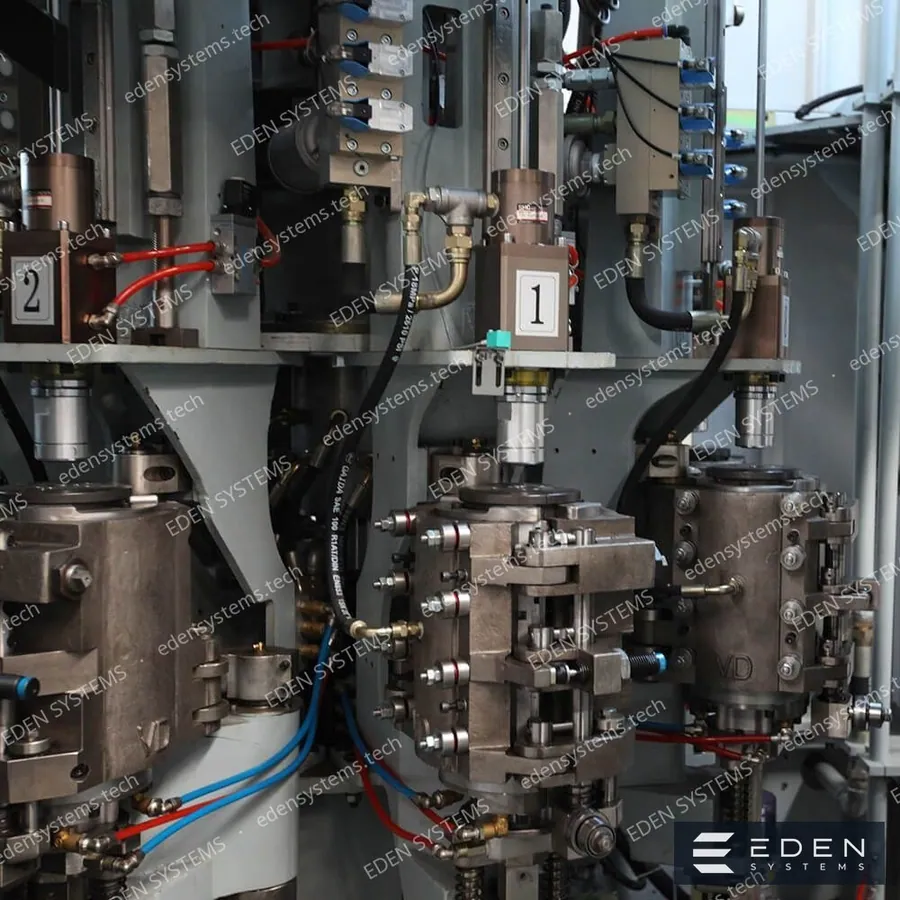
Heat-resistant PET bottle blow molder
Blow molding of the bottle from a heat-resistant wide-mouth preform for subsequent filling of the pulp-containing product.
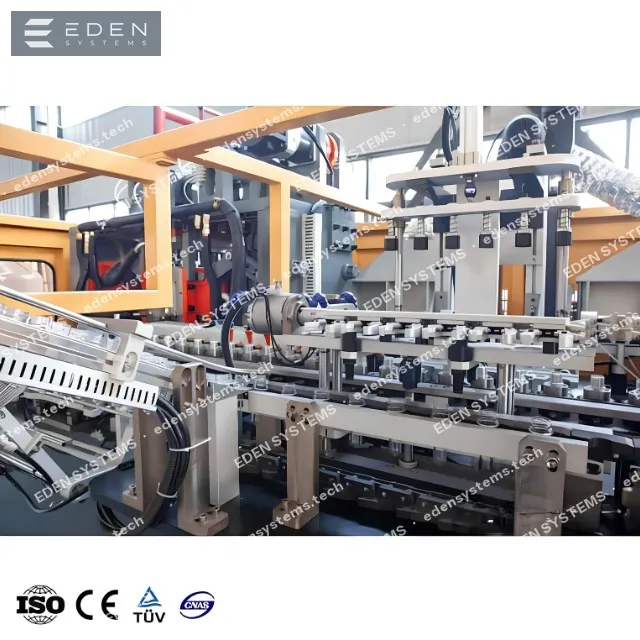
Air conveyor for containers
Transfers the bottle by the neck ring from the blow molder to the monoblock without the body touching the guide rails.
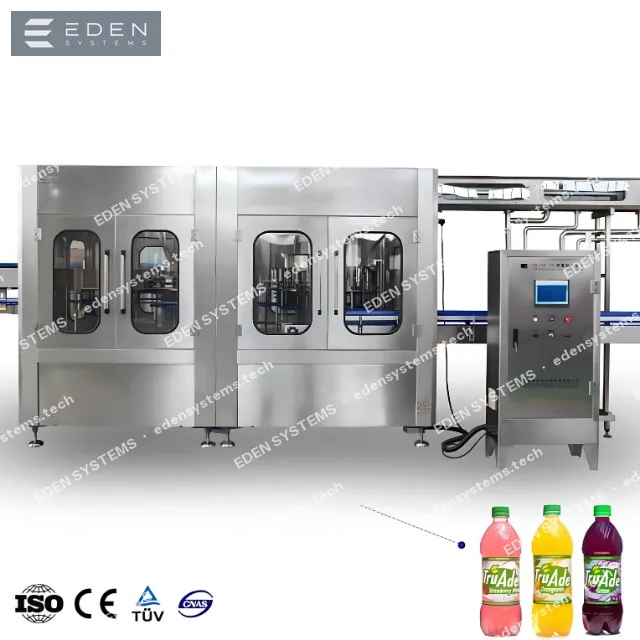
4-in-1 rinsing-pulp-filling-capping monoblock
Rinsing, wide-passage valve pulp dosing, volumetric filling of the liquid phase and capping on a single frame without intermediate container transfer.
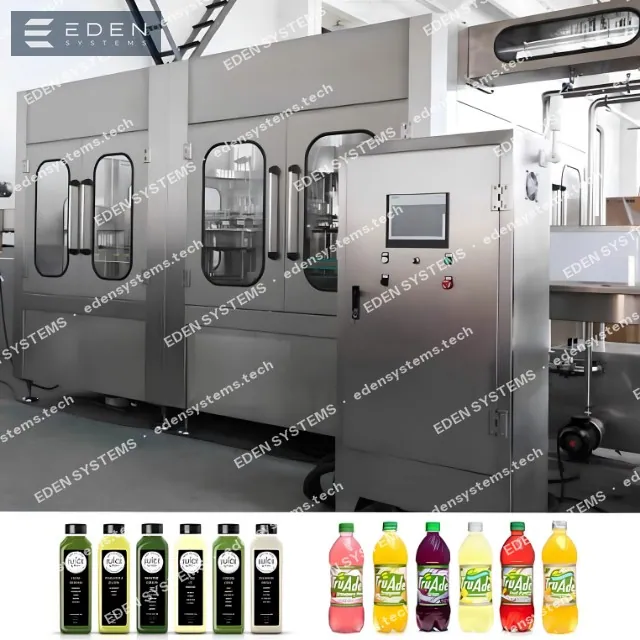
Pulp doser
Wide-passage nozzle and volumetric doser pass pulp particles and fibers without clogging; the dose is calibrated independently from the liquid phase.
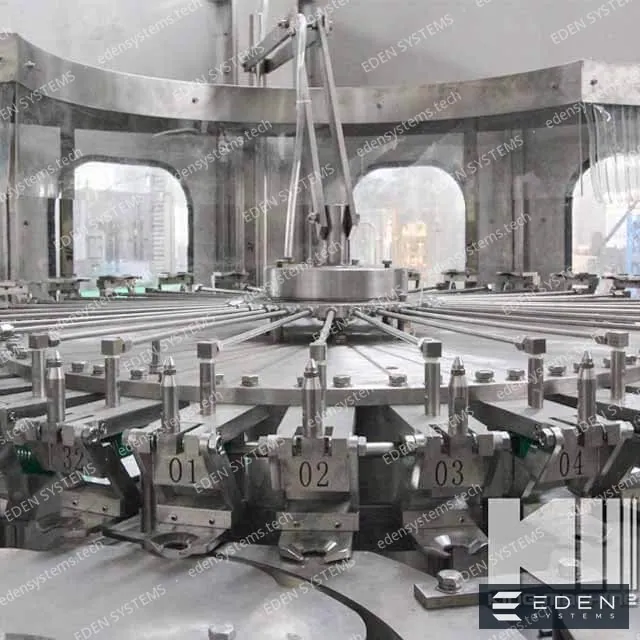
Bottle inverter
A brief bottle flip after capping uses the product's own heat to sterilize the inner surface of the cap.
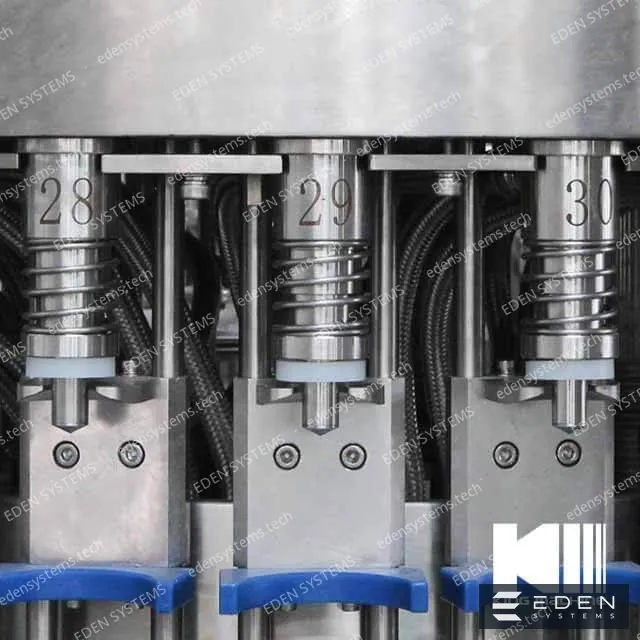
Spray cooling tunnel
Stepwise showering of the bottle with water of increasing hardness after hot filling, with a hinged top for nozzle maintenance.
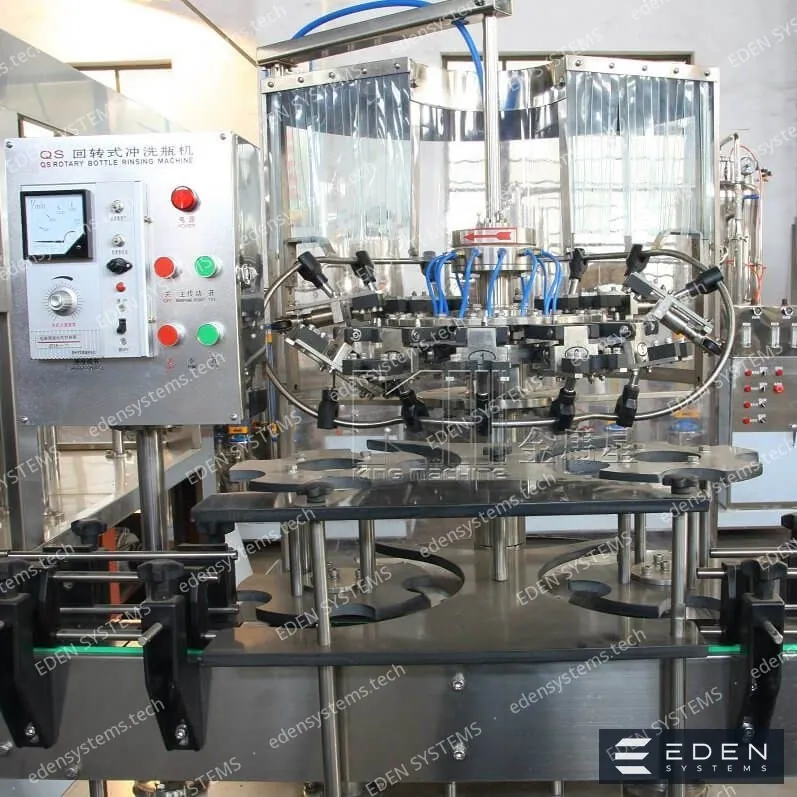
Fill level and capping inspector
Checks fill level, cap presence and seating by transmitted light with automatic rejection on the conveyor.
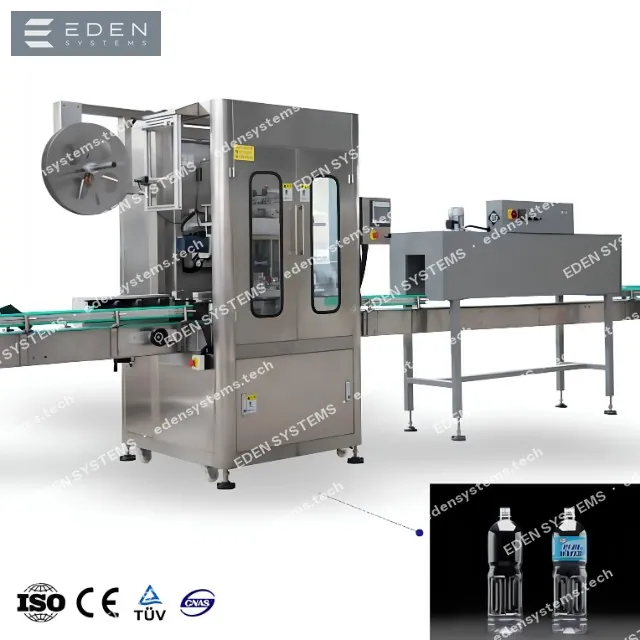
Labeling machine
PVC shrink sleeve or self-adhesive label matching the package design, full or half-body application.
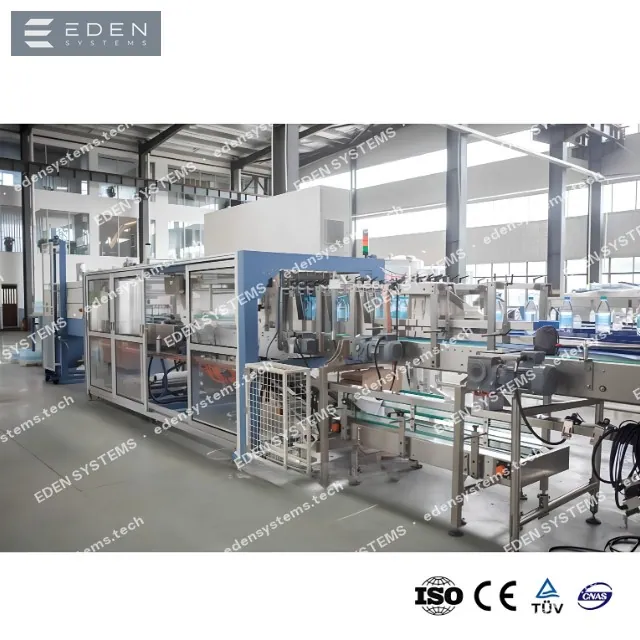
Packing and palletizing
Group shrink wrap packaging or case packing with pallet formation and stretch wrap before shipment.
Which closure do you use
The cap type defines the capping block: heads, feeding and orientation of the closure, torque or press-on force. State your option in the request and we will select the head and sorter for it.
PCO 1881 / 28 mm / 38 mm
Plastic screw cap
The tamper-evident band tears on opening. Torque is set on the HMI and monitored on every chuck.
Capping unit: Magnetic screwing head
foil 0.2–0.9 mm
Induction liner under the cap
The liner is welded to the finish after capping — tamper protection and seal integrity during transport.
Capping unit: In-line induction sealer
Auxiliary systems of the line
The engineering utilities without which a line never reaches its rated output: water and product preparation, sanitation, container handling.
Water treatment
Water for concentrate reconstitution and sanitation.
- The scheme is built from a feed-water analysis: mechanical filtration, carbon, softening, reverse osmosis
- Station output sized with a 20% margin over peak line consumption and wash cycles
- Membranes with automatic flushing and VFD-driven pumps — no water hammer
- UV and ozone disinfection, AISI 316 buffer tank with a breather filter
Pulp-containing juice preparation
Handling a product with fiber and fruit particles.
- Slow-agitator blending vessel — pulp stays intact and does not settle
- Tubular pasteurizer with a wide flow path for particulates
- Aseptic or buffer tank with even suspension agitation
- Liquid-phase-to-pulp ratio control per batch recipe
Piston dosing for pulp
Precise dosing of a product with particulates.
- Servo-driven piston doser, dose repeatability ±0.5%
- Lifting bottom-up nozzle — fill from the bottom without splashing or foam
- Flow path clears particles up to 8 mm without shredding
- Quick-change dosing units: volume change in about 15 minutes
Inverter and cooling tunnel
Cap sterilization and temperature drop.
- 15–30 second on-side hold — sterilizes the cap from the inside
- Three to four shower zones, cooling to 35–40 °C without thermal shock
- Cooling-water recirculation with filtration and disinfection
- Bottle body air-blow before labeling
CIP station (clean-in-place)
A pulp-bearing path needs higher flow rate and turbulence to wash out.
- Alkali, acid and hot-water tanks holding temperature within ±2 °C
- Recipe-driven wash programs: phase time, concentration and flow are logged
- Flow meter on the supply line — actual flow is verified, not assumed from the nameplate
- Filtered detergent return to the tanks; discharge only once the solution is spent
Conveying systems
Conveying of hot and cooled containers.
- Air conveyor for empty containers with air filtration and neck guide rails
- Slat-top conveyor with independent drives and accumulation buffers between stations
- AISI 304 frame, Siemens / Schneider drives and controls, Sick photo sensors
- Photoelectric jam detection with automatic section stop before a line stoppage
Coding and inspection
Date coding and fill-level inspection on an opaque product.
- Inkjet or laser coder: date, shift, batch number, traceability code
- Fill-level, cap presence and seating inspection with automatic reject to a pocket
- Good/reject product counters logged per shift hour
- Ready for mandatory marking: case and pallet aggregation at the line outfeed
Packing and palletizing
Shrink-wrap and palletizing of finished product.
- Shrink film pack or corrugated case, format tailored to the retailer's requirements
- Layer palletizer to a defined pattern, robotic version for constrained floor space
- Pallet wrapper with pre-stretch film: lower film consumption, pallet withstands transport
- SSCC pallet label printing and application, data handoff to the ERP system
FAQ
What is the maximum piece size?
Up to 8–10 mm by default. Larger particles require a special dual-action doser — we evaluate that option separately for your recipe.
Can clear juice be filled on the same line?
Yes, the piston doser also works with homogeneous products; the reverse is not true — a gravity machine cannot handle pulp.
How much does the Hot-Fill Juice-with-Pulp Line, PET cost?
Price on request: the budget depends on output, container type, line composition and the level of automation. After a short brief we send a preliminary estimate within 1–2 working days and a full quotation broken down by machine within 3–5 days.
What are the delivery and commissioning lead times?
Standard machines ship 8–12 weeks after the specification is confirmed, complete lines 12–20 weeks. Transport takes 2–6 weeks depending on the route; installation and commissioning on site take 2–4 weeks, with operator training included.
What output does this line reach?
The working range is 2,000–12,000 bph. Exact output is confirmed against your container, product and shift plan: we calculate the line balance and keep a margin on the bottleneck machine.
Request a quote: Hot-Fill Juice-with-Pulp Line, PET
Tell us the product, the container and the target output — we will return the line composition, a layout, a budget range and a delivery schedule.
Related solutions
Lines with a similar equipment set — useful when you plan several products on one site.
2,000–18,000 bph
Hot-Fill Juice Line, PET
Pasteurisation, filling at 85–92 °C, cooling tunnel and labelling.
Open solution2,000–36,000 bph
Drinking Water Filling Line, 0.33–1 L
Rinser-filler-capper monobloc for PET, water treatment, labelling and shrink packing.
Open solution600–3,600 bph
Water Filling Line, 3–10 L
Filling of large-format handled PET containers, capping and shrink packing.
Open solutionServices for this line
Engineering, logistics, installation and service that turn this line into a working production site.
Digital layer
Any line can be supplied with a digital layer
SCADA, MES, OEE monitoring, batch traceability and integration with plant systems — engineered together with the line, not bolted on later.