

Production Startup
How Much Does a Filling Line Cost? Understanding the Budget
The question “How much does a filling line cost?” cannot be answered without five clarifications. We explain which parameters have the greatest impact on the budget, which items are often overlooked, and why the equipment price is not the full project cost.
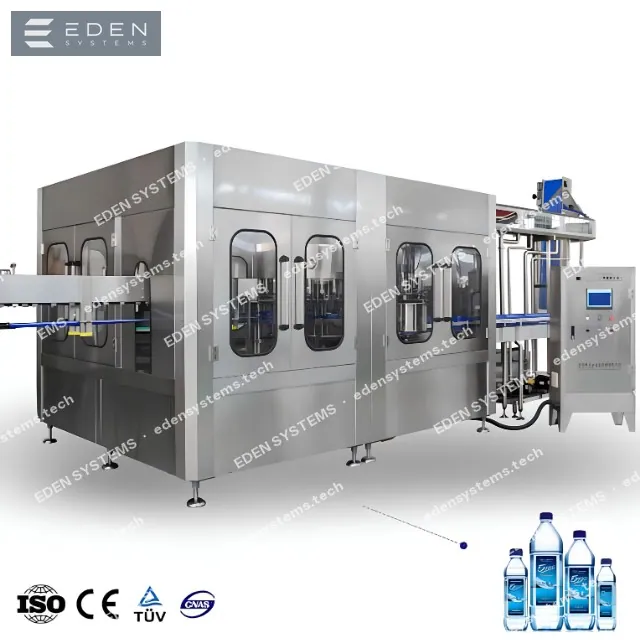
Why the Same “Water Filling Line” Can Vary Severalfold in Price
The difference between a semi-automatic section rated at 1 000 bottles per hour and an automatic line rated at 12 000 is not 50%, but an order of magnitude. Yet both are correctly described as water filling lines.
Even at the same capacity, the budget is affected by in-house blowing, the water treatment configuration required for the specific source, the level of packaging automation, the number of container formats, and coding requirements.
Therefore, the first honest response to a price inquiry is a list of clarifying questions, not a figure. A figure provided without those answers means the supplier has inserted a standard configuration that is not necessarily suitable for your site.
Five Parameters That Determine the Budget
- Capacity
- The primary multiplier. It is calculated from annual volume, accounting for seasonality and shift patterns, rather than based on a desired number. An oversized line means tied-up capital and slow payback.
- Product
- Water, carbonated beverages, hot-filled juice, oil, and chemicals require different filling valves, materials, and sanitation standards. Carbonated products require a more expensive filling block than water and also require carbonation.
- Containers and Number of Formats
- Each additional format requires a set of change parts and sometimes a separate mold. Reducing the packaging range is often more economical than expanding the tooling.
- In-House Blowing
- This adds a blow molder, high-pressure compressor, chiller, and molds. It is a significant cost item that pays back through lower container costs.
- Level of End-of-Line Automation
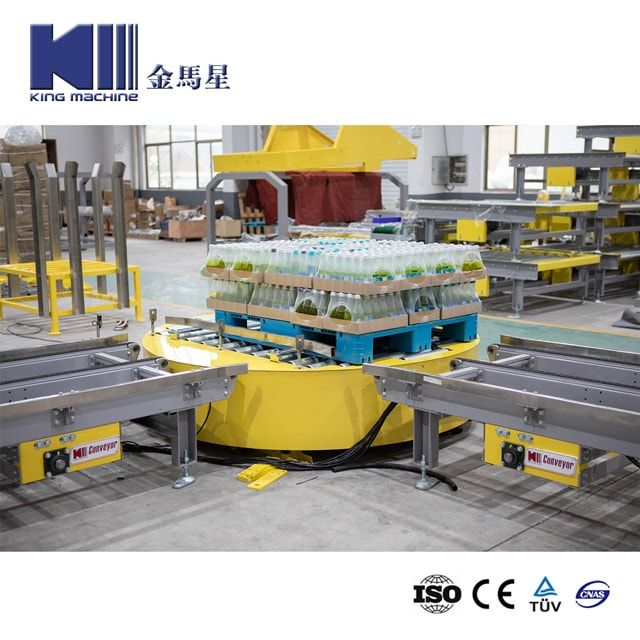
- Manual case packing, semi-automatic shrink wrapping, and an automatic robotic palletizer represent three very different budgets for the same filling process.
Project Cost Structure
The shares are approximate and vary by project, but the proportions are representative.
| Cost Item | What It Includes | Note |
|---|---|---|
| Main Equipment | Filling, blowing, capping, labeling | Usually the largest share of the budget |
| Product Preparation | Water treatment, syrup preparation, blending tanks | Determined by raw material analysis |
| Utilities | Compressors, chiller, air and water distribution | Often excluded from the machine supplier’s proposal |
| Packaging and Palletizing | Shrink wrapping, palletizer, stretch wrapper | Can be readily scaled to fit the budget |
| Logistics and Customs | Delivery, insurance, clearance, rigging | Depends on geography and equipment dimensions |
| Installation and Commissioning | On-site work, ramp-up to operating conditions | The most expensive area to cut |
| Facility and Utilities | Floors, finishes, electrical work, ventilation, drainage | Customer’s responsibility |
| Spare Parts and Training | Initial parts inventory, personnel preparation | Cost savings result in downtime |
Payback
The payback period is calculated from the difference between revenue and total production cost, including raw materials, containers, packaging, energy, personnel, logistics, and maintenance. The most common calculation error is assuming full line utilization from the first month.
A realistic model accounts for the ramp-up period, demand seasonality, and equipment utilization. A line physically capable of producing 12 000 bottles per hour has an annual output determined by the number of shifts and actual utilization, not by its rated capacity.
The second major factor is container cost. For mass-market beverages, the bottle cost can be comparable to the cost of the contents, and in-house blowing can affect project economics more than an increase in filling speed.
FAQ
Which is less expensive: a new line or a used line?
A used line has a lower purchase price. Total cost of ownership is less clear because of unknown operating history, missing documentation, discontinued components, and the inability to guarantee capacity. We regularly perform technical audits of this equipment before purchase, which costs significantly less than resolving problems afterward.
Can the budget be reduced without compromising product quality?
Yes, by reducing end-of-line automation: manual secondary packaging instead of automatic packaging and manual palletizing during startup. Water treatment, sanitation, inspection, and the CIP circuit are not appropriate areas for cost reduction because they directly affect product quality.
How strongly does the equipment’s country of manufacture affect the budget?
There is a difference, but it is smaller than the difference between configurations. Within the same price category, the decisive factors are the component class used in drives and automation, engineering quality, and the availability of service and spare parts in your region.
Read next
Ready solutions
Equipment catalog
Project services
Related projects
Calculation on the topic
We will calculate your line
Describe the product, packaging formats and planned volume — we will prepare a line scheme, specification and preliminary budget estimate with payback.
- Line scheme and unit specification for your product
- Budget range and payback period
- Site requirements: power, water, personnel