

Production Startup
Turnkey Filling Line: What Is Actually Included in the Supply
“Turnkey” means different things to different suppliers: from “the machines were delivered to the gate” to “the plant has reached its rated capacity and operates without us.” We explain what a complete system consists of, which tasks are commonly omitted from the contract, and which items should be compared when reviewing commercial proposals.
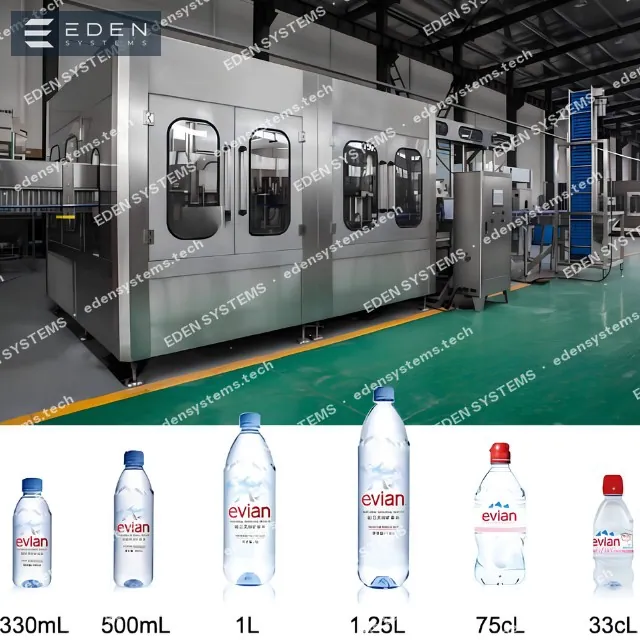
Why the Term “Turnkey” Requires Clarification
Formally, a turnkey filling line means a single contract under which the customer receives an operating production facility rather than a set of equipment. In practice, the scope of work varies dramatically among suppliers, making it meaningless to compare commercial proposals based only on the final price: one budget includes engineering, supervised installation, training, and a year of service, while another includes only machines supplied under FOB terms.
The difference becomes apparent at the site. The equipment is in the facility, but no one is responsible for supplying compressed air at the required pressure, integrating the conveyors with the existing warehouse, or addressing the fact that a line rated at 12 000 bottles per hour actually produces 8 000 because of a labeling bottleneck. Formally, the supplier has fulfilled its obligations.
The contract should therefore be reviewed based not on its title, but on the scope of work and how the result is measured. Below is the scope we consider complete.
Full-Cycle Project Stages
This is what a project looks like when one contractor is responsible for the result from the first meeting through ramp-up to operating conditions.
- 1
Requirements Analysis and Economic Evaluation
Product, container formats, target output, and sales market. The deliverables are the required capacity, estimated budget, and payback period. This is also where it becomes clear whether a line rated at 3 000 or 12 000 bottles per hour is needed: overpaying for excess capacity takes longer to recover than it may seem.
- 2
Site Survey
Facility dimensions, ceiling height, floor load capacity, available electrical power, and the availability of compressed air, water, and drainage. The water source and its chemical analysis are reviewed separately if water will be filled.
- 3
Engineering
Equipment layout, material flow diagram, process piping P&ID, equipment specifications, and utility requirements. The design shows whether the line will fit and whether raw material and finished product flows will intersect.
- 4
Manufacturing and Factory Acceptance Testing (FAT)
Machines are manufactured to specification and tested at the factory before shipment. FAT verifies capacity, dosing accuracy, and automation performance. Defects are less expensive to correct at the manufacturer’s facility than at the customer’s site.
- 5
Logistics and Customs
Packaging, insurance, delivery, customs clearance, unloading, and moving the equipment into the facility. Rigging of oversized machines is a separate task that is often omitted from the budget.
- 6
Installation and Commissioning
Installation according to the design, utility connections, integration of units, automation setup, and process adjustment. This is usually the longest stage after manufacturing.
- 7
Site Acceptance Testing (SAT) and Training
Testing with the actual product and containers, with the actual capacity documented. Operator and mechanic training covers format changeovers, sanitation, and common faults.
- 8
Service and Spare Parts
Warranty, scheduled maintenance, and an inventory of consumables and wear parts. A line without an adequate spare parts kit can remain idle for weeks while waiting for a part costing only a few thousand rubles.
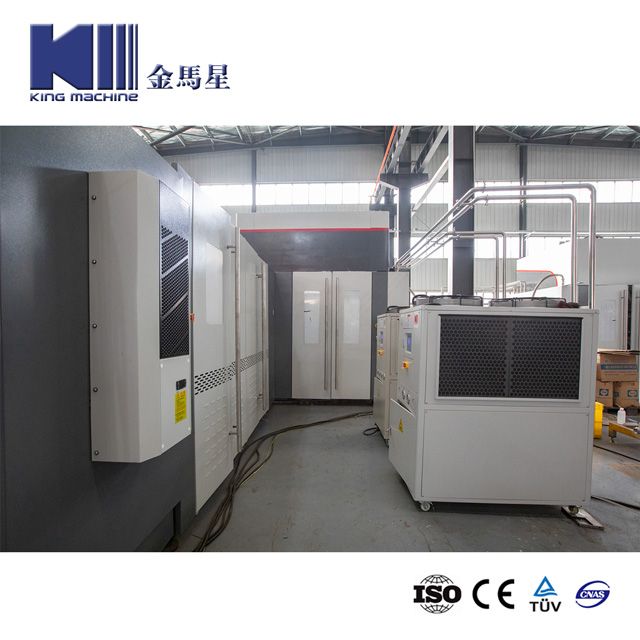
Items Most Commonly Omitted from the Budget
This list is based on our technical audits of projects completed by other suppliers. These are not rare exceptions, but common omissions.
- Compressed Air System
- PET blowing requires high-pressure air—up to 40 bar—plus a separate low-pressure circuit for pneumatics. Compressors, receivers, dryers, and distribution piping are often treated as “customer infrastructure,” even though they account for a significant share of the line cost.
- Water Treatment
- Well water is not automatically potable water. The water treatment system configuration is determined by a chemical analysis of the specific source, and an accurate price cannot be provided before the analysis.
- Chiller and Cooling
- Blow molds and several processes require recirculating cooling. Chiller capacity is calculated from the line’s heat load, not the facility floor area.
- Conveyors Between Sections
- Machines are supplied separately, while the distances between them are determined by the layout. Air and tabletop conveyors are calculated by linear length after the equipment arrangement has been finalized.
- Format Change Parts
- Changing from 0.5 L to 1.5 L requires a set of parts: starwheels, guides, grippers, and molds. Each additional format adds cost.
- Coding and Traceability
- Identification coding is mandatory for certain product categories. Printers, verification cameras, and case and pallet aggregation are added to the line as a separate section.
Three Supply Models
The same line under different supply models varies in price and in who is responsible for the result.
| Comparison Item | Equipment Supply | Equipment + Supervised Installation | Turnkey |
|---|---|---|---|
| Site Engineering | Customer | Partial | Contractor |
| Installation | Customer | Customer’s crew under supervision | Contractor |
| Utilities | Customer | Customer | Contractor or its subcontractor |
| Capacity Guarantee | Individual machine | Individual machine | Complete line |
| Personnel Training | Optional | Basic | Complete, with qualification approval |
| Who is responsible for integrating two machines | No one | Disputed | Contractor |
Schedule
A realistic schedule for a moderately complex project is 4 to 9 months from contract signing to reaching operating conditions. Equipment manufacturing, typically 10-16 weeks, and logistics take most of the time. Engineering proceeds in parallel with manufacturing, while on-site installation and commissioning take from two to six weeks depending on the line configuration.
Three factors delay the schedule: the facility not being ready when the equipment arrives, insufficient electrical capacity, and the absence of an approved layout. All three are identified during the site survey—if one is performed at all.
FAQ
Can production be launched in phases?
Yes, and this is often the better approach. A typical scenario is to launch the first phase with one high-volume container format, then add formats and packaging sections later. The first-phase layout should reserve space and utilities for future sections from the outset; otherwise, expansion will require relocating an operating line.
Is it necessary to purchase a blow molder if finished bottles can be purchased?
No. In-house blowing pays off with stable volumes and a consistent container range: savings come from the difference between the cost of a preform and a finished bottle, while eliminating the logistics of transporting air. For a startup with low volumes, purchasing finished containers is often more practical, with blowing added in the second phase.
What does the warranty cover?
The warranty covers equipment units and achievement of the stated capacity, provided operating procedures are followed and original consumables are used. Wear parts—seals, belts, and filter elements—are generally not covered by the warranty and are included in the spare parts kit.
Read next
Ready solutions
Equipment catalog
Project services
Related projects
Calculation on the topic
We will calculate your line
Describe the product, packaging formats and planned volume — we will prepare a line scheme, specification and preliminary budget estimate with payback.
- Line scheme and unit specification for your product
- Budget range and payback period
- Site requirements: power, water, personnel