

Carbonated Soft Drink Filling Line, Can
A complete cycle for a 200–500 mL aluminium can: depalletising, rinsing, isobaric filling, double-seam closing, inspection and case or shrink packing.
- Product
- Carbonated drinks, energy drinks, beer, low-alcohol cocktails
- Container
- Aluminium can, 200–500 mL
- Output
- 3,000–36,000 cph
- Filling
- Isobaric, with CO₂ purge before filling
- Seaming
- Double seam, 4–12 seaming heads
- Product temperature
- 1–6 °C
- Inspection
- Fill level and lid presence control, on-line rejection
- Materials
- AISI 304 / AISI 316
Line parameters
About the solution
A can needs different handling than a bottle: containers are fed on an air conveyor with no neck grip, filling uses short valves with CO₂ purging, and leak-tightness comes from a double seam rather than a cap.
The seamer is the key station on the line. Seam parameters are checked against a template and micrometer: they determine both leak-tightness and shelf life. We include seam-inspection tooling and technician training in the supply.
Built into the design
CO₂ purging
Displacing air from the can before filling lowers dissolved oxygen and preserves flavour.
Precision seaming
Heads with independently adjustable rollers, seam parameters checked against a reference every few hours.
No-tip container handling
Empty cans are light, so feeding runs on a pressure-belt air conveyor — no tipping at speed.
Format flexibility
Switching between 330 and 500 mL is done by changing starwheels and adjusting height — up to 40 minutes.
Line composition along the product flow
8 positions along the product flow. Every unit opens in the catalog: series, specifications, scope of supply and a quote request.
- 1
1. Can depalletising
Automatic layer-by-layer breakdown of the empty-can pallet and feed to the conveyor.
Aluminium can beverage filling →
- 2
2. Can rinsing
Inversion and ionised-air blowing, or water rinsing with subsequent draining.
Aluminium can beverage filling →
- 3
3. Product preparation and carbonation
Mixer, deaerator and carbonator with online CO₂ and Brix monitoring.
Carbonated soft drink filling →
- 4
4. Isobaric can filler
CO₂ purge, counter-pressure filling, pressure release and transfer to the seamer.
Aluminium can beverage filling →
- 5
5. Seamer
Lid feeding, double-seam formation, lid-presence control.
Aluminium can beverage filling →
- 6
6. Inspection and date coding
Fill-level control, rejection of light cans, date coding on the base.
Marking and quality inspection →
- 7
7. Pasteurisation (product-dependent)
Tunnel pasteuriser for beer and preservative-free drinks.
Beer and low-alcohol drink filling →
- 8
8. Packing and palletising
Multipack shrink wrap, case packing, palletiser and wrapping.
Packing and palletising →
Line model selection
Selecting a can filler-seamer
Compact design: filler, valve manifold, seamer, and control cabinet assembled in one block.
| Machine type | Output | Container | Product |
|---|---|---|---|
| Compact monoblock | 5,000–28,000 cans/h | Aluminum can ⌀52.3–65.5 mm | CSD, energy drinks, beer |
| Rotary filler | 8,000–28,000 cans/h | Aluminum or PET can | CSD, juice, tea, milk |
Can height adjusts within 39–160 mm. Total installed line power starts from 11 kW, 380 V, 3-phase, 50 Hz.
Packing and palletizing
The group packing scheme is selected based on can volume and retailer requirements.
| Packing type | Layout patterns | Palletizing |
|---|---|---|
| Half-tray + film | 2×3, 3×4, 3×5 | Manual, gantry palletizer |
| Cardboard case | 3×4, 4×6 | Robotic palletizer, single-axis palletizer |
Product variants on one platform
Format and recipe changes without replacing the line's core units.
| Product | Container | Feature |
|---|---|---|
| Carbonated soft drink / cola / soda | Aluminum can | Isobaric pressure filling |
| Energy drink | Aluminum can | CO₂ saturation + aseptic options |
| Beer | Aluminum can | Counter-pressure filling, low foam loss |
| Juice, tea, milk | PET or aluminum can | Still filling by flow meter |
Line process flow
The can line is built around a compact filler-seamer: product preparation and packing at the inlet and outlet are matched to the product range — from plain CSD to energy drinks and pasteurized beverages.
Key features of the can line
- Filler, valve manifold, and seamer in a single compact housing with a common control panel
- Isobaric counter-pressure filling — minimal foam and CO₂ loss at high speed
- Fill level and internal can pressure monitoring immediately after seaming, automatic rejection
- Product-contact parts in stainless steel, design for fast washdown and format changeover
- Can diameter range 52.3–65.5 mm and height 39–160 mm on the same equipment
- A single platform for CSD, energy drinks, juice, tea, milk, and beer
Base layout for CSD and energy drinks without thermal treatment of the product.
- 1Can depalletizer
- 2Can rinser (ionized air or water)
- 3Syrup room and batching block
- 4Mixer-carbonator
- 5Can filler-seamer
- 6Fill level and internal pressure detector
- 7Date coding / batch marking
- 8Shrink film packing
- 9Palletizer
Key line stations
What sits behind the nameplate output: contact-part execution, operating logic and service points for every station.
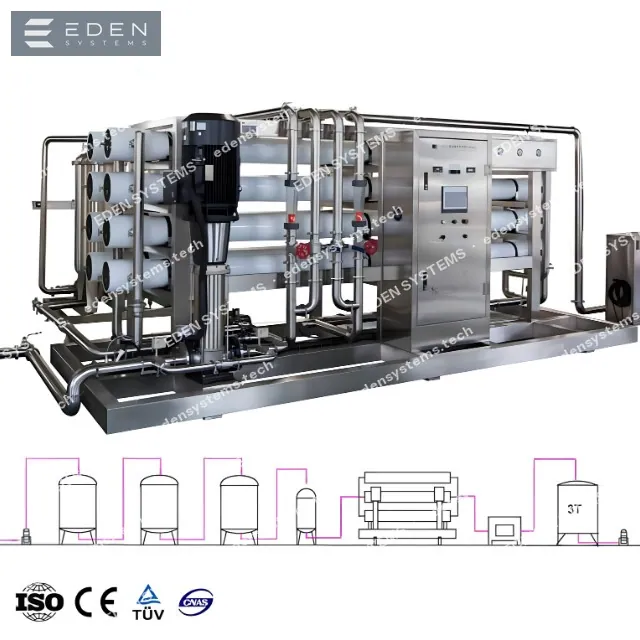
Water treatment station
Process-grade water
- Mechanical and carbon filtration, softening, reverse osmosis — the scheme is built from the raw-water analysis.
- Membranes with a flush system and VFD pump start: longer membrane life, no water hammer.
- UV and ozone disinfection, storage tank in AISI 316.
- Station capacity sized with a 20% margin over the line's peak demand.
Core machines of the line
Equipment of the “Carbonated Soft Drink Filling Line, Can” layout: each tile opens the catalog with series, specifications and a quote request for that machine.
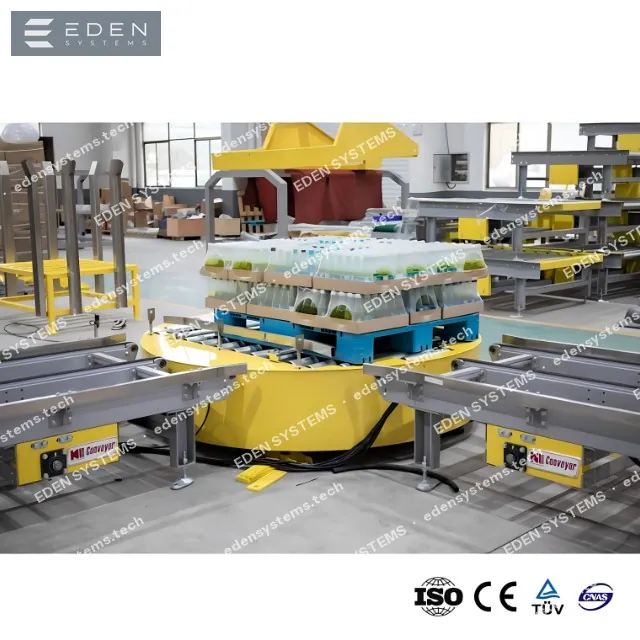
Can depalletizer
Layer-by-layer removal of empty aluminum or PET cans from the pallet and feeding onto the conveyor without manual labor.
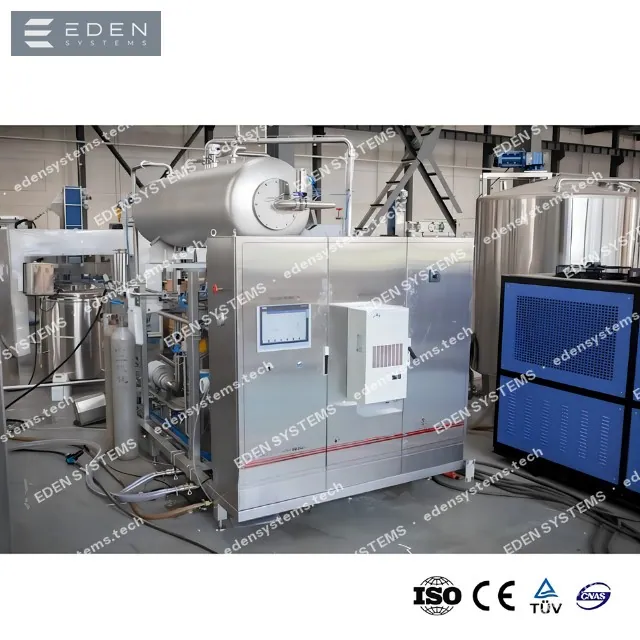
Mixer-carbonator
Water deaeration, syrup dosing, and CO₂ saturation per recipe before feeding the filler.
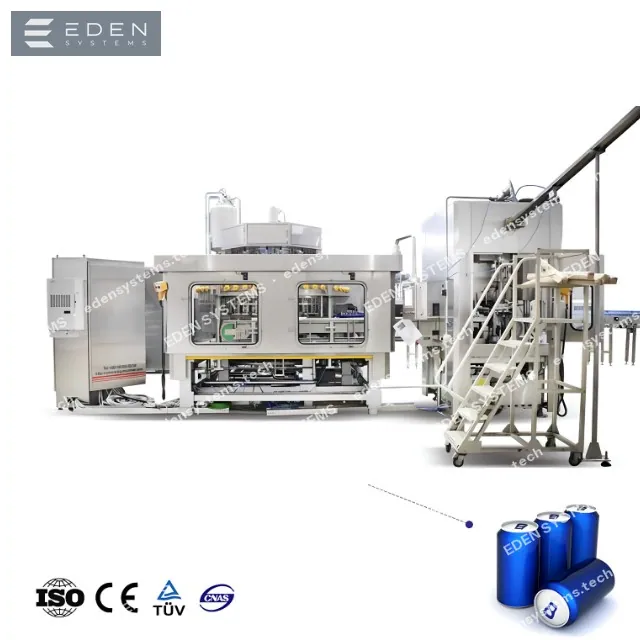
Can filler-seamer
Flow-metered isobaric filling and lid seaming in one compact block: filler, seaming head, and control panel in a single housing.
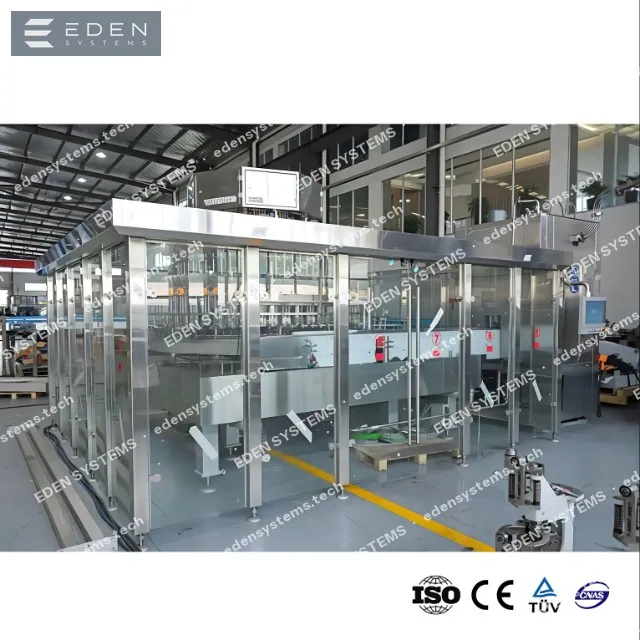
Rotary can filler
Rotary design for high volumes: up to 28,000 cans per hour, synchronized with the seamer via a single encoder.
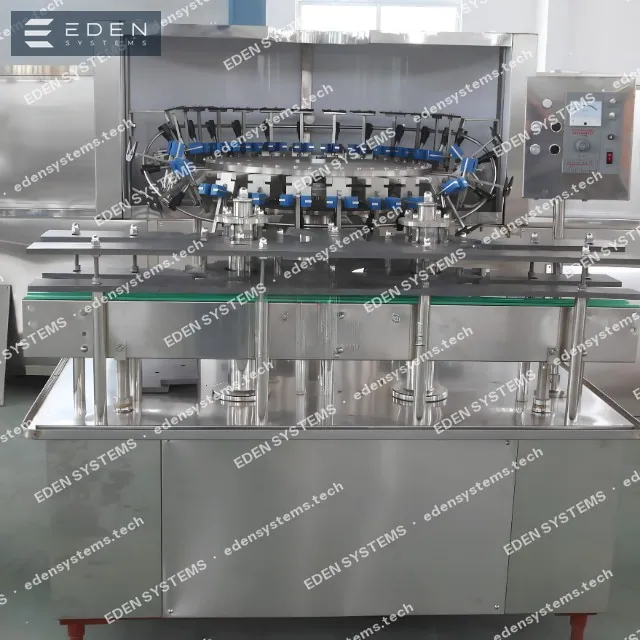
Fill level detector
Non-contact monitoring of product level in the sealed can right after seaming, rejecting underfilled units on the conveyor.
Internal pressure detector
Vacuum check of seam integrity and can soundness before pasteurization — leaking containers are removed from the line.
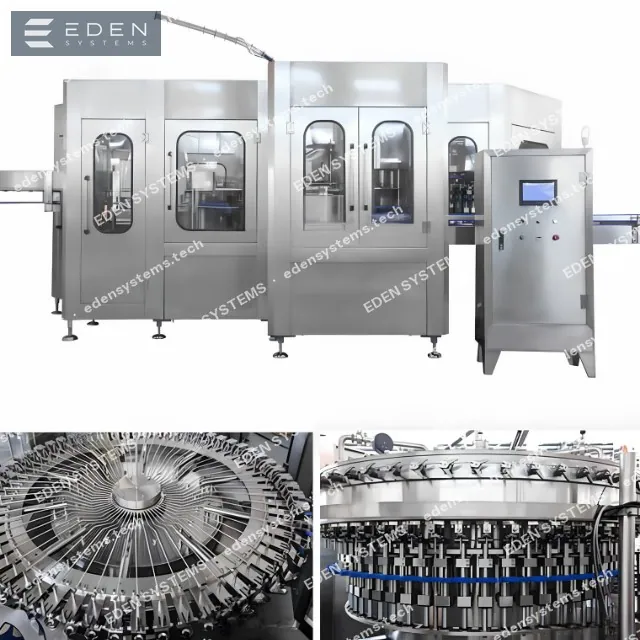
Pasteurization tunnel
Stepped heating and shower cooling for products requiring thermal stabilization, low-wear Rexnord belt.
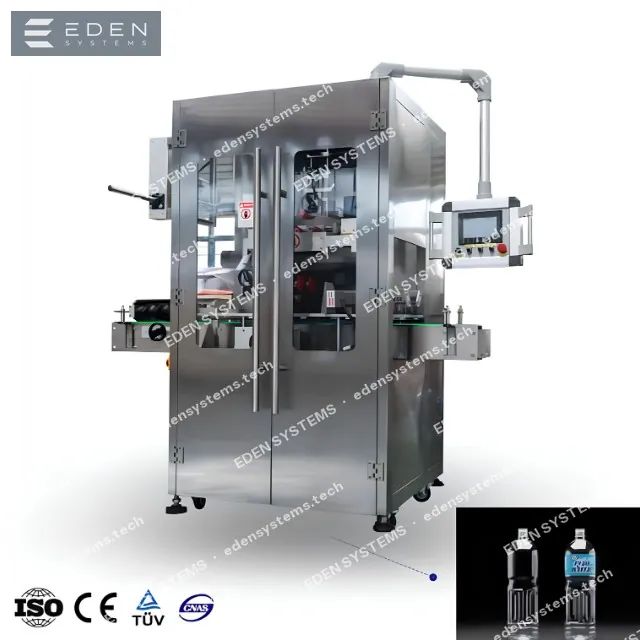
Labeling machine
Shrink sleeve or self-adhesive label on the can body — matched to brand design and retailer requirements.
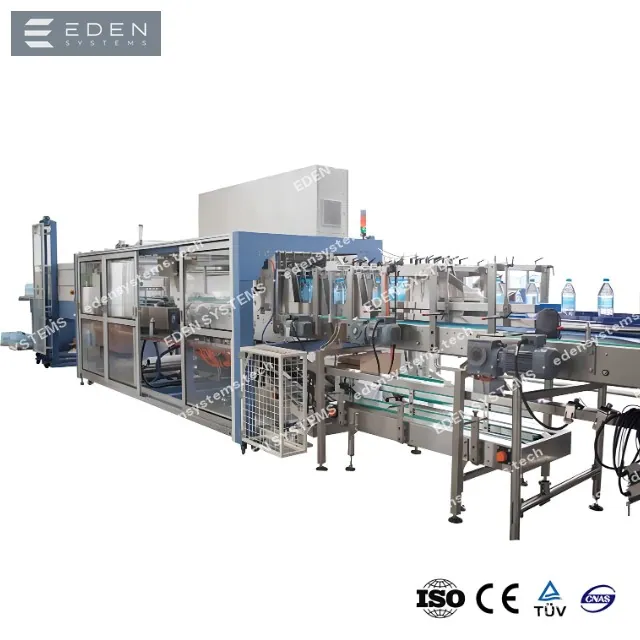
Shrink film packer
Group packing of 2×3, 3×4, or 4×6 in PE film with or without a half-tray — matched to the customer's shipping case.
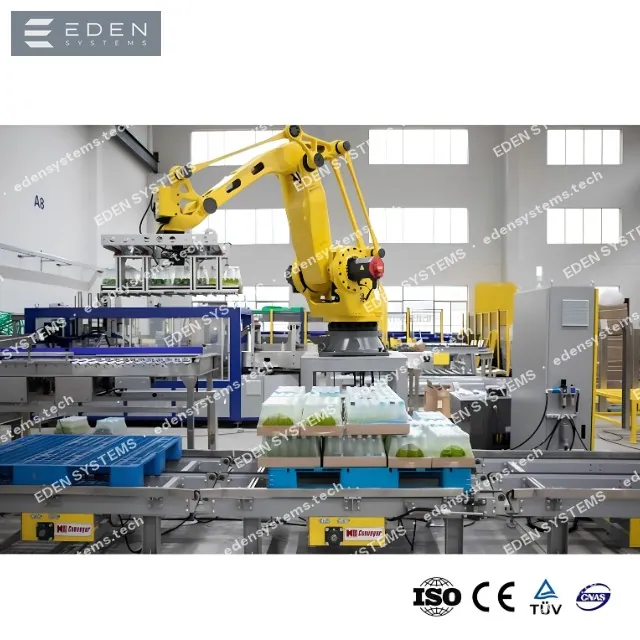
Palletizer
Layer-by-layer stacking of cases and half-trays on a pallet: gantry, robotic, or single-axis palletizer — matched to required speed.
Which closure do you use
The cap type defines the capping block: heads, feeding and orientation of the closure, torque or press-on force. State your option in the request and we will select the head and sorter for it.
202 SOT / 200 B64
Aluminum can lid
The double seam is formed in two rollers; seam thickness and height are logged in the inspection record.
Capping unit: Seamer (double seam)
Auxiliary systems of the line
The engineering utilities without which a line never reaches its rated output: water and product preparation, sanitation, container handling.
Water treatment
Deaerated water for blending and can rinsing.
- The scheme is built from a feed-water analysis: mechanical filtration, carbon, softening, reverse osmosis
- Station output sized with a 20% margin over peak line consumption and wash cycles
- Membranes with automatic flushing and VFD-driven pumps — no water hammer
- UV and ozone disinfection, AISI 316 buffer tank with a breather filter
Depalletizing and can rinsing
The line's inlet for aluminum containers.
- Automatic depalletizer that removes interlayer sheets
- Can inversion, ionized air blow-off and rinse with drying
- Magnetic and vacuum can handling — no drops or dents
- Rejection of deformed containers before the filler
Carbonator and CO₂ loop
Carbonation and delivery to isobaric filling.
- In-line blending with Brix and syrup/water ratio control
- Carbonation to 2.5–4.0 volumes CO₂, fill temperature 2–4 °C
- CO₂ purge of the headspace before seaming
- Sterile barrier and pressure reduction at the gas manifold inlet
CIP station (clean-in-place)
Scheduled wash of the blending and product loops.
- Alkali, acid and hot-water tanks holding temperature within ±2 °C
- Recipe-driven wash programs: phase time, concentration and flow are logged
- Flow meter on the supply line — actual flow is verified, not assumed from the nameplate
- Filtered detergent return to the tanks; discharge only once the solution is spent
Coding and inspection
Date and batch on the can bottom, underfill monitoring.
- Inkjet or laser coder: date, shift, batch number, traceability code
- Fill-level, cap presence and seating inspection with automatic reject to a pocket
- Good/reject product counters logged per shift hour
- Ready for mandatory marking: case and pallet aggregation at the line outfeed
Packing and palletizing
Multipack, case packing and palletizing.
- Shrink film pack or corrugated case, format tailored to the retailer's requirements
- Layer palletizer to a defined pattern, robotic version for constrained floor space
- Pallet wrapper with pre-stretch film: lower film consumption, pallet withstands transport
- SSCC pallet label printing and application, data handoff to the ERP system
Plant utilities
Chilled water and CO₂ for the can-filling area.
- Steam circuit or electric heating sized against peak thermal load
- Chilled water: chiller and glycol loop with a buffer tank
- Process-water piping, floor drains with traps and slope, condensate removal
- Line power panel sized per station load with a reserve for expansion
FAQ
What makes can filling harder than PET filling?
The seam is critical: its parameters must be checked regularly, or the whole batch loses leak-tightness. Also, a can cannot be gripped by the neck — the entire transport system is built differently.
Is the line suitable for beer?
Yes, with an added pasteuriser and dissolved-oxygen control. We often build such lines to be universal for soft drinks and beer.
How much does the Carbonated Soft Drink Filling Line, Can cost?
Price on request: the budget depends on output, container type, line composition and the level of automation. After a short brief we send a preliminary estimate within 1–2 working days and a full quotation broken down by machine within 3–5 days.
What are the delivery and commissioning lead times?
Standard machines ship 8–12 weeks after the specification is confirmed, complete lines 12–20 weeks. Transport takes 2–6 weeks depending on the route; installation and commissioning on site take 2–4 weeks, with operator training included.
What output does this line reach?
The working range is 3,000–36,000 cph. Exact output is confirmed against your container, product and shift plan: we calculate the line balance and keep a margin on the bottleneck machine.
Request a quote: Carbonated Soft Drink Filling Line, Can
Tell us the product, the container and the target output — we will return the line composition, a layout, a budget range and a delivery schedule.
Related solutions
Lines with a similar equipment set — useful when you plan several products on one site.
2,000–36,000 bph
Drinking Water Filling Line, 0.33–1 L
Rinser-filler-capper monobloc for PET, water treatment, labelling and shrink packing.
Open solution100–1,200 bph
19-Litre Bottle Water Filling Line
Washing, disinfection and filling of returnable polycarbonate containers with capping and seal application.
Open solution3,000–36,000 bph
Carbonated Soft Drink Filling Line, PET
Mixer-carbonator, isobaric filling, capping and labelling.
Open solutionServices for this line
Engineering, logistics, installation and service that turn this line into a working production site.
Digital layer
Any line can be supplied with a digital layer
SCADA, MES, OEE monitoring, batch traceability and integration with plant systems — engineered together with the line, not bolted on later.