

Juice-with-Pulp Filling Line, Glass
Two challenges combined — glass containers and a product with particulates. The line is built around a piston doser with a wide channel and gentle glass handling.
- Product
- Juices and nectars with pulp, purée drinks, compotes with berries
- Particle size
- up to 10 mm
- Container
- Glass 0.2–1.0 L, neck 38–63 mm
- Output
- 1,500–8,000 bph
- Dosing
- Piston, ±1%
- Filling temperature
- 85–92 °C
- Capping
- Twist-off with torque control
- Pasteurisation
- Tunnel type, 3–4 zones
Line parameters
About the solution
Product with pulp in glass is a typical premium format: baby food, fruit purée drinks, direct-press juices. Dosing is done with a piston filler so particle content stays consistent from bottle to bottle.
After hot filling and twist-off capping, the bottle passes through a tunnel pasteuriser: the closed container is treated to a temperature profile specific to the recipe, then cooled and sent to labelling.
Built into the design
Doser for particulates
A wide channel and a slow fill cycle keep pieces intact and distribute them evenly.
Agitated tank
Continuous mixing and recirculation keep the suspension uniform through the whole batch.
Wide neck opening
Layout sized for containers with a neck up to 63 mm — standard for products with pieces.
Full product-path teardown
Sanitation after every shift: components disassemble without tools, with no dead zones.
Line composition along the product flow
8 positions along the product flow. Every unit opens in the catalog: series, specifications, scope of supply and a quote request.
- 1
1. Glass feed and washing
Depalletising, rinsing or a full wash of returnable containers.
Beer and low-alcohol drink filling →
- 2
2. Product preparation
Blending, pulp addition, deaeration in an agitated tank.
Water treatment →
- 3
3. Tubular pasteurisation
Heating of product with particulates without damaging structure.
Juice and pulp drink filling →
- 4
4. Piston filling
Metered-volume dosing at 85–92 °C through a large-bore valve.
Juice and pulp drink filling →
- 5
5. Twist-off capping
Cap screwing with torque control and vacuum formation.
Capping equipment →
- 6
6. Tunnel pasteurisation
Treatment of the closed bottle to the recipe's temperature profile.
Juice and pulp drink filling →
- 7
7. Labelling
Self-adhesive body label and back label, batch date coding.
Labelling equipment →
- 8
8. Case packing
Case forming, loading, sealing and palletising.
Packing and palletising →
Line model selection
Selecting a monoblock for pulp juice filling
Output is given for 0.25–2.5 L containers; the pulp unit operates independently of the juice unit.
| Model | Rinsers / pulp valves / juice valves / capping heads | Output |
|---|---|---|
| EDS-PW8-8-8-3 | 8 / 8 / 8 / 3 | 1,000–3,000 btl/h |
| EDS-PW12-12-12-4 | 12 / 12 / 12 / 4 | 4,000–8,000 btl/h |
| EDS-PW18-18-18-6 | 18 / 18 / 18 / 6 | 8,000–16,000 btl/h |
| EDS-PW24-24-24-8 | 24 / 24 / 24 / 8 | 16,000–24,000 btl/h |
| EDS-PW32-32-32-10 | 32 / 32 / 32 / 10 | 24,000–32,000 btl/h |
Pulp dosing — piston type, juice dosing — volumetric. Contact parts and the tank — AISI 304/316, electrical components by Mitsubishi, OMRON, Siemens.
Pulp unit and product loop
The difference from a standard juice line is the separate feed of the two fractions and CIP cleaning of the valves.
| Unit | Purpose |
|---|---|
| Finishing machine | Bringing the pulp to the required fineness before dosing |
| Pulp filling valve | Piston dosing, protective cap preventing backflow into the piping |
| Juice filling valve | Volumetric dosing, German Igus bearings in the bottle-lift unit |
| Monoblock CIP station | Circulation cleaning of contact parts without disassembly |
Line process flow
The pulp juice line is built around a four-function monoblock: rinsing, separate pulp filling, juice filling, and capping are all performed on one frame, while the line's tail matches a standard hot-fill glass line.
Key line features
- 4-in-1 rinse — pulp fill — juice fill — cap technology
- Separate dosing of fractions: piston filling of pulp and volumetric filling of juice
- Juice filling valve with protective cap — pulp does not return into the piping or clog it
- Output 1,000–32,000 btl/h, containers 0.25–2.5 L
- Igus bearings in the bottle-lift unit — lubrication-free and corrosion-resistant
- Online CIP cleaning of valves through built-in CIP cups
- Contact parts and the tank — AISI 304/316, electrical components by Mitsubishi, OMRON, Siemens
Full cycle from pulp and juice preparation to the finished-product pallet.
- 1Water treatment station
- 2Finishing machine and pulp pasteurization
- 3Glass bottle unscrambler
- 44-in-1 monoblock: rinse — pulp fill — juice fill — cap
- 5Bottle inverter (cap sterilization)
- 6Cooling tunnel
- 7Cold-glue labeling machine
- 8Date coder / batch marking
- 9Case packing and palletizing
Key line stations
What sits behind the nameplate output: contact-part execution, operating logic and service points for every station.
Blending and UHT block
Product preparation
- High-shear blending unit: sugar, concentrate and stabilizer disperse without clumping.
- Tubular or plate heat exchanger, holding and cooling on a set curve.
- Homogenizer up to 200 bar — a stable emulsion with no separation in the bottle.
- Jacketed buffer tank maintains the filling-supply temperature.
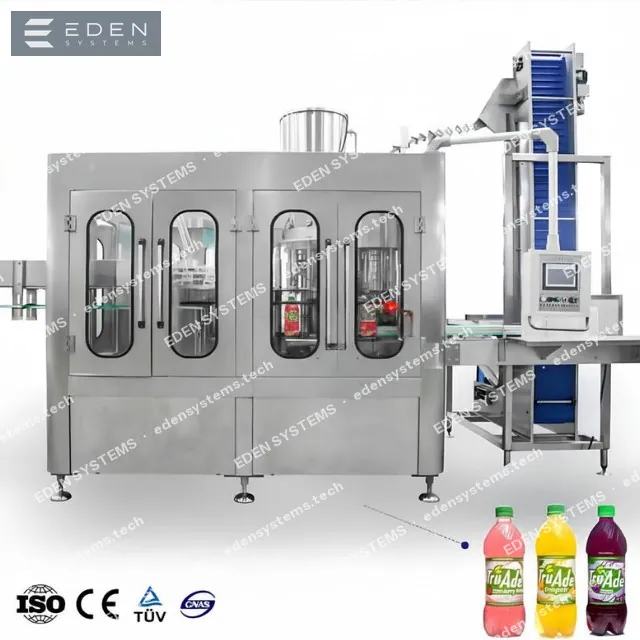
Core machines of the line
Equipment of the “Juice-with-Pulp Filling Line, Glass” layout: each tile opens the catalog with series, specifications and a quote request for that machine.
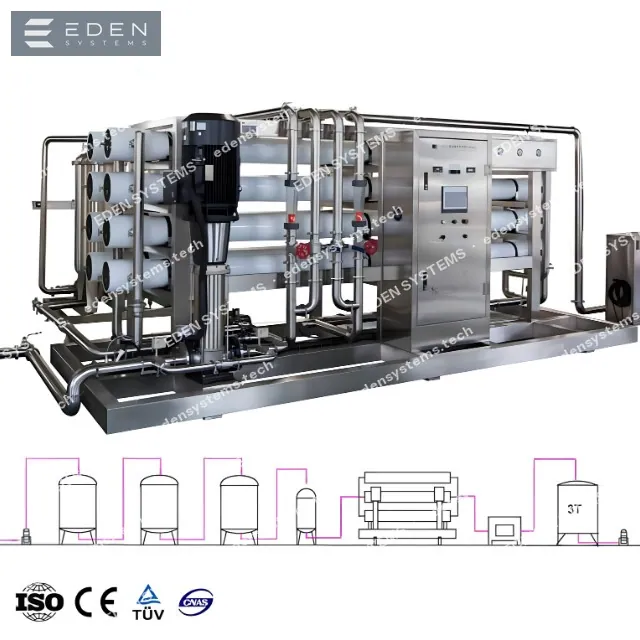
Water treatment station
Filtration, softening, reverse osmosis, and UV disinfection of water for blending and container rinsing.
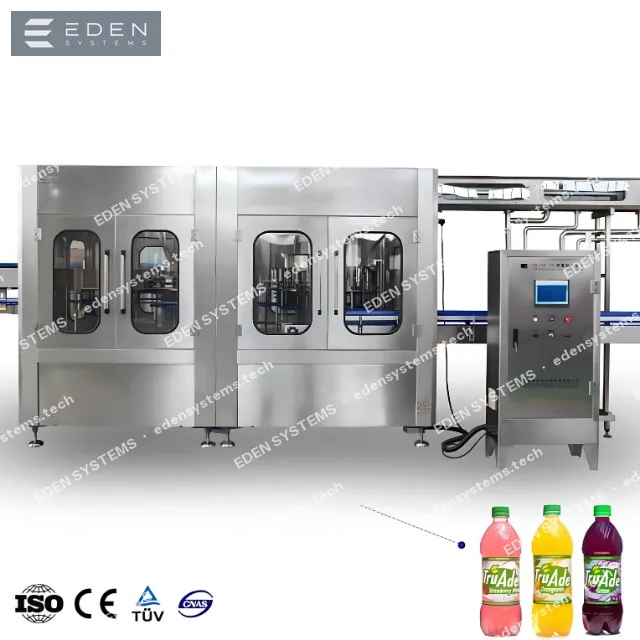
Pulp juice preparation
The finishing machine and deaerator bring the pulp to the required fineness, and the pasteurizer reduces microbial load before filling.
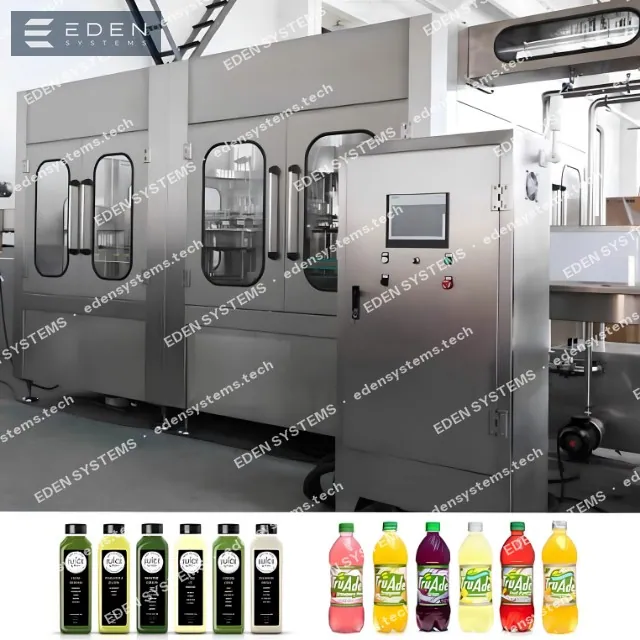
Glass bottle unscrambler
Depalletizing and orienting heat-resistant glass containers before feeding to the filling monoblock.
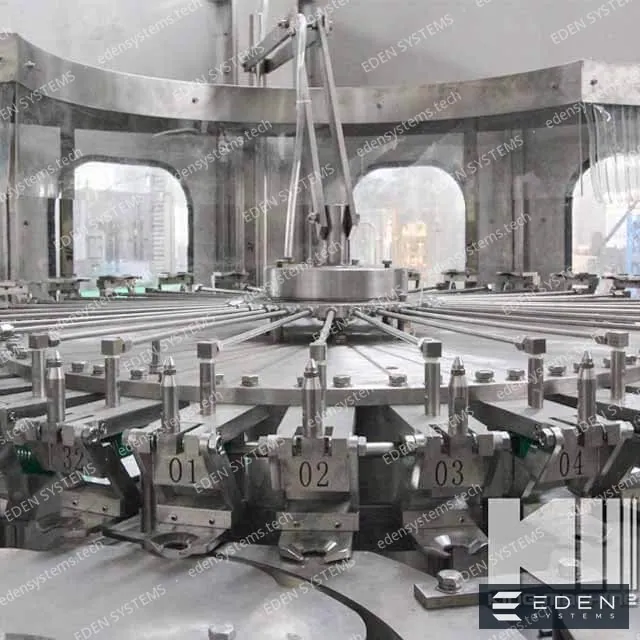
4-in-1 monoblock: rinse — pulp fill — juice fill — cap
Separate piston dosing of pulp and volumetric filling of juice on one frame; a check valve with a protective cap prevents pulp from entering the return line.
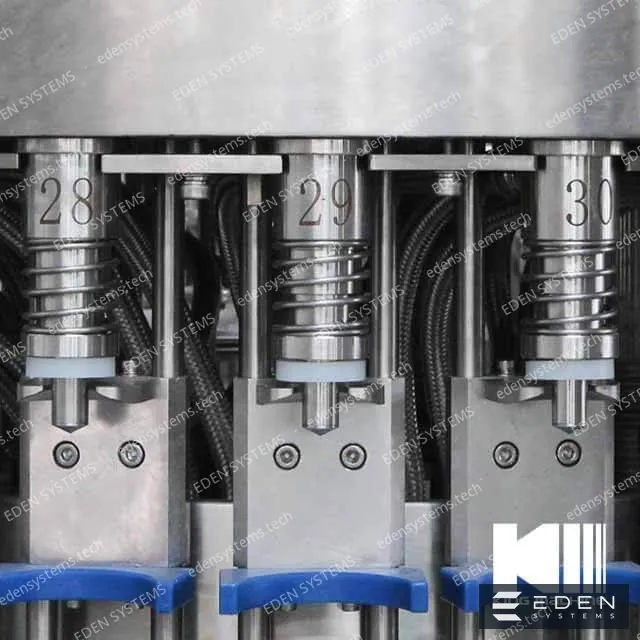
Bottle inverter
Turns the capped bottle over to sterilize the cap and headspace using the product's own heat.
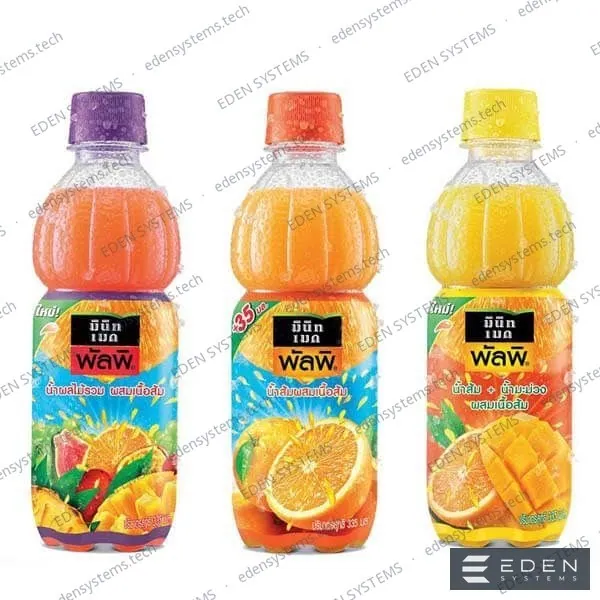
Cooling tunnel
Multi-zone showering with decreasing temperature brings the bottle back to room temperature without thermal shock.
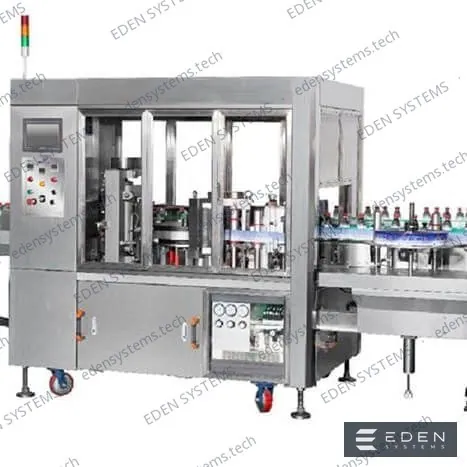
Cold-glue labeling machine
Die-cut paper label application with a straight hot-glue application line, quick format changeover in under 10 minutes.
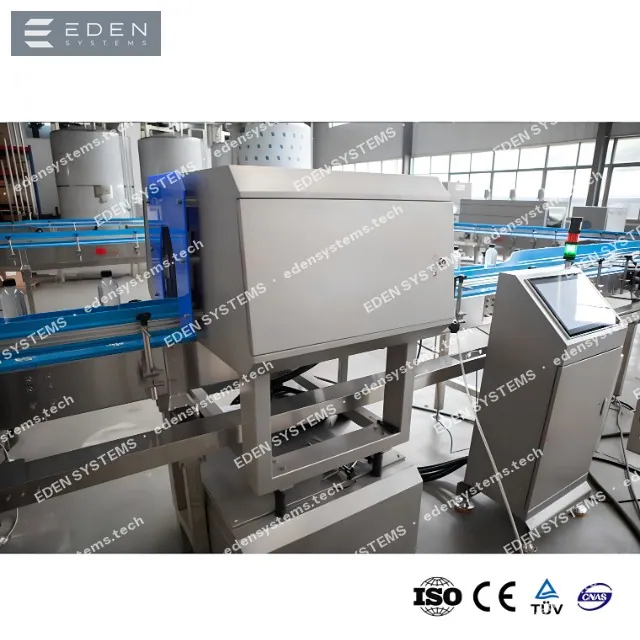
Date coder and batch marking
Inkjet printing of the fill date and batch number on the bottle and case with code readability checking.
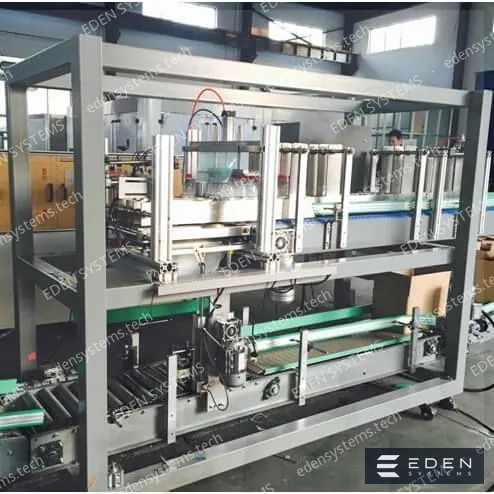
Case packing machine
PLC control, automatic positioning system, drive interlock when a container or case is missing.
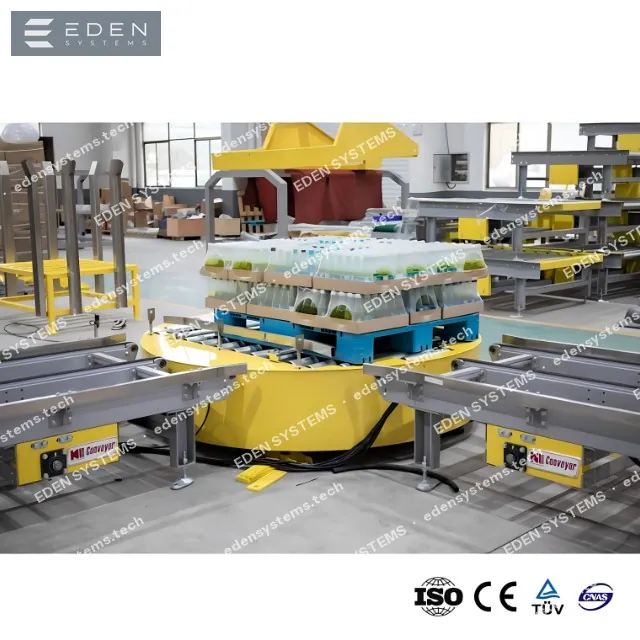
Palletizer and wrapper
Pallet formation from cases and stretch-wrap with pre-tension before the warehouse or shipment.
Which closure do you use
The cap type defines the capping block: heads, feeding and orientation of the closure, torque or press-on force. State your option in the request and we will select the head and sorter for it.
TO-53 … TO-82
Metal twist-off lid
For jars with sauces, jams and preserves. Works together with vacuum or steam injection before capping.
Capping unit: Seaming/screwing head
28×18, 30×60 (ROPP)
Aluminum screw cap
The thread is rolled directly onto the bottle neck, the skirt is crimped over the finish — tamper-evidence without an extra seal.
Capping unit: ROPP thread-rolling head
26 mm, 21 teeth
Crown cork
Beer, soda, cider. Crimping over the finish with force control — seal integrity up to 4 bar in-bottle pressure.
Capping unit: Crown head with magnetic chuck
Auxiliary systems of the line
The engineering utilities without which a line never reaches its rated output: water and product preparation, sanitation, container handling.
Water treatment
Process water for reconstitution and washing.
- The scheme is built from a feed-water analysis: mechanical filtration, carbon, softening, reverse osmosis
- Station output sized with a 20% margin over peak line consumption and wash cycles
- Membranes with automatic flushing and VFD-driven pumps — no water hammer
- UV and ozone disinfection, AISI 316 buffer tank with a breather filter
Depalletizing and glass washing
Preparing jars and bottles before filling.
- Depalletizer, rinser and sterile-air drying
- Finish and foreign-material inspection on empty containers
- Guide rails and diverters with polymer inserts — minimal breakage
- Accumulation buffer before the filler
Dosing product with particulates
Jams, nectars and juices with pulp in glass.
- Piston doser with a wide path for particulates up to 10 mm
- Heated product tank and jacketed lines
- Lifting nozzle with drip-free cutoff for a clean bottle finish
- Weight-based dose verification at a sampling station
Pasteurization and cooling
A thermal profile suited to glass containers.
- Tunnel pasteurizer with heating, holding and cooling zones
- No more than 20 °C between zones — protection from thermal breakage
- Process lethality monitored via a control container's probes
- Container drying before labeling
CIP station (clean-in-place)
Hot caustic wash of the viscous path with turbulent flow.
- Alkali, acid and hot-water tanks holding temperature within ±2 °C
- Recipe-driven wash programs: phase time, concentration and flow are logged
- Flow meter on the supply line — actual flow is verified, not assumed from the nameplate
- Filtered detergent return to the tanks; discharge only once the solution is spent
Packing and palletizing
Case, dividers and pallet formation for glass containers.
- Shrink film pack or corrugated case, format tailored to the retailer's requirements
- Layer palletizer to a defined pattern, robotic version for constrained floor space
- Pallet wrapper with pre-stretch film: lower film consumption, pallet withstands transport
- SSCC pallet label printing and application, data handoff to the ERP system
FAQ
Why a piston doser if the product is liquid?
Even with a small share of pulp, a gravity valve gives uneven particle content: the first bottles come out thicker, the last thinner. A piston meters an identical volume of suspension.
Is tunnel pasteurisation mandatory?
For products with pieces — yes: particulates heat more slowly than liquid, and hot filling alone is not enough to guarantee sterility.
How much does the Juice-with-Pulp Filling Line, Glass cost?
Price on request: the budget depends on output, container type, line composition and the level of automation. After a short brief we send a preliminary estimate within 1–2 working days and a full quotation broken down by machine within 3–5 days.
What are the delivery and commissioning lead times?
Standard machines ship 8–12 weeks after the specification is confirmed, complete lines 12–20 weeks. Transport takes 2–6 weeks depending on the route; installation and commissioning on site take 2–4 weeks, with operator training included.
What output does this line reach?
The working range is 1,500–8,000 bph. Exact output is confirmed against your container, product and shift plan: we calculate the line balance and keep a margin on the bottleneck machine.
Request a quote: Juice-with-Pulp Filling Line, Glass
Tell us the product, the container and the target output — we will return the line composition, a layout, a budget range and a delivery schedule.
Related solutions
Lines with a similar equipment set — useful when you plan several products on one site.
2,000–18,000 bph
Hot-Fill Juice Line, PET
Pasteurisation, filling at 85–92 °C, cooling tunnel and labelling.
Open solution2,000–12,000 bph
Hot-Fill Juice-with-Pulp Line, PET
Large-bore valves and piston dosers for drinks containing particulates.
Open solution1,500–12,000 bph
Juice Filling Line, Glass
Glass rinsing, hot filling, twist-off capping and tunnel pasteurisation.
Open solutionServices for this line
Engineering, logistics, installation and service that turn this line into a working production site.
Digital layer
Any line can be supplied with a digital layer
SCADA, MES, OEE monitoring, batch traceability and integration with plant systems — engineered together with the line, not bolted on later.